8.02.2006

The Limits of Credibility: A Review of Bart Ehrmans book--Misquoting Jesus--by J.R. Ensey


Book title: MISQUOTING JESUS: The story behind who changed the Bible and why
by Bart D. Ehrman
San Francisco: HarperCollins Publishers; 2005
242 pages; cloth; 24.95

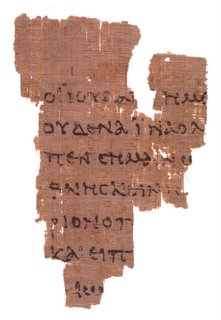
Today’s cultural trends make it popular to be a Bible-basher. While we cannot know an author’s motives beyond question, Misquoting Jesus appears to be written with an agenda to evoke doubt as to the authenticity and authority of Scripture. Bart Ehrman, an expert on biblical texts who has published several books on textual criticism, writes in a warm and readable style. His other works, however, have seemingly served as teasers in anticipation of this book. He confesses that this is what he has wanted to say about the Bible all along. Admitting that he has undergone a metamorphosis in his view of Scripture, he candidly states that he sees the Bible as “a very human book from beginning to end.” It is now easy to understand his goal of helping the rest of us to view the Bible as an uninspired mishmash “written by human authors at different times and in different places to address different needs.” One wonders: then why bother? Without inspired Scriptures we humans are nothing more than robots of destiny and fate, without hope in the world—lemmings on our march to the sea of nothingness. Ehrman’s penchant for quoting Celsus, a late second century critic of the Bible and Christianity, suggests a closer alignment with his views than with the Christian writers of that era, and perhaps even the biblical writers themselves. Overall, he does not seem to be writing to scholars but to lay readers who can easily be impressed by his assumptions drawn from unnamed manuscripts.

Technically, much of what Ehrman points out about biblical manuscripts is not new. Textual critics have struggled for centuries with many of the same texts on which he focuses. For example, he suggests that Mark made a “mistake” when he wrote that David ate the showbread of the Tabernacle “in the days of Abiathar the high priest” (Mark 2:26). He points out that I Samuel 21:1-6 states that Abiathar’s father Ahimelech was the high priest at that time. It is well known that “in the days of” can mean during the lifetime. The biblical record reveals that Ahimelech died shortly after this event (I Samuel 22:19,20) and Mark added this designation to identify the well-known companion of David who succeeded his father as high priest, along with Zadok (II Samuel 15:35). This perceived “mistake” by Mark opened the floodgates of doubt for Ehrman. He began to find other “errors” of Scripture, such as the mustard seed being the smallest of seeds in the world (Mark 4:31). Since that time smaller seeds have been found to exist, but it was the smallest in comparison to all the other seeds sown in Palestine. Ehrman began to feel that such “mistakes” indicated that others, perhaps bigger and more important ones, were also in the Holy Writ. He has made the search for them his life’s work.

The obvious target of the author is the divinity of Jesus, which of course could be easily set aside if Scripture were proved unreliable. Ehrman tries hard to discredit this cardinal doctrine of the Christian faith. One reference cited is Acts 20:28, which speaks of “the church of God, which he hath purchased with his own blood.” He posits that since the fifth century Codex Alexandrinus manuscript (and a few other less notables) has “Lord” rather than “God,” it is not a usable text to demonstrate the deity of Jesus. As some other scholars do, he eschews the translation of “God” in I Timothy 3:16, preferring “he.” The subject in context is God, so it changes nothing of a doctrinal nature. Ehrman’s Socinian leanings seem quite evident.

The author feels it is immensely important to determine whether the text of Mark 1:41 shows that Jesus was angry or compassionate, whether He was calm or in deep distress in Luke 22:43,44, and if Hebrews 2:9 suggests that Christ died by God’s grace or “apart from God.” Those passages contain textual variants, but they change no fundamental doctrine. He points out differences in style here and there, such as in the Gospel of John. Too many positions on the sacred text are taken based on assumptions—“it appears...we can surmise...we assume...we can expect....” His deductive arguments are wearying, such as his treatment of the role of women in Scripture. He is obviously as fond of pseudepigrapha as he is of the accepted canon itself. We should be glad that the Gospel According to Judas did not appear on the scene before this book was published or he might be trying to convince us that Judas was Jesus’ best friend to the end.

To Ehrman’s credit he is correct on many of his assessments of manuscript changes and interpolations. But why rehash over and over that the story of the woman taken in adultery and the long ending of Mark do not appear in what experts consider the oldest and best manuscripts, or that I John 5:7,8 contains a scribal addition to delineate the doctrine of the Trinity, or that “and fasting” was probably added later to Mark 9:29? That is fairly common knowledge. Copies of copies of copies made by an over-zealous scribe or a sleepy monk working in the dim light of some ancient monastery usually lacked perfection. But it is significant that these examples do not negatively affect any apostolic doctrine, although they do reveal the weakness of the Trinitarian position, as in the case of I John 5:7,8. At the bottom line, Ehrman has not shown us why we should distrust the Bible on its history or geography, but he has given us more reason to distrust those who handle it deceitfully (II Corinthians 4:2). He has stretched the limits of credibility, not for the Bible but for the skeptics, although scoffers will surely quote him.

“Heaven and [Bart] shall pass away, but my words shall never pass away” (Jesus, Luke 21:33).

J. R. Ensey

Bio: J.R. Ensey is a former president of Texas Bible College, having served in that capacity for fourteen years (1982-1996). Prior to that time, he founded a church in North Carolina and served the General Home Missions Division of the United Pentecostal Church International in various capacities for eight years. Subsequent pastorates were held in Texarkana, Arkansas, and Wichita Falls, Texas. He is the founding editor of two denominational magazines and the author of fifteen books, including The Pastoral Epistles, Letters From a Roman Jail, and many booklets, tracts, and articles. He holds degrees in Theology and Business Administration and currently directs the extension campus program for Texas Bible College. You can go to Ensey's website and bookstore by clicking here.

7.22.2006

The Problem of Evil:


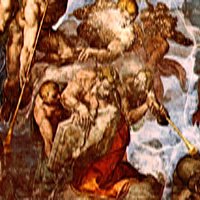
One of the two most influential frescos(1) in the career of Michelangelo—The Last Judgment—depict angelic hosts holding the Book of Good Deeds and the Book of Evil Deeds. Ironically Michelangelo paints the latter, the Book of Evil Deeds, as substantially larger. Sadly, as far as one can tell, this is true in the human condition. Even to Michelangelo in the 1500's it was apparent that the tally of evil human deeds significantly outnumbers those of our good deeds.

Consequently an atheist will appeal to the existence and proliferation of evil in our society as a claim that there is no God. If there were a God and was good He would not allow evil, i.e. that which is contrary to His nature. According to the atheist if there was indeed a God He would intervene in the evil happenings of our world. The cliché is, “Why do bad things happen to good people?” or “How can there be a good God in a world where evil exists?”

Critics and honest people alike have wrestled since and no doubt before the times of Socrates and Aristotle with this issue of a good God and evil co-existing simultaneously. If God is such a good God and a God of love why does he tolerate the genocide of Ruwanda, the Oklahoma City Bombing, 9/11, Abortion, Euthanasia, or Homosexuality. Why is God silent or seemingly passive? Clearly this argument assumes many things and also exhibits an inadequate understanding of theology.

The Problem of Evil (hereon POE) is one of the most important arguments against theism primarily because it is an apparent proof used by an atheist to make the absolute claim that there is no God because evil exits. In fact this argument is apparently the only one that claims to prove that there is no God. There are many arguments against theism, but none of them amounts to a proof or demonstration. There are objections to all the arguments for theism, but even if they are successful, these objections only refute the arguments as invalid or inconclusive—they do not thereby disprove God's existence.

There are also serious practical and personal objections against faith, such as the atrocity of the Inquisition or hypocrisy among believers, or the trouble and surprise to one's ego of having to repent of prized sins. However, none of these prove that God does not exist.

A second reason why POE is important is because it is worldwide. People of all types, Americans or Russians, wonder why bad things happen to good people. POE knows no racial, cultural, or geographical boundary.

In The Problem With Pain(2) C.S. Lewis, a former atheist, formulates the argument in an anthropomorphic or existential version. He suggests that the argument would go something like this:

1. If God is all-good, he wants his creatures to be happy.
2. If he is all-powerful, he can do whatever he wants.
3. But the creatures are not happy. Therefore God lacks either goodness or power or both. Missing either of the two would make Him finite.


"How much evil can a ant do?" Douglas Groothius, from Denver Seminary. "How much evil can a bear do?" Obviously the point is that evil can be experienced in degrees. Groothius went on to say that"Evils is good gone wrong...we are all damaged goods". Evil is sometimes defined as a cosmic force. Although it is real, it is not an entity or a being. Evil has been defined as suffering. In some sense this is true but can we honestly say that all suffering is evil? Some suffering may not be inflicted upon the innocent and some suffering may be inflicted to achieve a greater moral good. Evil is unruly love, unmitigated will. It is a vile relationship, it is nonconformity between our will and God's will. God did not make it—we did.

For clarity, it is possible that evil can be placed in three categories—Moral, Natural, and Physical. “Actually there are many problems relating to evil, for example, the problems about its origin, nature, purpose, and avoidability.”(3) Moral evil possibly relates to the inner condition, the natural to the harmful and physical to negative environmental events. In some sense it is possible that all three have some relationship, this point can be seen as we progress.

There is evidence that would seem to indicate that the psychology of the POE argument is emotive or at least some attempt to understand one’s own suffering or even that of others. For example, Sigmund Freud, popularly known as an atheist and the father of psychoanalysis, is often quoted and has written voluminous works defending his claim. However, Dr. Armandi M. Nicholi Jr., in The Question of God(4), states,

“Freud kept trying to identify our primary sources of pain, perhaps in an effort to understand his own suffering. He [Freud] writes in The Future of an Illusion: ‘There are the elements, which seem to mock at all human control: the earth…water…diseases…the painful riddle of death…’ A few years later, in Civilization and Discontents, he adds another source of pain—namely, other human beings. ‘The suffering which comes from this last source is perhaps more painful to us than any other.’ Freud concludes that ‘life is hard to bear’ and often results in ‘a permanent state of anxious expectation.’”
First, would we want to see laws forbidding pre-marital sex or divorce? The obvious answer by both a Christian and an atheist would be “No!” This is because we have and cherish moral freedom. To say that an evil choice should be eliminated from our abilities to choose would contradict the idea of moral freedom or free will. In fact, there would in fact be no choice but to only do good. We would be bound to commit only acts of goodness. The argument can then turn circular because some would ask why God doesn’t allow them to indulge in natural pleasures.

Second, if we were bound to certain choices there would be no moral freedom. If God forced us to make certain decisions would that be love? No. That would be force. Love is the utmost good for all free creatures—because love is the greatest commandment and we are told to love our neighbors as ourselves (Matthew 22:36-40). This being so it is virtually impossible for love to exist apart from freedom. All else is coercion, manipulation, or bondage.

Therefore, to destroy all propensities for evil then would indeed be an act of evil itself. Norman Geisler suggests that “If evil is to be overcome we should talk of its defeat and not it’s destruction.”(5) A syllogism then could be:

1. Man is the principle source of moral and natural evil.
2. God has given us the Holy Spirit as a source of power to indeed defeat evils.
3. Moral and Natural Evil can be defeated in and by man.


Then the atheist would argue that our God is a mean God and why isn’t there a God who gives us choices? The answer is obvious. If God turned every bullet or every knife to butter when aimed or plunged at innocent lives then God would overstepping free-will. God did not create humans as chess pieces for His pleasure, instead we move towards Him willingly.

In Mere Christianity(6) C.S. Lewis states,
“Because free will, though it makes evil possible, is also the only thing that makes possible any love or goodness or joy worth having. A world of automata—of creatures that worked like machines—would hardly be worth creating.”
Third, when God made humans as free moral agents He made possible the existence of evil. He created the actuality of freedom; we perform the acts of freedom. Geisler says, “God made evil possible and subsequently men make evil actual.”(7)

Man when left to natural unmitigated impulses will use all manner of contrivances to succeed or exact revenge upon others. In fact, most of human suffering can probably be attributed to this source. It is humans, not God, who have fashioned guns, bombs, whips, torture chambers, disease and genocide. Indeed it is primarily by human greed and languor that we have poverty.

Atheism tends to run circular or contradictory in some sense eventually. Nicholi explores this area in his book,

"Freud in his paper “A Religious Experience”, asserts “God allows horrors” to occur and that he will hold God responsible. In a later letter to Dr. James J. Putnam of Boston, Freud says, “I…have no dread at all of the Almighty. If we ever were to meet I should have more reproaches to make to Him than he could to me.” These are indeed common sentiments of bewildered believers experiencing loss; however, Freud is an atheist—with whom is he angry? The question could aptly be posed to most professed atheists, “With whom are you angry?”

“God whispers to us in our pleasures, speaks in our conscience, but shouts in our pains; it is His megaphone to rouse a deaf world.” ~C.S. Lewis


Sources Cited in Order of Appearance:

1. For actual online representations of these frescos go to: http://www.christusrex.org/www1/sistine/40-Resurrect.html
2. Lewis, Clives Staples. The Problem of Pain. Harper Collins Edition 2001
3. Geisler, N. L. (1999). Baker encyclopedia of Christian apologetics. Baker reference library (219). Grand Rapids, Mich.: Baker Books.
4. Nicholi Armandi M. The Question of God. Free Press © 2002 by Armand Nicholi
5. Lewis, Clives Staples. Mere Christianity. Harper Collins Edition 2001
6. Geisler, Norman L., and Ronald M. Brooks. When Skeptics Ask. Wheaton, Ill.: Victor Books, 1990.
7. Ibid.

Are You Really An Atheist?


It has been estimated that only about 5%, a small fraction, of the world’s population question or denies the existence of God. Historically, the belief in supernatural beings is a universal ingredient in all human cultures, whether they are highly technical like the United States or primitive like the Australian aborigines. For most, the issue isn’t whether or not God exists but what is that God like? Or, are there more than one?

Atheism is probably an ancient belief, but as a philosophical movement it is relatively new. Polytheism dominated much of ancient Greek thought and theism dominated the medieval Christian view; however, atheism has had emerged modern times. Early philosophers such as Socrates and Aristotle did not deny the existence of an eternal being, they simply questioned and were at time unsure of what that God is like or how He interacted with the human world. Late philosophers like David Hume or Immanuel Kant laid much groundwork for contemporary agnostics and atheists alike. In fact, most atheistic arguments stem from these two men’s writings.

An atheist is a person who denies the existence of a God. This position, however, is indefensible and is frankly arrogant. Virtually, the only way anyone can prove no God exists is to be a god themselves. A person would have to be omnipresent and omniscient to have enough information to know that no deity exists. Ironically, these are the very attributes that a God indeed would posses. Therefore, it is quite plausible that no finite being can prove that God does not exist because God may very well exist beyond one’s comprehension or experience.

Many alleged atheists are actually agnostics, ignostics, or antitheists. Some atheists do not concern themselves with proofs or absolute truths therefore the idea of God is unknowable or doubted; this view is basic agnosticism. Gnosticism is actually a more tenable position and is less arrogant for the finite. Ignostics feel that the question about whether or not God exists is meaningless and thus do not care to discuss it at length. Antitheists are just generally against God or divine things in general, thus they do not necessarily have to be an atheist. It is easy for antitheists to posit emotive arguments based upon bitter pasts. Atheists typically assert that they either “know” God does not exist (Strong/Hard Atheism) or that they simply believe that God does not exist (Weak/Soft Atheism). The former is the most arrogant whereas the latter is simply blind faith, which ironically is accused of believers.

Atheists attempt to assert that the believer has the burden of proof, rather than an atheist bearing the burden of proving God does not exist. When Christians state that God exists and offer evidences to support this claim, they have moved the debate into a new arena—an arena in which atheists must prove that the Christian evidences are erroneous. The theistic argument is historically the principle belief and general arguments have been asserted in time affirming this belief. Therefore, since atheism is relatively new it bears the burden of proving its assertion. Sadly, the person who claims that he does not have to defend his position normally does so because he has no evidence to support his view.

When an atheist does argue they usually have a myriad of arguments. These arguments are varied and more nuanced as you observe them closer; however, atheistic arguments are typically Non-design in the Universe, Argument from Evolution, Theological Non-Cognitivism, Incoherency Arguments such as The Problem of Evil and The Argument from Non-Belief, and more.

6.16.2006

The Confusion of Tongues:


William G. Bellshaw the Dean of the San Francisco Conservative Baptist Theological Seminary authored a work entitled, "The Confusion of Tongues" in the Bibliotheca Sacra, Vol. 120 (April-June, 1963; North American revival of Pentecost began in 1901; UPCI formed in 1945). This paper will be the source of discussion. Bellshaw’s view is antagonistic to the Pentecostal explanation of tongues. His view asserts that tongues speaking was a sign for the Jews and that tongues have ceased since the canonization of scripture. The early arguments Bellshaw offers have become fodder for contemporary cessationist; therefore, this paper will briefly consider many points that are posited therein.

As a preface, please note that speaking in tongues is not the Holy Spirit. Speaking in tongues is the sign that the Holy Spirit has made His abode in a believer. There are many evidences of the Holy Spirit being present in a believers life (See Gal. 5:22-23); however, the phenomenon of speaking in tongues is treated as a sign authenticating Christian believers.[1] The Gift of the Holy Spirit (Acts 2:38) is not glossolalia, rather it is the sign that the Gift has been received by the believer. This paper is not written to clearly distinguish between the types of tongues, but there is a fundamental difference between the sign of tongues, the gift of tongues, and tongues for interpretation. Biblical research by cessationist and Pentecostals alike should be given to the glossolalia in the New Testament, specifically focusing on the apparent distinction of tongues as a sign in Luke’s writings (Acts) and those of Paul’s where tongues are private and for self-edification and another public and for collective edification (cf. Acts 2, 10, 19 and 1 Corinthians 12-14).

After Peter preached at the house of Cornelius, the Gentiles there began to speak in tongues (Acts 10:46). Consequently, the Jews were surprised that the Holy Spirit had even been poured out upon the Gentiles. This was taken as a sign that the Holy Spirit had indeed granted salvation to not only the Jew but also the Gentiles. In Acts 19, Paul met some disciples of Apollos at Ephesus. These disciples, had known only “John’s baptism” until this time (Acts 19:3), they had never heard of the Holy Spirit. Paul showed them that there was indeed more for them, baptized them in the name of Jesus, and laid his hands on them. As this happened the Holy Spirit came on them and they spoke with tongues (Acts19:6). Luke, the author of Acts no doubt considered these two incidents as identical to the one described in Acts 2:38, there Peter tells us that the Promise (cf. Acts 2:33) had been poured out.

Both in 1 Corinthians and in Acts, the glossolalia is associated with the activity of the Holy Spirit. Paul’s treatment of tongues as a language which is not understood (1 Cor. 14:2) by the Corinthian people probably reflects actual practices in his churches. The author believes that the tongues of scripture are languages that may be human or angelic (1 Cor. 13:1). Some, however, mistakenly proclaim that God supernaturally grants people the ability to speak in foreign languages for the purpose of missionizing the lost; this theory has been called the Augustinian explanation[2]. Conversely, when Paul said tongues were not understood then how could they strictly be for missionary purposes, as some claim? Was this a practice session? Also, linguists are not simply granted with an ability to speak in foreign languages apart from laborious hours of study. This doesn’t seem miraculous.

Those who spread aspersions about tongue talkers should consider that “[Martin] Luther and [John] Calvin both spoke positively of the gift and some believe Luther actually had such experiences.”[3] (Emphasis in brackets mine). In addition, John Wesley felt necessary to defend certain early religious, namely the Montanists, that spoke with tongues and even called them “real scriptural Christians”. Wesley noted that the disappearance of the charismatic gifts from the church was due to “dry formal orthodox men,” who had begun to ridicule what they themselves did not possess.[4]

Bellshaw’s paper cannot be considered in any way exhaustive or a final word for several reasons. First, Bellshaw begins with an aphorism of limited inerrantists, i.e. “the Bible is our only rule of faith and practice.” This aphorism has long been the slogan for those who have a limited view of biblical inerrancy. His point, however, is taken—the Bible should be the rule by which we measure doctrines. Using this method, I find Bellshaw’s view lacking.

Second, Bellshaw makes the common mistake of asserting that tongues are rarely mentioned in the text, therefore, he concludes, they are non-important. Has Bellshaw considered that it may have not been the intent of those books to discuss such an issue, as the Holy Spirit inspired them? This approach cannot be a rule of thumb for measuring doctrine, in fact it is dangerous. For example the Virgin Birth is rarely mentioned yet it is vital to Christianity, also homosexuality is dealt with rarely in the texts, do we conclude that the bible is not concerned with either of these issues? Ironically, the New Testament contains four passages that indisputably describe speaking in tongues: Acts 2; 10:44-47; 19:6, and in I Corinthians chapters 12-14 are full of references to tongues. In each case, those who spoke in tongues did so by the power of God’s Spirit, “as the Spirit gave them utterance” (Acts 2:4).[5] Also, Mark 16:17 is a direct reference to speaking in tongues as a sign of them that are believers. Pre-New Testament occurrences are also prophetically interjected, tongues was even foretold by the prophet Isaiah in Isaiah 28:12-12. Decidedly, then, the issue of tongues receives more attention than such foundational truths as the Virgin Birth and homosexuality

Third, Bellshaw naively mentions the fact that whenever tongues were demonstrated that Jews were present. This is a simple logical fallacy, because Bellshaw fails to remember that the early church was primarily Jewish. It was to the Jew first and then the Gentiles. In fact, excluding Luke, the bible was authored by Jews. Early on Christianity was almost entirely Jewish, it was not until Acts 15—the Jerusalem Council—that the Apostles came to solidarity concerning Gentile soteriology.

Fourth, tongues are a sign, and a language, that attest to the Holy Spirits indwelling. Bellshaw feels they have ceased, I do not. Speaking in tongues is not gibberish or merely an unintelligible utterance without meaning. Those who speak in tongues speak in genuine languages, even though the speakers themselves do not understand what they say, observers can recognize these languages (Acts 2). The languages can be either human or angelic in nature (cf. 1 Cor. 13:1). The term “glossolalia” derives from glōssais lalō, a Greek phrase used in the New Testament meaning “speak in, with, or by tongues [i.e., other languages].” The related term “xenolalia” is used to describe glossolalia when the language being spoken is an identifiable language never learned by the speaker.[6]

In Bibliotheca Sacra Bellshaw fights half the battle by proving that tongues were:

1. A reality. Pg. 152
2. A sign and a gift of the Holy Spirit. Pg. 151

Fifth, his argument depends upon the cessation of these tongues and that tongues are cultural—to the Jews only. Therefore, if these assumptions can be proven wrong then the “reality” of tongues as well as it being both a “sign” and a “gift” are still maintained for contemporary Christianity.

The culture argument can be dismissed by Acts 2:39, this verse declares that the “gift of the Holy Spirit” is for all that are “afar off” and anyone that God may call. This verse clearly indicates that God’s calling can and would include those that are afar off, not just Jews. God’s plan for New Testament salvation did not ever include Jews alone. In fact, New Testament salvation came as a result of Israel’s unbelief (See Romans 11).

The outpouring of the Holy Ghost and its sign of speaking in tongues involves the seeing and hearing of the Promise as told us in Acts 2:33. Luke wrote:

Therefore being exalted to the right hand of God, and having received from the Father the promise of the Holy Spirit, He poured out this which you now see and hear. (Acts 2:33 NKJV)

Bellshaw admits that the “see and hear” is “an evident reference to the tongues” mentioned in Acts 2:4. The Promise of the Holy Spirit is an obvious reference to the outpouring of the Holy Spirit promised by Jesus before His death. John records:

On the last day, that great day of the feast, Jesus stood and cried out, saying, If anyone thirsts, let him come to Me and drink. (38) He who believes in Me, as the Scripture has said, out of his heart will flow rivers of living water. (39) But this He spoke concerning the Spirit, whom those believing in Him would receive; for the Holy Spirit was not yet given, because Jesus was not yet glorified. (John 7:37-39 NKJV)

Therefore, the Promise of the Holy Spirit outpouring is irrefutably connected to something seen and heard. Speaking in tongues fulfills this verse, as Bellshaw indicates, and is also tied to the transcultural Promise of God’s Spirit upon mankind.

Sixth, Bellshaw cites the view that the gift of tongues ceased with the canonization of the New Testament. Immediately, this argument is completely absent from scripture and is abandoned today by popular trinitarian apologists, e.g. Dr. James White, Hank Hannegraff (The Bible Answer Man). In addition, as later noted, even the late Dr. F.F. Bruce refuted this notion. By engaging the argument in this way Bellshaw commits circular logic. He begins his argument by disparaging tongues based upon a low mention frequency in Scripture, yet as we have seen this is not so and now his current argument of the closed canon theory is conspicuously vacuous in the biblical texts. In short, Bellshaw attempts to qualify his argument in the same way that he previouslydisparaged another, this is circular logic.

This argument fails also because of 1 Cor. 13:10-12. Paul says:

But when that which is perfect has come, then that which is in part will be done away. (11) When I was a child, I spoke as a child, I understood as a child, I thought as a child; but when I became a man, I put away childish things. (12) For now we see in a mirror, dimly, but then face to face. Now I know in part, but then I shall know just as I also am known. 1 Corinthians 13:10-12 NKJV

Paul and the “perfect” is referring to the coming end, he was referring to when we must see Christ face to face. The perfect here is referring to the Second Coming of Christ, because when we are glorified such things as tongues will no longer be needed. “Paul’s point in this analogy, then, is not that our current understanding and relationship with God is distorted (as if the mirror reflected poorly), but rather that it is “indirect,” (i.e., the nature of looking in a mirror) compared to the relationship we will enjoy with him in the future when we see him “face to face””[7]

Also the word “perfect is the Greek teleios which is neuter singular. The neuter gender, albeit not always, is used to refer to persons and groups (cf. John 3:6; 1 John 5:4; John 17:2; 6:37; Gal 3:22)[8] The singular obviously narrows the scope of the neuter because it is referring to one person, i.e. Jesus Christ. If this was a reference to the complete canon the reference would’ve seemingly been plural a reference to the multiple books of the bible. Actually, “Greek Christians called their sacred Scriptures ta Biblia, "the Books." When this title was subsequently transferred to the Lat., it was rendered in the singular and through Old French came into English as "Bible.”"[9]

As mentioned earlier, various well-known scholars, like F.F. Bruce conclude that "according to 1 Cor 13:8-10, prophecies, tongues, and knowledge are to be done away, but only 'when that which is perfect is come.' That which is perfect is not come yet . . . the literature of the period following the apostolic age makes it plain that the gifts did not come to a full stop with the closing of the New Testament canon."[10]

An example of literature that made plain references to speaking in tongues and other miracles was the historian Edward Gibbons. He produced the work The Decline and Fall of the Roman Empire; this work has long been the standard by which many other writings are judged. Gibbons looks at the history of the Roman Empire from the time of the Antonines through the rise of Christianity. This work is considered to be one of the most well written histories around. It is claimed that Winston Churchill had at one point credited Gibbons with influencing his own style.

Gibbons records that the early church “claimed an uninterrupted succession of miraculous powers, the gift of tongues, of vision, and of prophecy, the power of expelling (sic) daemons, of healing the sick, and of raising the dead.”[11] He also stated, “…about the end of the second century, the resurrection of the dead was very far from being esteemed an uncommon event; that the miracle was frequently performed on necessary occasions, by great fasting and the joint supplication of the church of the place, and that the persons thus restored to their prayers had lived afterwards among them many years.”[12]

In conclusion, first we have seen the glossolalia or speaking in tongues is a predominant theme in the book of Acts, 1 Corinthians, and has mention in Mark and certain other Old Testament prophecies. Second, the early church and the scriptures are primarily Jewish due to chronological sequence and exposure. Third, the sign of speaking in tongues is not mere gibberish but is the tongues of men and angels and can be understood by others (Acts 2). Fourth, tongues is as transcultural as the Promise of the Holy Spirit’s outpouring. Lastly, literature and syntax prove that speaking in tongues can and has extended beyond the Apostolic age and the canonization of the scriptures. Decidedly, there is no text that calls for the cessation of tongues/glossolalia.

I encourage each reader as Paul did:

Therefore, brethren, desire earnestly to prophesy, and do not forbid to speak with tongues. (40) Let all things be done decently and in order. (1 Corinthians 14:39-40 NKJV)

NOTES:

[1] Achtemeier, P. J., Harper & Row, P., & Society of Biblical Literature. (1985). Harper's Bible dictionary. Includes index. (1st ed.) (1082). San Francisco: Harper & Row.

[2] This form of explanation was conceived by Augustine of Hippo, later Pope Leo 1 parroted and expanded this view in his sermon “The Sprit and Truth”, and this explanation is widely held today. See: Fahlbusch, E., & Bromiley, G. W. (1999-<2003).>The encyclopedia of Christianity (1:iii). Grand Rapids, Mich.; Leiden, Netherlands: Wm. B. Eerdmans; Brill

[3] “Tongue, Speaking” Evangelical Dictionary of Theology (C) Copyright 1984, by Baker Book House Company. (C) Copyright 1988.

[4] Fahlbusch, E., & Bromiley, G. W. (1999-<2003).>The encyclopedia of Christianity (1:iii). Grand Rapids, Mich.; Leiden, Netherlands: Wm. B. Eerdmans; Brill

[5] “Speaking in Tongues” THE NEW BIRTH, pg. 221 Copyright © 1984 by David K. Bernard

[6] Fahlbusch, E., & Bromiley, G. W. (1999-<2003).>The encyclopedia of Christianity (1:iii). Grand Rapids, Mich.; Leiden, Netherlands: Wm. B. Eerdmans; Brill

[7] Biblical Studies Press. (2006; 2006). The NET Bible First Edition; Bible. English. NET Bible.; The NET Bible. Biblical Studies Press.

[8] Wheeler's Greek Syntax Notes, Copyright © 1985-2002 by Rev. Dale M. Wheeler, Ph.D. All rights reserved. Used by Permission

[9] The New Unger's Bible Dictionary. Originally published by Moody Press of Chicago, Illinois. Copyright © 1988

[10] F.F. Bruce, "Answers to Questions," The Harvester, August 1964.

[11] “Miraculous Powers of the Primitive Church” The Decline and Fall of the Roman Empire, PC Study Bible formatted electronic database Copyright © 2003 Biblesoft, Inc. All rights reserved.

[12] Ibid.

5.26.2006

Anarthrous Phrase: “and the Word was God” (kai theos en ho logos)


We have visited the text of John 1:1 before (see John 1:1 "With God" and "pros"). A lot of controversy surrounding John 1:1 exists around the fact that the theos (Grk. God) of the last phrase in John 1:1 kai theos en ho logos is anarthrous, i.e. it has no article. There are three schools of thought here, the first—Jehovah’s Witnesses—says the correct translation, consequently, is ‘the Word was a god,’ basing the argument on the lack of the definite article ho before theos.

The second school of thought is the that of the trinitarians, who often assert that the text of John 1:1 speaks of two distinct persons—the Father and the Son. This is, of course, a presupposition assumed into the text starting with the interpretation. James White says, “By the simple omission of the article (‘the,’ or in Greek, ho) before the word for God in the last phrase, John avoids teaching Sabellianism. . . . ”[1] Of this same passage White also says, “Without a trinitarian understanding of God, this passage ends up self-contradictory and illogical.” [2] Therefore, his argument is somewhat circular and confounding, unless one views it through a trinitarian lens. Most scholars would call this pretext. The trinitarian view versus that of Oneness will be discussed in this paper.

In essence, trinitarians like A.T. Robertson, Marvin Vincent, Phillip B. Harner and Kenneth Wuest, who are used as building blocks for this proposition concerning the anarthrous phrase, assert that the anarthrous phrase implies that Jesus was divine or possessed what God was in nature. The argument is that John was not saying Jesus is identical with God but that He is like God—qualitative rather than definite—meaning, the last clause in John 1:1 was not an attempt to identify Jesus but to express His quality of being. Trinitarians assert that Jesus was identical to God in terms of nature, not in terms of Person.

Beasley-Murray says, “without the article signifies less than ὁ θεός [theos]; but it cannot be understood as ‘a god,’ as though the Logos were a lesser god alongside the supreme God; nor as simply ‘divine,’ . . . rather it denotes God in his nature. ”[3] Bruce says, “What is meant is that the Word shared the nature and being of God, or (to use a piece of modern jargon) was an extension of the personality of God.”[4]

Daniel B. Wallace also asserts that theos is qualitative rather than definite.[5] Wallace emphasizes “the nature of the Word, rather than his identity.”[6] One of the translations he cites as affirming his suggestion is the New English Bible: “What God was, the Word was” (John 1:1). It should be noted that in the rendering of the NEB “the translators were very experimental, producing renderings never before printed in an English version and adopting certain readings from various Hebrew and Greek manuscripts never before adopted. As a result, The New English Bible was both highly praised for its ingenuity and severely criticized for its liberty.”[7]

Trinitarians ignore the emphatic of John’s last phrase ‘the Word was God,’ and assume that a Hebrew thinker as John could see a plurality in the being of God. However, if John is implying a tri-personal deity, then it is with the utmost subtlety and thus counterproductive, if the trinity is to be known and believed upon. Paul places strong soteriological influence upon a proper understanding of the Godhead in Romans 1:20 by saying that it is ‘without excuse.’ John must have known this as well; if so, then why aren’t great efforts made to exalt this tri-personal deity? In fact, the Prologue, as it reaches back to call to remembrance the Creation story, is the ideal place to elucidate such a concept. Nevertheless, trinitarians are left to impose upon the texts post-Nicean and philosophical concepts.

William Arnold has this response to the anarthrous phrase, “ . . . My first response would be: Why does the presence of the article demand that this is God the Father? Why not God the Holy Spirit? For some reason, when a Trinitarian reads ‘God’ they first assume it is a reference to God the Father unless they have reason to believe otherwise. Somehow the Father is more ‘God’ than the other two persons. Second, I would simply point out that almost every time the phrase ‘God the Father’ or ‘God our Father’ appears in Scripture, the article is lacking. This includes every one of Paul’s benedictions as well as several other verses (Rom. 1:7; 1 Cor. 1:3; 2 Cor 1:2; Gal. 1:1,3; Eph. 1:2; Eph. 6:23; Phil. 1:2; 2:11; Col. 1:2; 1 Thess. 1:1; 2 Thess. 1:1,2; 1 Tim. 1:2; 2 Tim. 1:2; Titus 1:4; Phm. 1:3; 1 Peter 1:2; 2 Peter 1:17; 2 John 1:3; Jude 1:1). So there is no justification to claim that the second theos in John 1:1 does not refer to God the Father simply because there is no article. Finally, John was a devout Jew who had no concept of persons in the Godhead. The only God he knew of was God the Father. Therefore, to identify the Word as God was to identify him as the Father.”[8]

D.A. Carson does not totally agree with James White. Of the aforementioned trinitarian logic he says, “A long string of writers has argued that because theos, ‘God,’ here has no article, John is not referring to God as a specific being, but to mere qualities of ‘God-ness.’ The Word, they say, was not God, but divine. This will not do. There is a perfectly serviceable word in Greek for ‘divine’ (namely theios). More importantly, there are many places in the New Testament where the predicate noun has no article and yet is specific. Even in this chapter, ‘you are the King of Israel’ (1:49) has no article before ‘King’ in the original (cf. also Jn. 8:39; 17:17; Rom. 14:17; Gal. 4:25; Rev. 1:20). It has been shown that it is common for a definite predicate noun in this construction, placed before the verb, to be anarthrous (that is, to have no article; cf. Additional Note). Indeed, the effect of ordering the words this way is to emphasize ‘God,’ as if John were saying, ‘and the word was God!’ ”[9]

It is interesting to expound further on Carson’s mention of ‘theios’ (thay-os). Theios is used roughly three times in the NT: Acts 17:29; 2 Peter 1:3 and 4. In the KJV it is rendered ‘Godhead’ in Acts, and twice as ‘divine’ in 2 Peter. In most translations the rendering of theios as ‘divine’ in 2 Peter is preserved; however, the NKJV and the NASB render theios as ‘Divine Nature.’ It is the adjective typically used to describe qualities of an entity. As Carson posits, ‘theios’ would be more than apropos if John were just describing the quality of Jesus as God-likeness.

E.D. Radmacher aims at Jehovah’s Witnesses and utilizes Colwell’s Rule: “The last portion of 1:1 is the major point of contention. It reads in the Greek theos en ho logos, or literally, ‘the Word was God.’ God, or theos, occurs in this verse without the Greek article ho, so that some have contended that the lack of the article in the Greek text should cause the statement to be translated ‘the Word was a god.’ The best understanding for the translation, however, as recognized by Greek scholars, is that since theos is a predicate and precedes the noun logos and a verb, it is natural for it to occur here without the article. Greek scholars are agreed that the verse should be translated as it regularly is in modern and ancient translations, clearly affirming that Jesus is indeed God.”[10] Notice that Radmacher does not allude to Jesus possessing the nature of God-ness or etc.; he simply says, “Jesus is indeed God.”

“A Definite Rule for the use of the Article in the Greek New Testament” by E. C. Colwell in the 1933 Journal of Biblical Literature, has helped to solidify an alternative interpretation. It later became known simply as “Colwell’s Rule.” On page 21 Colwell begins comments on the Prologue with this statement, “The opening verse of John’s Gospel contains one of the many passages where this rule suggests the translation of a predicate as a definite noun. [και2532 CONJ θεος2316 N-NSM ην2258 V-IXI-3S ο3588 T-NSM λογος3056 N-NSM][11] looks much more like ‘And the Word was God’ than ‘And the Word was divine’ when viewed with reference to this rule. The absence of the article does not make the predicate indefinite or qualitative when it precedes the verb; it is indefinite in this position only when the context demands it. The context makes no such demand in the Gospel of John, for this statement cannot be regarded as strange in the prologue of the gospel which reaches its climax in the confession of Thomas.”

Thomas’ confession is “My Lord and my God” (John 20:28 KJV). Thomas here calls Jesus his Lord and his God. God or theos here is a noun in “the vocative case though the form of the nominative, a very common thing in the Koine,”[12] which means Thomas was most likely making an emphatic and direct address to Jesus.

It would seem that Robertson and others are at odds with Colwell’s Rule. James White says, “It should be noted that Robertson [and others] . . . had passed away before the work of Colwell, and their comments reflect this.”[13] James White tells us that Colwell’s view “is the same view taken by [Leon] Morris, [Bruce] Metzger, Griffith and others.” Prior to this concession White proclaims, “A slightly different tact is taken by another group of scholars.” Subsequently, in an effort to find trinitarian solidarity, White asserts that “both approaches [his and Colwell’s] lead to the same conclusion in that ‘the passage teaches the Deity of Jesus Christ.’ ”[14] This is not a conclusion that Oneness adherents deny, but affirm greater. White offers no real interaction with Colwell’s Rule; he only suggests that everyone is in agreement.

Kai theos en ho logos: the article ho before logos naturally indicates that the logos is the subject of the verb kai. Logos receives the verb’s action and theos, as Colwell mentions, can be the definite predicate noun. In a correspondence Eddie Dalcour, author of a new Oneness critique, states, “Some well meaning apologists in their quest to refute JWs have tagged theos (1:1c) with a definite force.”[15] Here Dalcour recognized earlier leanings towards the last phrase of John 1:1 to be definite but suggest that they done so because of a reaction to JW's.

White summarizes by saying, “The phrase kai theos en ho logos is most literally translated as ‘and the Word was God’ (Robertson, Bruce). The reason that theos is anarthrous is both that it is the predicate nominative (Robertson, Dana and Mantey) and that it is demanded by the fact that if it had the article, it would be then interchangeable with logos, which is contextually impossible (Robertson, Dana and Mantey, Bruce, Nicoll). Colwell's rule also comes into play at this point. We have seen that the majority of scholarship sees the theos as indicating the nature of the Word, that He is God as to His nature. The noun form is here used, not the adjectival theios, which would be required to simply classify the Word as ‘god-like.’ Hence, John 1:1 teaches that the Word is eternal (the imperfect form of eimi, en), that He has always been in communion with God (pros ton theon), and hence is an individual and recognizable as such, and that, as to His essential nature, He is God. Anything less departs from the teaching of John, and is not Biblical.”[16]

White raises the issue of convertible propositions, or whether or not logos and theos can be used interchangeably. In my opinion (and I do not contend for this) Oneness adherents do not need to have logos and theos as interchangeable to affirm Oneness theology. The logos is the plan and/or unexpressed thought ‘with God’ or, as in the UBS Handbook, ‘the Word was there where God was.’ As it relates to the Prologue, Theos is the proper name of God; it is God himself. In my opinion, the Word was not literally the complete sum of God but with God and part of God. In terms of post-Incarnational theology, the Word became flesh, or the unexpressed thought of God became expressed in man. The thought was that God himself, in time would become man (not just ‘robed’ as a man) and, therefore, would redeem fallen humanity.

Finally, trinitarians like Dalcour assert that Colwell “did not consider or evaluate the qualitative tags of nouns—his investigation was greatly limited.”[17] This is basically a smokescreen to marginalize Colwell’s Rule of definite predicate nouns. However, on page 17 Colwell notes: “There are bound to be mistakes in the list of definite predicate nouns without the article, but an attempt has been made to exclude all nouns as to whose definiteness there could be any doubt. This means, of course, that ‘qualitative’ nouns have been omitted, since all such nouns (and their total in the New Testament is small) are not definite.” What this means is that Colwell was very aware of qualitative nouns and therefore purposely excluded them from his work. When he says he excluded all nouns as to “whose definiteness there could be any doubt,” he means that he has searched for qualitative nouns and thereby removed them. Therefore, seeing John 1:1 included in Colwell’s work on page 21, it is obvious that since he did consider qualitative nouns, theos in John 1:1 did not fit his criteria for being qualitative.

Therefore, the anarthrous phrase in the last clause of the Prologue presents no problems for Oneness theology. Theos here can be demonstrated to be definite and not necessarily qualitative and does affirm that Jesus is God. The Apostle John under the inspiration of the Holy Spirit was compelled to identify the logos as the original plan with God to humanity, and also in time, to be shown as Jesus—God Himself manifest in flesh.

NOTES:

[1] White, James. John 1:1: Meaning and Translation - http://aomin.org/JOHN1_1.html
[2] White, James. The Trinity, the Definition of Chalcedon, and Oneness Theology - http://aomin.org/CHALC.html
[3]Beasley-Murray, G. R. (1998). Vol. 36: Word Biblical Commentary: John (electronic ed.). Logos Library System; Word Biblical Commentary. Dallas: Word, Incorporated.
[4] F. F. Bruce, The Gospel of John, (Grand Rapids: Wm. B. Eerdmans, 1983), pg. 31.
[5] Wallace, Daniel B. Greek Grammar Beyond the Basics, (Grand Rapids: Zondervan, 1996), pg. 269
[6] Arnold, William III Colwell’s Rule and John 1:1. http://www.apostolic.net/biblicalstudies/colwell.htm
[7]Comfort, Philip W. The Complete Guide to Bible Versions. Wheaton, IL: Tyndale House Publishers, 1991.
[8] Arnold, William III, In the Beginning was the Word - http://www.apostolic.net/biblicalstudies/logos.htm
[9] Carson, D.A. Pillar New Testament Commentary, The Gospel According to John. Eerdman Publishing, © 1991
[10] Radmacher, E. D., Allen, R. B., & House, H. W. (1999). Nelson's new illustrated Bible commentary (Jn 1:1). Nashville: T. Nelson Publishers.
[11] Brackets here indicate my emphasis, i.e. parts of speech/case listing and Strong’s numbering.
[12] Robertson's Word Pictures in the New Testament, Electronic Database. Copyright (c) 1997 by Biblesoft & Robertson's Word Pictures in the New Testament. Copyright (c) 1985 by Broadman Press
[13] White, James. John 1:1: Meaning and Translation - http://aomin.org/JOHN1_1.html
[14] White, James. John 1:1: Meaning and Translation - http://aomin.org/JOHN1_1.html
[15] Dalcour, Edward L. M. Apol. Private Email. Monday, February 14, 2005 12:21 PM
[16] White, James. John 1:1: Meaning and Translation - http://aomin.org/JOHN1_1.html
[17] Dalcour, Edward L. M. Apol. Private Email. Monday, February 14, 2005 12:21 PM


5.10.2006

A Case for Inerrancy: Argument from Animation

Varying definitions of “inerrancy” exist today. However, an orthodox interpretation should include the idea that the Bible, when correctly interpreted, is completely truthful and accurate in all and every respect and that its original autographs are free from error. This paper is not exhaustive on the subject of “inerrancy” because there are so many paradigms to consider; however, one particular view that this paper considers is the “argument from animation.”

All Scripture is given by inspiration of God, and is profitable for doctrine, for reproof, for correction, for instruction in righteousness, 2 Timothy 3:16 NKJV

This paper presupposes that its readers understand and affirm the “divine inspiration” of Holy Scriptures. However, the phrase “given by inspiration of God” in 2 Timothy 3:16 is one Greek word, theopneustos. It literally means “God-breathed”.[1] If the book is God-breathed, then it is God's Book and not just man's book. In the Genesis 2 God formed man (Adam) from the dust of the ground, and breathed into his nostrils the breath of life, and man became a living soul. The body was present, created by God, but it was dead. It had no animation—no life. The difference here is between life and death.

We should not understand the Holy Scriptures as written merely by people but as breathed into by God (as in the case of the Adam). The words of the Bible came from God but were written by men. The apostle Peter affirmed this when he said that “prophecy never came by the will of man, but holy men of God spoke as they were moved by the Holy Spirit.” (2 Peter 1:21 NKJV). These men were literally “moved” (Grk. phero) to write or go into the destination that the Holy Spirit desired. It is as if the Holy Spirit picked them up in one place and carried them or bore them to another. They did not write by their own will, but were moved by the Spirit. These writings are living, not inanimate, and have the ability to encourage and convict the hearts of people.

It has been a common thing for non-believers to argue against the inerrancy of Scripture. In recent times, however, many Christian scholars have come to disallow in part or in whole the scriptural doctrine of inerrancy (Jack Rogers of Fuller Theological Seminary affirms limited inerrancy[2]). In view of this attack against the reliability, inspiration, and veracity of Scripture from those within and without the ranks of Christianity, it is important that Christians be able to defend and articulate the proper position on the inerrancy of Scripture against all attacks. Here is my personal statement on inerrancy; it is basically a modification of Article XII of the Chicago Statement on Biblical Inerrancy:

“When all facts are known, the Scriptures--the original autographs--properly interpreted will be shown to be wholly true in everything that they affirm whether that has to do with doctrine or morality or with the social, physical, or life sciences. We affirm that Scripture in its entirety is inerrant, being free from all falsehood, fraud, or deceit. This inerrancy is not limited to spiritual, religious, or redemptive themes, exclusive of assertions in the fields of history and science. Past, present, or future scientific hypotheses about earth history will not overturn the teaching of Scripture on creation and the flood.”

Without understanding or perhaps realizing their position many preachers or lay persons have made statements like this, “Well, the bible does not claim to be a science book so it may have some errors about biology or creation.” Such a statement is on par with “limited inerrancy” and should be avoided. If the bible is God’s book, and God is omniscient, it is only counterproductive to use such reasoning. Usually the faux pas is the fault of the exegete. Typically the texts are not interpreted properly or the translations make an error—not the original texts. In any case, all supposed biblical errors in English translations have a plausible explanation.

Another common argument against the true inerrancy of the Scripture is that man wrote the bible, man is errant, thus there must be mistakes in the bible. This is a circular argument. None of us would question the fact that George Washington was the first American president. Yet, we can only know this fact by reading the historical writings of men. Another attempt to undermine inerrancy is the change in certain terminology. Some scholars prefer the term "inerrancy" over "infallibility." “Infallibility” is the “idea that Scripture is not able to lead us astray...”[3] This switch of terms, most likely, has to do with the insistence of some that one could have an infallible message while also having an errant biblical text.[4] Here, we should wonder if the critics really understand or affirm divine inspiration.

As Christ made no room in His claims to simply be a “good man” or a “good prophet”, so the Holy Scriptures affirm that all of Scripture is profitable for us (2 Timothy 3:16) and that all of it is "God-breathed." Thus it is completely pure (Psalms 12:6), perfect (Psalms 119:96), and true (Proverbs 30:5). The Bible itself does not make any exclusions or special restrictions on the class of subjects to which it speaks truthfully or un-truthfully. As Jesus told us that He is “the way”, so the scriptures tell us that they are breathed by God Himself—they have life and animation by Him.

A denial of inerrancy presents us with the snowball effect. It begins like this, since the scriptures are indeed inspired of God, yet is not inerrant then it is possible that God has inspired lies. If God is a liar, and we are being made into God’s image should we expect to lie? This would lead us to wonder if we can really believe anything God says. Thus, by discounting certain passages as errant we are making the claim that we have a higher level of understanding and truth than God’s Word. Essentially we end up in a humanistic paradigm, where human reasoning has exalted itself above God. Therefore, we end up with Pandora’s Box and all of biblical doctrine subject to error and easily dismissed.

The Bible lets us know about its human authorship, but it also makes us aware of its divine authorship as well—dual authorship (2 Timothy 3:16, 2 Peter 1:21). The argument for Spirit animation, in my opinion, is a very strong argument—albeit significant others do exist. Dr. Elmer Towns, of Liberty University, says, “Since the process of inspiration is “in-breathing” God did more than breathe accurate content into the Bible, He breathed His Spirit into it.”[5] God is not a stranger to the supernatural. The Incarnation is accompanied by a virgin birth—a supernatural infusion of divinity and humanity. The Word of God should be seen as no less supernatural—an infusion of a divine author and human authors. Thus, we have a supernatural book. This supernatural book has the ability to transform lives. It is a supernatural book that has the power to convict, convince, and convert.

NOTES:


[1]Friberg, T., Friberg, B., & Miller, N. F. (2000). Vol. 4: Analytical lexicon of the Greek New Testament. Baker's Greek New Testament library (Page 196). Grand Rapids, Mich.: Baker Books.
[2] Belief that the Bible is free of error only in its theological content, and not in its historical or scientific statements
[3] Systematic Theology, Copyright © 1994 by Wayne Grudem. All rights reserved.
[4] Horton, Stanley M. Systematic Theology © 1994, 1995 by Gospel Publishing House. All rights reserved
[5] Theology for Today, Elmer Towns. Copyright © 2002 by Wadsworth Group. Pg. 72

Adversus Trinitas

"...unless you believe that I am he you will die in your sins." (John 8:24 ESV)