Showing posts with label Pain and Suffering. Show all posts

2.14.2008

Sacrifce and Reward:


When Pharaoh let the people go, God did not lead them on the road through the Philistine country, though that was shorter. For God said, "If they face war, they might change their minds and return to Egypt." So God led the people around by the desert road toward the Red Sea. [1] The Israelites went up out of Egypt armed for battle. (Exodus 13:17-18 NIV)
Pharaoh’s decree was sent and God’s people were declared free from this Egyptian oppression. They were no longer slaves to a world that enslaves unto death but now liberated unto new life. With Moses leading they gather their meager belongings, despite the wounds and labor of cruel slavery, and follow God's chosen leader.

As the children of Israel make their exodus God did not send them along the path that was the shortest. The shortest route, referred to as the Via Maris in the late Bronze age (1600-1100 BC), was not in the plan of the Almighty. The Via Maris eventually comes to a split where one must leave the Mediterranean coast and start towards desert. This route being so popular, it is possible that many recognized it as they saw the final glimpse of their journey’s nearest passage.

That way was a common trade route where large caravans would pass through with spices, herbs, wares, and slaves. Maybe even a few of the Israelites had been on that route with Egyptian caravans on route to deliver goods or to dig the mines for minerals and turquoise--a very sought after stone of their time. The way God chose for Moses to lead the people was, no doubt, unpopular. Just imagine the possible exclaims heard on that day.

The NKJV records:
Then it came to pass, when Pharaoh had let the people go, that God did not lead them by way of the land of the Philistines, although that was near; for God said, Lest perhaps the people change their minds when they see war, and return to Egypt. (Exodus 13:17)
This passage is frequently used in application to suggest that God does not always take us the shortest route and thereby concluding that God has some hard times before us and "living for God isn’t easy". The Christian life is certainly not characterized by flowery utopia. In fact, it is commonly characterized by military terms and in fact we will be hated because of our Lord and those who stand "firm to the end will be saved." (Matthew 10:22 NIV) Military terms are frequent in the epistles of Paul who reminded Timothy that he was "enlisted...as a soldier" by God Himself. (2 Timothy 2:4 NKJV)

A closer look at this passage though does not match the application or characterization. In fact, the last portion of 13:17 indicates God concern for the people that "If they face war, they might change their minds and return to Egypt." God had concern here as He led them to His destination.

Scholars confirm that the trade route would have certainly brought conflict to the tired and well traveled Israelites. The exodus from cruel slavery and bringing the bones of Joseph out of Egypt was certainly a defining moment in the history and collective thought of the Israelite people. Jewish theology and thought, and later Christian partially, defined in these times.

God had purposed for Israel to remember this exodus and created the sanctification of the firstborn and the Passover celebration to serve as symbols and reminders. The Almighty was using an indelible marker, so that this time would be a reminder if they turned from Him but also to encourage and build their faith to draw closer to Him.

I believe God purposed that their faith should be strengthened by His supernatural road of experience which lay ahead. It included God’s power, His faithfulness, and goodness with food and provision, and then His mighty acts and decrees at the foot of Mount Sinai.

God is not the taskmaster of cruel slavery; rather He asks willful servitude to a cross, that we carry, but with rewards everlasting. Sacrifice and reward are included. In fact, the writer of Hebrews, would remind Israelites generations removed, that without faith it is "impossible" to please God and there are two prerequisites to those who come to God (Hebrews 11:6). One, they must believe that He is--the self-existing God over all and finally that He is a "rewarder" (KJV). He rewards those that diligently seek Him.

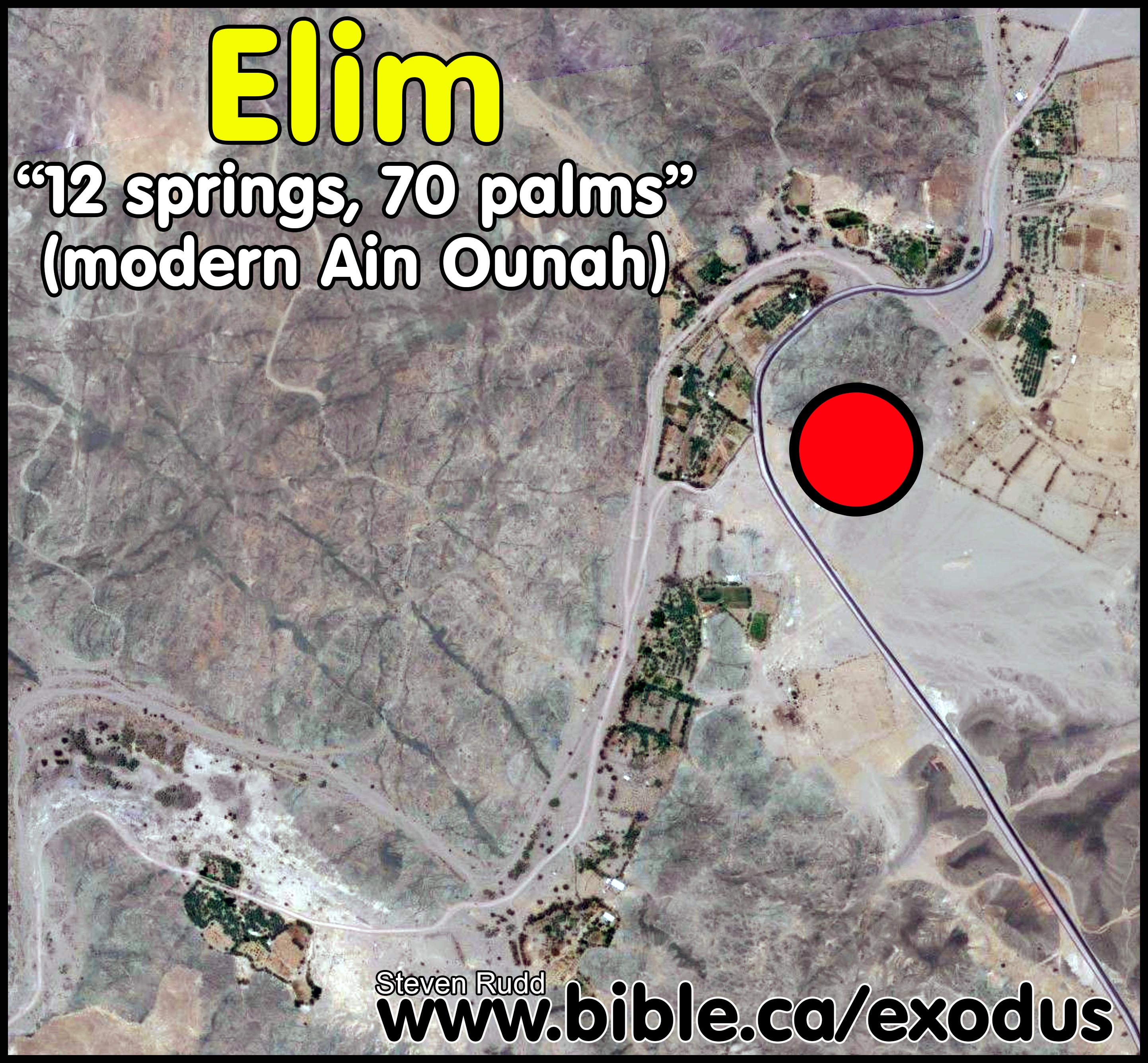
Two chapters later, in 15:17, we read of Elim. This passage is situated after the bitter waters of Marah. Beyond Mount Sinai where they were punished to drink water with the ashes of their idolatrous concoction. We simply read:
Then they came to Elim, where there were twelve springs and seventy palm trees, and they camped there near the water. (Exodus 15:27 NIV)
Thank God for Elim. This may appear to be such a small and seemingly insignificant verse yet it clearly shows the sovereignty of Almighty God. He can open the bitter waters of Marah yet shortly after lead them to a place of delight and happiness.

Elim: 70 palm trees and 12 wells of water.

Only God knows the limits of our strengths. Only God knows how much we can truly bear. When we seemingly are on the precipice of spiritual death and starvation, there will be times when He leads us to Elim. In spite of us He continues to bless and mercifully bestow delight and "reward" upon His chosen.

Long and straight is the path of righteousness yet as the Psalmist records it is for His names sake (23:3). The blessings and trials, the battle and the victory, the storm and the rainbow is all for His names sake!

Many times believers have knelt in prayer and seemingly cannot feel a thing from God. No visceral or spiritual connection. It seems that direction and His will, then, become to us as enigma and speculation. All the while we "diligently seek Him" with faith believing in our eternally powerful God and knowing that He is a "rewarder". Yes, He does reward and suddenly out of the darkness--in our secret place with Him--the Glory of God comes shining through.

Only one touch of His Spirit and our Faith is renewed. Seemingly, all hope is gone and God manifests His Glory upon us. We stumble and fall in the darkness of this world groping for our way, yet the light and direction of God comes lighting the way! That is the sovereignty of God moving in our lives as vessels which are submitted unto Him.

7.22.2006

The Problem of Evil:


One of the two most influential frescos(1) in the career of Michelangelo—The Last Judgment—depict angelic hosts holding the Book of Good Deeds and the Book of Evil Deeds. Ironically Michelangelo paints the latter, the Book of Evil Deeds, as substantially larger. Sadly, as far as one can tell, this is true in the human condition. Even to Michelangelo in the 1500's it was apparent that the tally of evil human deeds significantly outnumbers those of our good deeds.

Consequently an atheist will appeal to the existence and proliferation of evil in our society as a claim that there is no God. If there were a God and was good He would not allow evil, i.e. that which is contrary to His nature. According to the atheist if there was indeed a God He would intervene in the evil happenings of our world. The cliché is, “Why do bad things happen to good people?” or “How can there be a good God in a world where evil exists?”

Critics and honest people alike have wrestled since and no doubt before the times of Socrates and Aristotle with this issue of a good God and evil co-existing simultaneously. If God is such a good God and a God of love why does he tolerate the genocide of Ruwanda, the Oklahoma City Bombing, 9/11, Abortion, Euthanasia, or Homosexuality. Why is God silent or seemingly passive? Clearly this argument assumes many things and also exhibits an inadequate understanding of theology.

The Problem of Evil (hereon POE) is one of the most important arguments against theism primarily because it is an apparent proof used by an atheist to make the absolute claim that there is no God because evil exits. In fact this argument is apparently the only one that claims to prove that there is no God. There are many arguments against theism, but none of them amounts to a proof or demonstration. There are objections to all the arguments for theism, but even if they are successful, these objections only refute the arguments as invalid or inconclusive—they do not thereby disprove God's existence.

There are also serious practical and personal objections against faith, such as the atrocity of the Inquisition or hypocrisy among believers, or the trouble and surprise to one's ego of having to repent of prized sins. However, none of these prove that God does not exist.

A second reason why POE is important is because it is worldwide. People of all types, Americans or Russians, wonder why bad things happen to good people. POE knows no racial, cultural, or geographical boundary.

In The Problem With Pain(2) C.S. Lewis, a former atheist, formulates the argument in an anthropomorphic or existential version. He suggests that the argument would go something like this:

1. If God is all-good, he wants his creatures to be happy.
2. If he is all-powerful, he can do whatever he wants.
3. But the creatures are not happy. Therefore God lacks either goodness or power or both. Missing either of the two would make Him finite.


"How much evil can a ant do?" Douglas Groothius, from Denver Seminary. "How much evil can a bear do?" Obviously the point is that evil can be experienced in degrees. Groothius went on to say that"Evils is good gone wrong...we are all damaged goods". Evil is sometimes defined as a cosmic force. Although it is real, it is not an entity or a being. Evil has been defined as suffering. In some sense this is true but can we honestly say that all suffering is evil? Some suffering may not be inflicted upon the innocent and some suffering may be inflicted to achieve a greater moral good. Evil is unruly love, unmitigated will. It is a vile relationship, it is nonconformity between our will and God's will. God did not make it—we did.

For clarity, it is possible that evil can be placed in three categories—Moral, Natural, and Physical. “Actually there are many problems relating to evil, for example, the problems about its origin, nature, purpose, and avoidability.”(3) Moral evil possibly relates to the inner condition, the natural to the harmful and physical to negative environmental events. In some sense it is possible that all three have some relationship, this point can be seen as we progress.

There is evidence that would seem to indicate that the psychology of the POE argument is emotive or at least some attempt to understand one’s own suffering or even that of others. For example, Sigmund Freud, popularly known as an atheist and the father of psychoanalysis, is often quoted and has written voluminous works defending his claim. However, Dr. Armandi M. Nicholi Jr., in The Question of God(4), states,

“Freud kept trying to identify our primary sources of pain, perhaps in an effort to understand his own suffering. He [Freud] writes in The Future of an Illusion: ‘There are the elements, which seem to mock at all human control: the earth…water…diseases…the painful riddle of death…’ A few years later, in Civilization and Discontents, he adds another source of pain—namely, other human beings. ‘The suffering which comes from this last source is perhaps more painful to us than any other.’ Freud concludes that ‘life is hard to bear’ and often results in ‘a permanent state of anxious expectation.’”
First, would we want to see laws forbidding pre-marital sex or divorce? The obvious answer by both a Christian and an atheist would be “No!” This is because we have and cherish moral freedom. To say that an evil choice should be eliminated from our abilities to choose would contradict the idea of moral freedom or free will. In fact, there would in fact be no choice but to only do good. We would be bound to commit only acts of goodness. The argument can then turn circular because some would ask why God doesn’t allow them to indulge in natural pleasures.

Second, if we were bound to certain choices there would be no moral freedom. If God forced us to make certain decisions would that be love? No. That would be force. Love is the utmost good for all free creatures—because love is the greatest commandment and we are told to love our neighbors as ourselves (Matthew 22:36-40). This being so it is virtually impossible for love to exist apart from freedom. All else is coercion, manipulation, or bondage.

Therefore, to destroy all propensities for evil then would indeed be an act of evil itself. Norman Geisler suggests that “If evil is to be overcome we should talk of its defeat and not it’s destruction.”(5) A syllogism then could be:

1. Man is the principle source of moral and natural evil.
2. God has given us the Holy Spirit as a source of power to indeed defeat evils.
3. Moral and Natural Evil can be defeated in and by man.


Then the atheist would argue that our God is a mean God and why isn’t there a God who gives us choices? The answer is obvious. If God turned every bullet or every knife to butter when aimed or plunged at innocent lives then God would overstepping free-will. God did not create humans as chess pieces for His pleasure, instead we move towards Him willingly.

In Mere Christianity(6) C.S. Lewis states,
“Because free will, though it makes evil possible, is also the only thing that makes possible any love or goodness or joy worth having. A world of automata—of creatures that worked like machines—would hardly be worth creating.”
Third, when God made humans as free moral agents He made possible the existence of evil. He created the actuality of freedom; we perform the acts of freedom. Geisler says, “God made evil possible and subsequently men make evil actual.”(7)

Man when left to natural unmitigated impulses will use all manner of contrivances to succeed or exact revenge upon others. In fact, most of human suffering can probably be attributed to this source. It is humans, not God, who have fashioned guns, bombs, whips, torture chambers, disease and genocide. Indeed it is primarily by human greed and languor that we have poverty.

Atheism tends to run circular or contradictory in some sense eventually. Nicholi explores this area in his book,

"Freud in his paper “A Religious Experience”, asserts “God allows horrors” to occur and that he will hold God responsible. In a later letter to Dr. James J. Putnam of Boston, Freud says, “I…have no dread at all of the Almighty. If we ever were to meet I should have more reproaches to make to Him than he could to me.” These are indeed common sentiments of bewildered believers experiencing loss; however, Freud is an atheist—with whom is he angry? The question could aptly be posed to most professed atheists, “With whom are you angry?”

“God whispers to us in our pleasures, speaks in our conscience, but shouts in our pains; it is His megaphone to rouse a deaf world.” ~C.S. Lewis


Sources Cited in Order of Appearance:

1. For actual online representations of these frescos go to: http://www.christusrex.org/www1/sistine/40-Resurrect.html
2. Lewis, Clives Staples. The Problem of Pain. Harper Collins Edition 2001
3. Geisler, N. L. (1999). Baker encyclopedia of Christian apologetics. Baker reference library (219). Grand Rapids, Mich.: Baker Books.
4. Nicholi Armandi M. The Question of God. Free Press © 2002 by Armand Nicholi
5. Lewis, Clives Staples. Mere Christianity. Harper Collins Edition 2001
6. Geisler, Norman L., and Ronald M. Brooks. When Skeptics Ask. Wheaton, Ill.: Victor Books, 1990.
7. Ibid.

Adversus Trinitas

"...unless you believe that I am he you will die in your sins." (John 8:24 ESV)