Showing posts with label Evil. Show all posts

5.26.2011

Isaiah 45:7 : Does God Create Sin and Evil?


Isaiah 45:5,6 and 7
I am the LORD, and there is no other, besides me there is no God...from the rising of the sun and from the west, that there is none besides me; I am the LORD, and there is no other. 7 I form light and create darkness, I make well-being and create calamity, I am the LORD, who does all these things. ESV
Isaiah 45:7
I form the light, and create darkness: I make peace, and create evil: I the LORD do all these things. KJV
Here the KJV translates the Hebrew noun רַע in vs. 7 as “evil”. This can be misleading if someone isn’t aware of the context or culture and even other valid translations of Scripture. The term can be translated variously as we see in the ESV above. Yahweh is speaking to Cyrus of Persia whom He had given power to “subdue nations” and bring deliverance.

The Persians believed in an earthly dualism (good/light vs. evil/darkness). In fact, Zoroastrianism was a major religion there. Obviously then the meaning here is not a reference to the evil of sin that God does not create but to the judgments of war and its calamities. Keil and Delitzsch confirm this.
as the prophecy concerning Cyrus closes with this self-assertion of Jehovah, it is unquestionably a natural supposition that there is also a contrast implied to the dualistic system of Zarathustra, which divided the one nature of the Deity into two opposing powers.
The terms “light” and “darkness” used in vs. 7 are more likely to be symbolic of “deliverance” or “judgement.” which Cyrus had been appointed to deliver for the peace of Israel. Notice these remarks by the NET translators:
This verses affirms that God is ultimately sovereign over his world, including mankind and nations. In accordance with his sovereign will, he can cause wars to cease and peace to predominate (as he was about to do for his exiled people through Cyrus), or he can bring disaster and judgment on nations (as he was about to do to Babylon through Cyrus).
No, God does not directly create evil. It is a secondary or indirect cause in the created world. Thus the earthly conflict of light vs. darkness being played out in our world. Here the Only True and Living God is seen to be the “Lord and there is no other”. He is truly sovereign over all creation. Keil and Delitzsch close their thoughts on this passage with these remarks:
The meaning of the words is not exhausted by those who content themselves with the assertion, that by the evil (or darkness) we are not to understand the evil of guilt (malum culpae), but the evil of punishment (malum paenae). Undoubtedly, evil as an act is not the direct working of God, but the spontaneous work of a creature endowed with freedom. At the same time, evil, as well as good, has in this sense its origin in God,—that He combines within Himself the first principles of love and wrath, the possibility of evil, the self-punishment of evil, and therefore the consciousness of guilt as well as the evil of punishment in the broadest sense. When the apostle celebrates the glory of free grace in Rom. 9:11ff., he stands on that giddy height, to which few are able to follow him without falling headlong into the false conclusions of a decretum absolutum, and the denial of all creaturely freedom.

Notes:

1. Keil, C. F., & Delitzsch, F. (2002). Commentary on the Old Testament. (Is 45:4–7). Peabody, MA: Hendrickson.

2. Biblical Studies Press. (2006; 2006). The NET Bible First Edition Notes (Is 45:7). Biblical Studies Press.

3.04.2010

Alvin Plantinga and Richard Gale on God and Evil

Here is a good discussion on the Existence of God and the Problem of Evil from Alvig Plantinga (Christian Philosopher) and Richard Gale (Atheist Philosopher) given at the Veritas Forum. Enjoy.

The Existence of Evil and the Problem of God from The Veritas Forum on Vimeo.

1.25.2010

The End of Evil: Quote from Christopher Wright

"When the reign of God extends over every corner of the universe, when the earth is filled with the knowledge of God as the waters cover the sea, when the kingdoms of this world have become the kingdoms of our God and of his Christ, when heaven and earth are renewed and united under the righteous rule of Christ, when the dwelling place of God is again with humanity, when the city of God is the center of all redeemed reality—then we will have been delivered from all evil forever...The cross and resurrection of Christ accomplished it in history and guarantee it for all eternity." Christopher Wright, The God I Don't Understand

5.22.2008

Does Proverbs 16:4 teach that God made wicked people?

Proverbs 16:3-5 NKJV, (3) Commit your works to the LORD, And your thoughts will be established. (4) The LORD has made all for Himself, Yes, even the wicked for the day of doom. (5) Everyone proud in heart is an abomination to the LORD; Though they join forces,[1] none will go unpunished."

Some people have noted this proverb and suggest that God created evil, and certain people for evil as well. Notice that the tenor here seems to be that we should "commit" our works to the Lord, even the wicked will be punished, and that a "proud heart is an abomination" and that all these will not go unpunished.

The Hebrew people had a very unique and majestic style of writing. Verse four, the verse in question, is actually a an example of synthetic parallelism. This is when one line of text affirms a truth, and the subsequent line expands on it with a specific application. In this case, about the wicked, whatever disaster comes their way is an appropriate correspondent for their life.

This proverb means that God has an end, object, or purpose for everything. There is a result for every cause, a reward or punishment for every act. He has ordained a day of trouble or evil for the wicked, just as He has prepared heaven for those who love Him. The Today's Englis Version renders verse four:

“Everything the Lord has made has its destiny; and the destiny of the wicked man is destruction” (Proverbs 16:4 TEV).
Though this may be difficult to understand and accept, punishment for the unrepentant is in keeping with God’s justice.The UBS Handbook Series suggests this as an alternate reading:

"The Lord has decided how everything he created should be, and he has decided the wicked should be destroyed." (Reyburn, W. D., & Fry, E. M. (2000). A handbook on Proverbs. UBS handbook series; Helps for translators (348). New York: United Bible Societies.)
This doesn't necessarily mean that God created the "wicked" in that state. It means that the wicked have an end--punishment. Even the wicked are subservient to His eternal purposes. They are destined to experience the day of wrath and receive their well-merited punishment.

Jude 4 is another text often misunderstood. It reads:

"For certain men have crept in unnoticed, who long ago were marked out for this condemnation, ungodly men, who turn the grace of our God into lewdness and deny the only Lord God[2] and our Lord Jesus Christ." (NKJV)

To some this says God selected these particular individuals to be doomed. But that is not the meaning. The Bible never teaches that some are chosen to be damned, that would be Calvinism. When men are saved, it is through the grace of God. But when they are lost, it is because of their own sin and disobedience. This expression teaches that the condemnation of apostates has been determined long beforehand. If men choose to fall away from the Faith, then their condemnation is the same as that of the unbelieving Israelites in the wilderness, the rebel angels, and the Sodomites. They are not foreordained to fall away, but once they do apostatize by their own choice, they face the punishment predetermined for all apostates.

11.24.2006

Physical Evil:


Recent ecological or environmental occurrences have caused many to speculate upon physical evil and what part God has to with such. Prior I presented the problem of evil from a moral aspect; the problem remains that these solutions do not appear to solve the problem of natural disasters. This article is by no means completely original. I have compiled and cited various philosophers and scholars to assist us in our journey.

The recent catastrophe of Hurricane Katrina, as it hurled itself upon the South, was truly an awakening for our culture. “Hurricane Katrina was the costliest and one of the deadliest hurricanes in the history of the United States. It was the sixth-strongest Atlantic hurricane ever recorded and the third-strongest landfalling U.S. hurricane on record.”(1)

In mere moments we realized how helpless and undone we were to the forces of nature. When the churches, schools, and Red Cross cots became full many(2) blamed the hurricane on God or stated that the city known as New Orleans was a direct recipient of God’s judgement. Some saw Katrina as a virtual revisiting of the plagues upon Egypt.

Conversely, the “past 10 years have seen more ferocious and more frequent hurricanes in the Atlantic Ocean and scientists are confident that there will be more to come. While some studies have suggested that global warming may be a contributing factor, many meteorologists instead believe that it is just part of a natural cycle.”(3)

The question remains, why is our planet seemingly plagued with tornadoes, hurricanes, and earthquakes? It does not logically follow that the moral choices of individuals causes such things. Evil is indeed a problem in society generally and is one of the strongest arguments, as mentioned prior, of the atheist (or Gnostic, anti-theist).

Norman Geisler offers the following syllogism:

1. Moral evil is explained by free choice.
2. But some natural evil does not result from free choice.
3. Natural evil cannot be explained by free choice of creatures.
4. Hence, God must be responsible for natural evil.
5. But natural evils cause innocent suffering and death.
6. Therefore, God is responsible for innocent suffering and death.(4)

Three Levels of Evil Awareness:

Before we endeavor to give a reasoned response to the problem of physical evil we should investigate the levels of evil which appear to our cognition and reasons why our speculations are often folly. Peter Kreeft and Ronald Tacelli indicate that “the problem of evil may arise on three levels of consciousness.”(5) These three levels are worth re-iterating here. I will not quote them verbatim but the ideas stem from these authors.

1. The emotional or “gut” level. This was mentioned prior concerning Sigmund Freud but it is on par with when you are informed that you or a relative are dying. Many of us have felt this level after learning of terrible news. Evil is no longer an abstract concept but is a personal reality.

2. The intellectual level. Kreeft and Tacelli state that this level is first “intuitive before it is calculative or argumentative.” This occurs when we see recognizes inconsistencies or the “glaring incompatibility between evil and an all-good God.” We move from an emotive acknowledgement to understanding how such a reality is justified logically and argumentatively. Many people, as Kreeft and Tacelli state, “this is the level on which philosophers and theologians especially work”.

3. The deepest level. This level is also the level that looks longer at solution. It is the level that sees the happenings of evil in history and life. “Evil does not just "exist," it happens.” Therefore, the solution cannot be one that is purely metaphysical or outside of finitude. The solution, then, must happen in the same world in which evil happens.

Did God Create Evil?

Something we often forget is that the world now is not the world that God originally intended or created. The Scriptures tell us that God did no create the world in the state in which it is now, but evil came as a result of man’s disobedience. The Bible says that God is a God of love (1 John 4:8) His desire for man was reciprocal love. The paradox then is that true love cannot exist apart from free will; anything else would appear to be bondage. Man has free will and is very capable of exhibiting love. The existence of free will makes evil possible—not actual. When Adam and Eve disobeyed God, they personally made the decision to rebel or disobey God. To say that God created evil and man succumbed to evil, as a creation of God, is a logical fallacy. God is neither evil nor did He create evil. It was by man’s own will that he, indeed, chose to do evil rather than good.

Dorothy Sayers, author and translator, views the problem of evil thusly: “For whatever reason God chose to make man as he is—limited and suffering and subject to sorrows and death—He had the honesty and the courage to take His own medicine. Whatever game He is playing with His creation, He has kept His own rules and played fair. He can exact nothing from man that He has not exacted from Himself. He has Himself gone through the whole of human experience, from the trivial irritations of family life and the cramping restrictions of hard work and lack of money to the worst horrors of pain and humiliation, defeat, despair and death. When He was a man, He played the man. He was born in poverty and died in disgrace and thought it well worth while”(6)

The Human Condition:

Many of us, including myself, have given speculative reasons about God and evil. Many times they are problematic. This is due to the human condition. As humans:

1. We are limited in time and space. We are finite. Therefore it is logical to conclude then that there are many aspects of God and infinitude that we cannot comprehend. Being finite we do not have access to all knowledge or data, especially the divine knowledge of deity.

2. We have many false presuppositions. A presupposition is something we have beforehand. It is an idea or belief that we hold prior to completely understanding or knowing certain data. Such postulations are often called a priori assumptions. We often think we are God’s proverbial pets and we have a notion that everything should be good in a world with God. Where is the evidence for these notions? We also think that God should inform the human race of his purpose for every act or occurrence, especially evil ones. This is indeed folly.

3. “No matter how many people steal, stealing remains wrong. No matter how many people are corrupt, corruption remains wrong. No matter how many people betray public trust, that action remains wrong. The fact that any misdeed becomes popular does not make it permissible. The problem of evil is not solved by multiplication.” ~ Sidney Greenburg ~

4. Many ask the question, “Why isn’t God doing something about evil?” My retort would be, “How do you know He isn’t?” The logic here is that the presence of evil, directly or indirectly, militates against the existence of God. Conversely, as we shall see, the existence of evil actually affirms God’s existence.

Benefits of Evil:

As noted earlier, some of God’s reasons for tolerating certain things may not be immediately apparent. It is definitely within the scope of Gods power to end evil now, but it is possible that certain goals are attainable while evil exists. With evil present more people choose God therefore there is moral improvement. We do not often learn from pleasure, or at least have a strong sense of self-realism in those moments that effect change for our future. Usually, when evil or negative times abound we learn valuable lessons. Suffering is not good in itself, but it can produce good. There are four ways that suffering/evil can produce good. I will include and expound on them briefly below.

1. Suffering brings people to God. Only in a world involving natural [physical] and moral evil would the maximum number of people come naturally to knowledge of God and salvation. Empirical evidence: the Gospel is increasing in its most rapid rates in those areas where the suffering is most intense. The Gospel is waning in areas such as the West where we are so content.

2. Suffering builds community. The hurricane Katrina gives new meaning to this. When Katrina finished her destruction to our shores Americans came together from far and near. Suffering brought unity, it brought community.

3. Helps teach us our human limitations and needs. Through suffering we realize that we are not fully independent and have need for, not only, community but a higher power as well.

4. Challenges us to go beyond our current state of moral development to develop greater moral virtue. (II Cor 4:17)


Reasonable Answers:

Objective Moral Values.

First, in a lecture (7), Dr. William Lane Craig offers this syllogism:

1. If God does not exist then objective moral values do not exist.
2. Objective moral values exist
3. Therefore God exists.

I believe it is possible to acknowledge and define morality and even to live somewhat morally apart from a belief in God’s existence. But, do objective moral values actually exist apart from Him? Or, do we find ourselves walking in step with cultural traditions? If God does not exist do objective moral values exist? I would say no. For example, in the atheist’s world we may understand that rape or molestation has became taboo in certain cultures because it was not at any point socially advantageous. However it never proves rape is absolutely wrong from the atheistic point of view. It simply acknowledges that a culture has developed such a negative view against rape. From an atheists point of view rape is socially unacceptable but not a moral evil.

How do we know the difference between good and evil? How did you know that Hitler’s Holocaust was evil? How did you know that 911 was an evil atrocity? How do we know what it means to be good or to be evil? We know these things by knowing the antithesis of either. Francois Mauriac (1885–1970) said, “We who live beneath a sky still streaked with the smoke of crematoria, have paid a high price to find out that evil is really evil.”

It is logical to conclude that murder is evil. It is logical to conclude that the ability to live is good. We know these things by the existence of both. We would not know how good God is without already knowing what evil is like—the antithesis.

Objective moral values Therefore, without God, and especially His revelatory Word, we would not have objective moral values. Alas, we do however and because of the existence of evil we realize that there are indeed objective moral values and thus God does exist. Why would we have a duty to be moral or merciful if there is no God? Dr. William Lane Craig suggests that, “After all, if there is no God, then what’s so special about human beings? They’re just accidental by-products of nature that have evolved relatively recently on an infinitesimal speck of dust lost somewhere in a hostile and mindless universe and that are doomed to perish individually and collectively in a relatively short time.”[1]

Certain virtues could not exist apart from evil: courage, mercy, forgiveness, patience, the giving of comfort, heroism, perseverance, faithfulness, self-control, long-suffering, submission and obedience.

Human Finitude:

Second, God’s moral and sufficient reasons for certain ecological occurrences may have answers that emerge centuries from now or in different locales. Our finitude limits us from all knowledge and information. It is often that we do not realize the purpose or full scope of events until hours, days, months or even years later. Is there evidence that we have not examined? Is there data needing analyzed? In our finiteness time will only tell.

A Biblical View: Human Responsibility and Sin:

Third, in this fallen world no one is innocent. From a biblical standpoint we sinned in Adam. The notion that we are simple good people deserving of all of God’s benevolence is folly. We are all sinners and not only have the propensity for evil but the inclination of it also. A.W. Tozer (1897–1963) states, “There is nothing evil in matter itself. Evil lies in the spirit. Evils of the heart, of the mind, of the soul, of the spirit—these have to do with man’s sin, and the only reason the human body does evil is because the human spirit uses it to do evil.” The scriptures tell us:

Romans 5:12, “Wherefore, as by one man sin entered into the world, and death by sin; and so death passed upon all men, for that all have sinned:” (KJV)


As a consequence man deserves death:

Romans 6:23, “For the wages of sin [is] death…” (KJV)
Natural disaster is a direct result of the curse on creation because of the fall of humankind (Genesis 3; Romans 8). Sadly, this curse will not be removed until Christ returns (Revelation 21–22).

Revelation 21:4, “He will wipe every tear from their eyes. There will be no more death or mourning or crying or pain, for the old order of things has passed away.” (NIV)

Revelation 22:2-3, “down the middle of the great street of the city. On each side of the river stood the tree of life, bearing twelve crops of fruit, yielding its fruit every month. And the leaves of the tree are for the healing of the nations. No longer will there be any curse…” (NIV)
Category Mistake:

Fourth, the logic of the atheist implies that God is morally responsible for taking the life of a creature. This is a category mistake, it wrongly assumes that, since it is wrong for a creature to take innocent life, it is also wrong for the Creator to do so. But God gave life and alone has the right to take it (Deut. 32:39; Job 1:21). We did not give life, and we do not have the right to take it.

Eight More Responses:

Fifth, natural evil can be explained by free-choice. In biblical language, the free choice of Adam and Eve brought natural disaster on this world. In addition the free choice of evil angels accounts for the rest of human suffering. But even putting this possibility aside, which could in itself explain all natural evil, physical suffering can be explained in reference to human free choice. Norman Geisler offers these responses:

1. Some suffering is brought on directly by our own free choice. The choice to abuse my body can result in sickness.

2. Some suffering is brought on indirectly by free choice. The choice to be lazy can result in poverty.

3. Some physical evil to others can result from our free choice, as in the case of spouse or child abuse.

4. Others suffer indirectly because of our free choice. Alcoholism can lead to poverty of one’s children.

5. Some physical evil may be a necessary byproduct of a good process. Rain, hot air, and cool air are all necessary for food and life, but a byproduct of these forces is a tornado.

6. Some physical evil may be a necessary condition for attaining a greater moral good. God uses pain to get our attention. Many have come to God through suffering.

7. Some physical suffering may be a necessary condition of a greater moral good. Just as diamonds are formed under pressure, even so is character.

8. Some physical evil is a necessary association of a morally good physical world. For instance, it is good to have water to swim and boat in, but a necessary association is that we can also drown in it. It is good to have sex for procreation and enjoyment, even though it makes rape and incest possible. It is good to have food to eat, but this also makes dying of food poisoning possible.(8)

At this point some may ask why a physical world is necessary. Why did not God make spirits, who could not hurt their bodies or die? The answer is: God did; they are called angels. The problem is that, while no angel can die of food poisoning, neither can they enjoy a prime rib. While no angel has ever drowned, neither has any angel ever gone for a swim or went water skiing. No angel has ever been raped, but neither has any angel ever enjoyed sex or the blessing of having children (Matt. 22:30). In this kind of physical world, we simply must take the associated evil along with the good.[2]

“The existence of evil is not so much an obstacle to faith in God as a proof of God’s existence, a challenge to turn toward that in which love triumphs over hatred, union over division, and eternal life over death.” Nikolai Aleksandrovich Berdyaev (1874–1948)

Sources in Order of Appearance:

1) http://en.wikipedia.org/wiki/Hurricane_Katrina

2) http://www.katc.com/global/story.asp?s=3914810&ClientType=Printable

3) http://www.livescience.com/forcesofnature/050831_hurricane_freq.html

4) Geisler, N. L. (1999). Baker encyclopedia of Christian apologetics. Baker reference library (222). Grand Rapids, Mich.: Baker Books.

5) Handbook of Christian Apologetics © 1994 by Peter Kreeft and Ronald K. Tacelli. All rights reserved.

6) Dorothy Sayers, Creed or Chaos? New York: Harcourt, Brace and Col, 1949, p.4

7) Dr. William L. Craig, Do Pain and Suffering Disprove God's Existence? http://www.leestrobel.com/videos/Creator/strobelT1212.htm

8) Geisler, N. L., & Hoffman, P. K. (2001). Why I am a Christian : Leading thinkers explain why they believe (75). Grand Rapids, Mich.: Baker Books.

7.22.2006

The Problem of Evil:


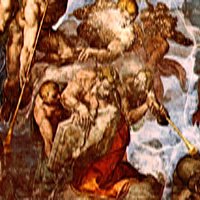
One of the two most influential frescos(1) in the career of Michelangelo—The Last Judgment—depict angelic hosts holding the Book of Good Deeds and the Book of Evil Deeds. Ironically Michelangelo paints the latter, the Book of Evil Deeds, as substantially larger. Sadly, as far as one can tell, this is true in the human condition. Even to Michelangelo in the 1500's it was apparent that the tally of evil human deeds significantly outnumbers those of our good deeds.

Consequently an atheist will appeal to the existence and proliferation of evil in our society as a claim that there is no God. If there were a God and was good He would not allow evil, i.e. that which is contrary to His nature. According to the atheist if there was indeed a God He would intervene in the evil happenings of our world. The cliché is, “Why do bad things happen to good people?” or “How can there be a good God in a world where evil exists?”

Critics and honest people alike have wrestled since and no doubt before the times of Socrates and Aristotle with this issue of a good God and evil co-existing simultaneously. If God is such a good God and a God of love why does he tolerate the genocide of Ruwanda, the Oklahoma City Bombing, 9/11, Abortion, Euthanasia, or Homosexuality. Why is God silent or seemingly passive? Clearly this argument assumes many things and also exhibits an inadequate understanding of theology.

The Problem of Evil (hereon POE) is one of the most important arguments against theism primarily because it is an apparent proof used by an atheist to make the absolute claim that there is no God because evil exits. In fact this argument is apparently the only one that claims to prove that there is no God. There are many arguments against theism, but none of them amounts to a proof or demonstration. There are objections to all the arguments for theism, but even if they are successful, these objections only refute the arguments as invalid or inconclusive—they do not thereby disprove God's existence.

There are also serious practical and personal objections against faith, such as the atrocity of the Inquisition or hypocrisy among believers, or the trouble and surprise to one's ego of having to repent of prized sins. However, none of these prove that God does not exist.

A second reason why POE is important is because it is worldwide. People of all types, Americans or Russians, wonder why bad things happen to good people. POE knows no racial, cultural, or geographical boundary.

In The Problem With Pain(2) C.S. Lewis, a former atheist, formulates the argument in an anthropomorphic or existential version. He suggests that the argument would go something like this:

1. If God is all-good, he wants his creatures to be happy.
2. If he is all-powerful, he can do whatever he wants.
3. But the creatures are not happy. Therefore God lacks either goodness or power or both. Missing either of the two would make Him finite.


"How much evil can a ant do?" Douglas Groothius, from Denver Seminary. "How much evil can a bear do?" Obviously the point is that evil can be experienced in degrees. Groothius went on to say that"Evils is good gone wrong...we are all damaged goods". Evil is sometimes defined as a cosmic force. Although it is real, it is not an entity or a being. Evil has been defined as suffering. In some sense this is true but can we honestly say that all suffering is evil? Some suffering may not be inflicted upon the innocent and some suffering may be inflicted to achieve a greater moral good. Evil is unruly love, unmitigated will. It is a vile relationship, it is nonconformity between our will and God's will. God did not make it—we did.

For clarity, it is possible that evil can be placed in three categories—Moral, Natural, and Physical. “Actually there are many problems relating to evil, for example, the problems about its origin, nature, purpose, and avoidability.”(3) Moral evil possibly relates to the inner condition, the natural to the harmful and physical to negative environmental events. In some sense it is possible that all three have some relationship, this point can be seen as we progress.

There is evidence that would seem to indicate that the psychology of the POE argument is emotive or at least some attempt to understand one’s own suffering or even that of others. For example, Sigmund Freud, popularly known as an atheist and the father of psychoanalysis, is often quoted and has written voluminous works defending his claim. However, Dr. Armandi M. Nicholi Jr., in The Question of God(4), states,

“Freud kept trying to identify our primary sources of pain, perhaps in an effort to understand his own suffering. He [Freud] writes in The Future of an Illusion: ‘There are the elements, which seem to mock at all human control: the earth…water…diseases…the painful riddle of death…’ A few years later, in Civilization and Discontents, he adds another source of pain—namely, other human beings. ‘The suffering which comes from this last source is perhaps more painful to us than any other.’ Freud concludes that ‘life is hard to bear’ and often results in ‘a permanent state of anxious expectation.’”
First, would we want to see laws forbidding pre-marital sex or divorce? The obvious answer by both a Christian and an atheist would be “No!” This is because we have and cherish moral freedom. To say that an evil choice should be eliminated from our abilities to choose would contradict the idea of moral freedom or free will. In fact, there would in fact be no choice but to only do good. We would be bound to commit only acts of goodness. The argument can then turn circular because some would ask why God doesn’t allow them to indulge in natural pleasures.

Second, if we were bound to certain choices there would be no moral freedom. If God forced us to make certain decisions would that be love? No. That would be force. Love is the utmost good for all free creatures—because love is the greatest commandment and we are told to love our neighbors as ourselves (Matthew 22:36-40). This being so it is virtually impossible for love to exist apart from freedom. All else is coercion, manipulation, or bondage.

Therefore, to destroy all propensities for evil then would indeed be an act of evil itself. Norman Geisler suggests that “If evil is to be overcome we should talk of its defeat and not it’s destruction.”(5) A syllogism then could be:

1. Man is the principle source of moral and natural evil.
2. God has given us the Holy Spirit as a source of power to indeed defeat evils.
3. Moral and Natural Evil can be defeated in and by man.


Then the atheist would argue that our God is a mean God and why isn’t there a God who gives us choices? The answer is obvious. If God turned every bullet or every knife to butter when aimed or plunged at innocent lives then God would overstepping free-will. God did not create humans as chess pieces for His pleasure, instead we move towards Him willingly.

In Mere Christianity(6) C.S. Lewis states,
“Because free will, though it makes evil possible, is also the only thing that makes possible any love or goodness or joy worth having. A world of automata—of creatures that worked like machines—would hardly be worth creating.”
Third, when God made humans as free moral agents He made possible the existence of evil. He created the actuality of freedom; we perform the acts of freedom. Geisler says, “God made evil possible and subsequently men make evil actual.”(7)

Man when left to natural unmitigated impulses will use all manner of contrivances to succeed or exact revenge upon others. In fact, most of human suffering can probably be attributed to this source. It is humans, not God, who have fashioned guns, bombs, whips, torture chambers, disease and genocide. Indeed it is primarily by human greed and languor that we have poverty.

Atheism tends to run circular or contradictory in some sense eventually. Nicholi explores this area in his book,

"Freud in his paper “A Religious Experience”, asserts “God allows horrors” to occur and that he will hold God responsible. In a later letter to Dr. James J. Putnam of Boston, Freud says, “I…have no dread at all of the Almighty. If we ever were to meet I should have more reproaches to make to Him than he could to me.” These are indeed common sentiments of bewildered believers experiencing loss; however, Freud is an atheist—with whom is he angry? The question could aptly be posed to most professed atheists, “With whom are you angry?”

“God whispers to us in our pleasures, speaks in our conscience, but shouts in our pains; it is His megaphone to rouse a deaf world.” ~C.S. Lewis


Sources Cited in Order of Appearance:

1. For actual online representations of these frescos go to: http://www.christusrex.org/www1/sistine/40-Resurrect.html
2. Lewis, Clives Staples. The Problem of Pain. Harper Collins Edition 2001
3. Geisler, N. L. (1999). Baker encyclopedia of Christian apologetics. Baker reference library (219). Grand Rapids, Mich.: Baker Books.
4. Nicholi Armandi M. The Question of God. Free Press © 2002 by Armand Nicholi
5. Lewis, Clives Staples. Mere Christianity. Harper Collins Edition 2001
6. Geisler, Norman L., and Ronald M. Brooks. When Skeptics Ask. Wheaton, Ill.: Victor Books, 1990.
7. Ibid.

Adversus Trinitas

"...unless you believe that I am he you will die in your sins." (John 8:24 ESV)