Showing posts with label Oneness. Show all posts

8.14.2012

Trinitarian Analogies: Cerberus and The Trinity Box?

Cerberus and Hades
I was scheduled to debate James White in October of this year concerning the Trinity but that debate will have to be rescheduled at a later time. In that debate I intended to ask White about his analogy of the Trinity. Recently, White and William (Bill) Craig, have been discussing the frightful nature of analogizing the Trinitarian doctrine. In an earlier post in April of 2011 I was discussing the eternal begotten Son doctrine where Trinitarians do not imagine "day" to be a period in temporal space but a timeless, incomprehensible process in atemporal space. I noted that Trinitarians "invoke a philosophical conclusion and then avoid explaining how that is so at all cost. In fact, every example or analogy of the Trinity will fail as has been repeatedly demonstrated (e.g. three headed dog Cerberus used by William Craig and J.P. Moreland in Philosophical Foundations for a Christian Worldview)." I have also discussed the Trinitarian argument using 1x1x1=1 here.

In a recent podcast responding to White's criticism of the Cerberus analogy (Greek mythological creature pictured above) Craig once again asserted the Cerberus analogy but rejects and denounces it as inadquate a few moments later. Craig indicates he is simply trying to explain his views in a comprehensible fashion. It is wise to admit that no analogy is perfect and is only good as far as it goes but a three-headed dog seems to be a non-starter. It seems that White and Craig both affirm and acknowledge this despite the analogy comparisons between them. Conversely, Unitarian philosopher Dale Tuggy contends God is analogous and has criticized White and Craig here.


In a video on March of 2012, criticizing Craig for his analogy, ironically White also produced his own. Surprisingly, Craig does not offer criticism of White's analogy which is called the Trinity Box. He does indicate that all analogies fall short but indicates that using them does help to make progress towards understanding the affirmations of the Trinity.

The Trinity Box? The name sounds like an upcoming video game by Sony but it is actually White's attempt at analogizing the "revelation" of the Trinity. White has rightly criticized Trinitarian philosophers and apologists for referring to Cerberus. But what of his Trinity Box which he posits in their place? As Craig points out there is nothing wrong with positing an analogy or using thought experiments to get a point across. If one realizes the limits of the analogy this is fine and well but I get the impression White feels the Trinity Box is a little better off than Cerberus. I must admit Cerberus is about as bad an analogy that I have ever heard but the Trinity Box is not any better or successful by any measure. 

White qualifies his analogy by saying that he believes God is the only being who exists as the Trinity. Therefore, there is nothing which is completely analogous to the Trinity. But as Craig does he also sees the limited benefit of analogies. The Trinity Box is a homemade illustration consisting of a little black box with an opening on one end and three on the other. Plug the cord into the electrical outlet and bingo--the revelation of the Trinity. 

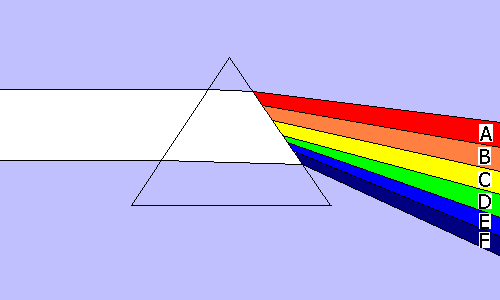
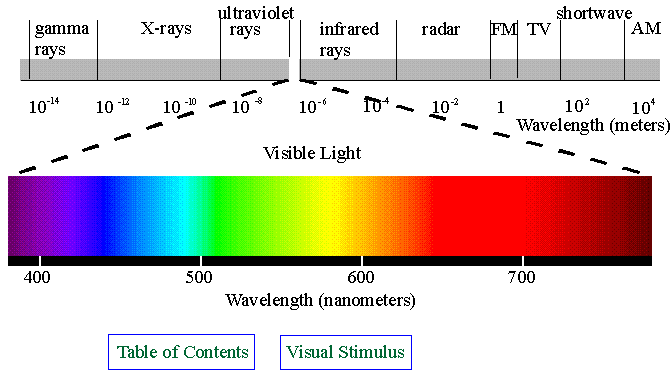
Actually, one end shows one opening of white light and the other has been made as to only show the three primary colors (red, green and blue). See the graphic above. That seems a little arbitrary but he explains that the white light in the light spectrum is analogous to the divine nature of God. Yet, the one white light in the Trinity Box can also be seen as red, green and blue. Thus God (white light which must represent His being) is revealed as three colors (red, green, and blue) or three persons (Father, Son and Holy Spirit). White contends in this analogy the revelation of the Trinity does not reveal something new but shows us something we simply have never seen before. White considers this analogy to be more fitting to the revelation of the Trinity as the three divine persons are believed to be eternally pre-existing and equally sharing in the divine nature.


In the graphics above we quickly see there is much more to be seen than red, green or blue. God's creation of light is not limited to three primary colors and a prism can be manipulated to produce more colors. One could ask then is there more revelation? Will we see more light in our glorified state? Perhaps, in the new heavens and new earth? For example, ultra-violet and infra-red are also colors in the light spectrum and with secondary instruments can easily be seen as well.

Which persons of the Trinity could these new colors represent? One must ask then is the revelation of God's divine nature (white light) really complete? After all, the three persons were not revealed to Abraham, Isaac, Jacob or even Moses who spoke with God and met Him face to face. Do we have a guarantee, in Scripture, that the Trinitarian revelation is complete?

Even the early and original Nicene Creed is not explicitly Trinitarian since its principle aim is Christological. This is not hopeful. Even in an embryonic creed a more explicit Trinitarianism is to be hoped for given the 1) divine inspiriation of Scripture gone before hand and 2) the conscious knowledge of the Trinity by the Bible writers (as Trinitarians must presuppose). Yet, after this original creed many more followed until a codified and articulate doctrine of the Trinity was hammered out by the Cappodocian bishops of AD 451.

Certainly this Trinity should be in later Church History literature where writers are supposedly building off New Testament concepts. Yet, many of these writers in the second century and after do not show an adequate appreciation to the Old Testament or Jewish heritage in which the Bible writers came from. The technical sense in which Trinitarians describe the Incarnation or the properties of the Father, Son and Holy Spirit are not found in Scripture but must come from later creeds and later formulations. Trinitarians argue from certain Bible passages and thus the Trinitarian must conclude that the Trinity is present in the consciousness of certain early Biblical writers and communities such as Phillippi or Corinth. These are necessary hermeneutical presuppositions for Trinitarianism in order for it to be an explicit teaching of Scripture. With such a knowledge repository and divine inspiration a more explicit Trinity should be found.

We should not have to appeal to frightening analogies of a dog with three heads that would scare the Pentecostal or Puritan school child. Nor to instantly contradictory arguments from nature such as the Trinity Box. As noted in prior posts and confirmed by many Biblical scholars, the Bible writers do not clearly and explicitly teach a doctrine of the Trinity. Instead, it must be pieced together, much like a quilt, from certain passages seen as applicable using the Trinitarian presupposition.

8.08.2012

Interpreting and Using Matthew 28:19 - III


Threefold Reference: 

James D.G. Dunn: "...in Matt. 28:19, the title Son is used with the Father and the Holy Spirit in a triadic formulation which foreshadows, in at least some degree, the later trinitiarian understanding of God; though here too it should be noted that the idea of pre-existence is absent (we are still far from talk of the eternal being of God in its threefold inner relationships), and the authority Jesus claims and expresses in his commission is that of the risen one."(1)

Matthew 28:19, Go therefore and make disciples of all nations, baptizing them in the name of the Father and of the Son and of the Holy Spirit, (ESV)

Above Trinitarian scholar James D.G. Dunn believes this text "foreshadows" a Trinity but here even he does not see Matthew 28:19 as referring to the divine nature of God existing as three persons. Using later creedal language one might see a Trinity in these verses. However, those present in the times of Jesus knew of no such thing nor did they impress upon us that God had even revealed such a thing to them. It is obvious from the setting that Jesus spoke to His disciples who were Jews strictly upholding monotheism and had no prior knowledge of a Trinity.

To embrace such concepts would require clear and explicit teaching. Instead, in the first chapter of Matthew we learn that Jesus is Immanuel--God with us. In the 28th and last chapter we learn that Jesus will be with us for all time. In the third chapter Matthew quotes from the prophet Isaiah saying "prepare the way of the Lord" (3:3). In the Hebrew Old Testament Isaiah had said, "prepare the way of the LORD" or the way of Yahweh. (Isa. 40:3 ESV) Jesus has also taught them, around the same time, that to see Him was to see the Father and that the Holy Spirit would come in another form (See John 14). There are no distinctions between the Father and Jesus except those produced by His humanity. The context reveals the authority of Christ in the glory of His resurrection. It tells us of His commandments and His continual presence. Not the glory or presence or commands of three divine persons who each comprise a Triune being.

The Theological Dictionary of the New Testament notes, "We thus find triadic formulas embracing God, Christ, and Spirit in 1 Cor. 12:4ff.; 2 Cor. 13:13; Mt. 28:19. These formulas express the indissoluble threefold relationship but do not actually speak of triunity. The clear-cut statement of 1 Jn. 5 is brought into the text only in the sixth century."(2) Here we see that triadic formulas do not necessarily speak of a unity between three divine persons. The author of the TDNT also suggests 1 John 5:7 is a clear cut statement of the Trinity but further admits that text is an interpolation inserted in the "sixth century".(2) As Dunn noted earlier the Trinitarian understanding is "later" and of course any doctrine can be made to order "later".

In Matthew 28:19 we have three titles that are used for representations of God's revelation, which all point to the one name of Jesus. The three subjects are called by the singular name of Jesus Christ. Well before the times of Christ's earthly, humble state kings and Pharaohs were given throne names. The prophet Isaiah foretold (Isaiah 9;6) early on that the child born and Son given was given throne names (wonderful, counselor (or wonderful counselor), mighty God, everlasting Father). Thus, according to Isaiah the Son would have many names expressing who He was--the mighty God, the everlasting father. The fulfillment of the command in Matthew 28:19 is to baptize into the one name by which we associate the Father and the Son and the Holy Spirit. All three subjects Father, Son and Holy Spirit are separated by "and" and are preceded by a definite article "the". This is no great wonder however since Matthew has in mind the Son of God and not just any Son of God.

Granville Sharp's sixth rule/exception

Matthew 28:19 does have a threefold reference to the Father, the Son and the Holy Spirit. Although Sharp never cites or includes Matthew 28:19 in his study some Trinitarians have appealed to Granville Sharp’s sixth rule here, which says, in part, that when two or more nouns are listed and separated by “and” and each noun has the definite article “the” in front of it, then each noun refers to a different person, place, thing, or quality than the first noun. There are exceptions however and such is the case when distinct or different actions are intended to be given to the same person. It is the context that must point this out though and not simply three nouns preceded by definite articles. 

When applied to Matt. 28:19 this rule simply identities the Father, Son, and Holy Spirit as distinct in some way. If the distinction is pressed to hard, as Trinitarians want to suggest, then they must show how these are not three separate beings when orthodox Trinitarians typically affirm one being consisting of three persons. Oneness believers have never ceased to acknowledge the distinctions made here. Oneness Pentecostals see that they are distinct manifestations or roles in our salvation, but all are fulfilled in, and revealed through Jesus. His is the one name mentioned. To say a grammatical rule forces three different nouns to be regarded as separate divine persons that are co-equal, co-eternal, and co-substantial is merely theological interpretation. No rule of grammar does such a thing.

In a Jewish way of thinking it is easy to use such a form stylistically. For example, the following verses uses such a threefold formula: 1 Tim. 5:21 speaks of God, Christ and elect angels (See also Luke 9:26). In 1 Thess. 3:13 Paul has God and Father, our Lord Jesus and all his saints. In Rev. 3:12 Johns uses this Hebraism for emphasis when he has the name of my God, the name of the city of my God and the new Jerusalem. Father, Son (John 1:1, 8:58; 20:28; Phil. 2:5-11) and Holy Spirit (Acts 5:3-9) are God/Yahweh of Israel and are identified as such. The God of Israel is not vague or hidden but has a personal name as one unified personal spirit being. Yet, these distinctions do not necessitate that the inexhaustible and unlimited personality of the God of Israel be divided or separated. Such threefold repetitions are for emphasis and glorify the majesty of our God. They are not to distinguish multiple divine persons.

In 1 Thess. 5:23 Paul records, "Now may the God of peace himself sanctify you completely, and may your whole spirit and soul and body be kept blameless at the coming of our Lord Jesus Christ." (ESV) In the Greek text the nouns "spirit", "soul" and "body" have the article before them are separated by "and" and refer to one person. The English translations leave out the articles. Yet, in spite of this verse some theologians still do not believe the soul and the spirit are distinct but the same.

Does anything in the context of Matthew 28:19 indicate an exception to Sharp's rule? Is there anything that indicates one person is in view rather than three persons? As we have already seen above we can safely answer, "Yes!" It's clear that the word "name" is a singular noun. Even Trinitarian scholar R. Kendall Soulen has argued that Matthew 28:19 does refer to one name but further adds "The name of the Holy Trinity is one name in three inflexions."(3)

This name refers to the One Who has been Resurrected and appeared before many. It is the name of the One whose empty tomb was covered up with money by the Jews as a night raid by the disciples. It is the name of the missing body in the empty tomb that the governor was never to know about. It is the name of the One who was worshiped while others doubted. It is the name of the One who has all power and for whom we are to make disciples. It is the name of the One who will be with us always. It is the name of the One who Matthew calls Immanuel "God with us" (Matt. 1:23).

The Great Commission:

Consider these other parallel Great Commission texts. In Mark 16 below we see something very similar to Matthew 28. Mark begins with the same participle.

Mark 16:15-16,
15 And he said to them, “Go into all the world and proclaim the gospel to the whole creation. 16 Whoever believes and is baptized will be saved, but whoever does not believe will be condemned.” (ESV)

Luke 24:44-49,
44 Then he said to them, “These are my words that I spoke to you while I was still with you, that everything written about me in the Law of Moses and the Prophets and the Psalms must be fulfilled.” 45 Then he opened their minds to understand the Scriptures, 46 and said to them, “Thus it is written, that the Christ should suffer and on the third day rise from the dead, 47 and that repentance and forgiveness of sins should be proclaimed in his name to all nations, beginning from Jerusalem. 48 You are witnesses of these things. 49 And behold, I am sending the promise of my Father upon you. But stay in the city until you are clothed with power from on high.” (ESV)

In Acts 3:6, 16 Peter orally invokes the name of Jesus and commands the cripple to "rise up and walk". He further clarifies in verse 16 that it was Jesus' name, through faith in His name, that brought healing to the cripple. In Acts 4:10, 12 the name of Jesus is connected to healing and salvation. 

Greek New Testament scholar D.A. Wallace notes, ""In many ways, the books of Acts is a detailed account of how these apostles accomplished the command of Matt. 28:19-20".(4) Trinitarians mistakenly baptize converts by actually quoting the titles Father, Son, and Holy Spirit. As noted earlier, the disciples are not being told something to say but rather something to do (Go, make disciples, teach). If quoting the words of Jesus was the intention of this Gospel writer or Christ Himself then we should expect to find it referenced in another parallel account or in passages relating to baptism. No such thing exists for good reason. In fact, as Wallace suggests the book of Acts records how the disciples carried out the commands of Matthew 28:19 and that was done by invoking the name of Jesus. 

NOTES:

1) Dunn, James D.G. (1989) Christology in the Making SCM Press (49)

2) Kittel, G., Friedrich, G., & Bromiley, G. W. (1995). Theological Dictionary of the New Testament (329). Grand Rapids, MI: W.B. Eerdmans.

3) Soulen, Kendall R. "Who Shall I Say Sent Me? The Name of God in Trinitarian Perspective" Wesley Theological Seminary, Washington, D. C.http://etext.lib.virginia.edu/journals/jsrforum/writings/SouWhos.html

4) Wallace, D.A. (1996) Greek Grammar: Beyond the Basics. Grand Rapids, MI: Zondervan (645)

4.15.2012

Interpreting and Using Matthew 28:19 - II


Matthew 28:19, Go therefore and make disciples of all nations, baptizing them in the name of the Father and of the Son and of the Holy Spirit, ESV

In the earliest times of Christianity the controversy that arose was Christological in nature and not Trinitarian. The discussion of the Trinity arises from the Christological controversies of those earliest times. To come to a proper Biblical and truly Apostolic interpretation of Scripture we must clearly and decisively subjugate the philosophy and theology of these later discussions to interesting yet nominal chatter. Oscar Cullman rightly notes,
"We can therefore say that early Christian theology is in reality almost exclusively Christology...If we are to avoid the danger of seeing the Christological problem of the New Testament in a false perspective from the very beginning, we must attempt first of all to disregard these later discussion...it was necessary for the Church at a certain period to deal with the precise problems resulting from the Hellenizing of the Christian faith..."(1)
In this post we will continue exploring Matthew 28:19. I have explored this important verse in prior posts here and here. So far, we have examined the context of 28:19 and content of Matthew 28. It is obvious that a clear overriding Christological tenor pervades in Matthew 28 and it takes center stage in verses 18-20. Let's continue in our unfolding of this Scripture.

"in the name"

The participles "make disciples" and "baptizing" are followed by a prepositional phrase which begins with "in the name..." This is similar to what we see in Acts 2:38 and other places (e.g. Acts 8:16) although in Matthew 28:19 a different Greek preposition is used to translate "in". Oneness scholar Talmadge L. French notes, "The use of varying prepositions, and the lack of of the precise wording accompanying the name "Jesus," can hardly be said to mitigate against the formula which the text appears to be intentionally establishing."(2) The use of different prepositions then, in no way, blunts the formula which includes the name of Jesus. For example, in Acts 19:5 we have "in the name of the Lord Jesus" and there the same preposition is used as is used in Matthew 28:19.

Some Trinitarians will suggest "in the name" is an idiom for something like "in the authority of". Although in certain contexts this meaning could be inferred this however should not be appealed to to overturn what has been established by the Old Testament and used by the earliest followers of Jesus while invoking His name. French also points out that "in the name" is not to be understood in these accounts as primarily "idiomatic phraseology referring to authority or ownership, for idiomatic nuance is considered insufficient explanation for the repeated use of the form "in the name."(3) Some Jewish scholars have even suggested that "in the name" is "a Semitic expression, perhaps coming from Aramaic-speaking Jesus-followers."(4)

The Gospels record several accounts of baptism but not once do we see a baptism done "in the authority of". Using this suggestion we would expect baptism's by those like John the Baptist to mean the same as "in the authority of" also. If so, baptism was the same and there should have been no need for re-baptism (See Acts 19:1 ff.). If "in the name" means "in the authority" or "in the authority of the Son" then the Apostles of Jesus did disobey Him because we have actual invocation of the name of Jesus not Yahweh (Acts 22:16). It seems incumbent then upon the Trinitarian, here, to indicate where anyone in the New Testament was baptized while invoking the name of Yahweh or Father, Son, Holy Spirit--not Jesus. If this cannot be provided any baptism done not invoking the name of Jesus is Biblically invalid and must rely upon later historical or liturgical formulations.

This perhaps peculiar use of "in the name" by the post-Pentecost community is clear. Any person baptized essentially enters into the relation or reality of belonging to Christ and His Lordship. Not the Trinity. In John 3:18 whoever believes in Jesus is not condemned but those who do not believe are condemned and have not "believed in the name of the only Son of God." (ESV) In John 20:31 we are also told that by believing we have "life in his name." (ESV) Three times in Acts 4 we see a reference to the "name" of Jesus, 1) salvation in no one else...no other name...by which we must be saved, (4:12, ESV) 2) charged them not to speak or teach at all "in the name of Jesus" (4:18, ESV) 3) healing, signs and wonders were done "through the name of your holy servant Jesus" (4:30, ESV) The high regard for the name of Jesus has no equal and if "Father" or "Holy Ghost" were names of two other divine persons this is not even considered by the Bible writers.

"name":
Richard Bauckham: "The formula, as in the phrase `calling on the name of the Lord' which New Testament usage takes up from the Old with reference to baptism and profession of Christian faith, requires precisely a divine name. `The Father, the Son and the Holy Spirit' names the newly disclosed identity of God, revealed in the story of Jesus the Gospel has told...The Old Testament phrase means to invoke God by his name YHWH," but the early Christian use of it applies it to Jesus. It means invoking Jesus as the divine Lord who exercises the divine sovereignty and bears the divine name."(5)

Spiros Zodhiates: "These believers are to be baptized "in the [one] name of the Father, and of the Son, and of the Holy Spirit," that is, the Triune God. The single name embraces Father, Son, and Holy Spirit in one distinct Deity; otherwise, Matthew would have said "names."(6)
Oneness Pentecostals would agree with Bauckham and Zodhiates here that a "divine name" instead of "divine names" should be understood and that the phrase means to invoke God "by his name". It is clear to some Greek New Testament scholars that the use of the word "name" in its singular form is significant. No constructions to unwrap this should include name distinction, or imply different names. If the singular use of "name" here means very little then it could also support name distinction which would seem to violate the very thing Matthew seems to intentionally be establishing--a Christological formulation.

As noted earlier the followers of Jesus actively called and referred to the name of Jesus. In Acts 2:21 "everyone who calls upon the name of the Lord shall be saved." (ESV) Here Luke has in mind an actual invocation of a name. As Bauckham recognizes above, the Old Testament paradigm was adopted by New Testament believers. That which they adopted involved an invocation of a name.
Psalm 80:18, Then we shall not turn back from you; give us life, and we will call upon your name! ESV

Isaiah 12:4, And you will say in that day: “Give thanks to the LORD, call upon his name, make known his deeds among the peoples, proclaim that his name is exalted. ESV

Joel 2:32, And it shall come to pass that everyone who calls on the name of the LORD shall be saved. For in Mount Zion and in Jerusalem there shall be those who escape, as the LORD has said, and among the survivors shall be those whom the LORD calls. ESV

Zephaniah 3:9, “For at that time I will change the speech of the peoples to a pure speech, that all of them may call upon the name of the LORD and serve him with one accord. ESV

Zechariah 13:9 They will call upon my name, and I will answer them. I will say, ‘They are my people’; and they will say, ‘The Lord is my God.’” ESV
Old Testament texts such as Isaiah 52:6 record that "my people shall know my name". In this text the people of Israel had allowed the name of God to be despised (Isa. 52:5) and those taken in Babylonian captivity "are taken away for nothing." Yet, we find also in Zechariah 14:9 "the LORD will be one and his name one." ESV Both of these texts use the singular form of "name" as well. Many mistakenly think a name is not that significant today but for the ancient culture from which the earliest followers of Jesus emerged a name represented who that individual was and their character and function.

Throughout the Scriptures "in the name of the Lord" can indicate an idiom. However, as we have seen there are other times when this phrase indicates that either the name of Yahweh or Jesus was invoked or called over individuals in covenant initiation or covenant renewal. For example, in Numbers 6 the Aaronic priesthood was to literally "pronounce" the name of Yahweh (Numbers 6:27, TEV) It was during the intertestamental period that pronouncing the name of Yahweh fell out of use. As Joel 2, above indicates, there was a future time when men and women shall call on the name of the Lord. For the believer today it is the name of Jesus. Joel's invitation to call on the name of the Lord is applied by the Apostle Peter and fulfilled in Acts 2:38 when those present called on the name of Jesus over those entering into covenant with Christ.

In Numbers 6 when the priests would "pronounce" the name of Yahweh His Spirit was also present. If it is Yahweh which is to be pronounced then this hardly distinguishes Christianity from Judaism (Old Testament) at this pivotal point. Besides, it is certainly not consistent with Apostolic praxis found in the New Testament. Oneness Pentecostals stress that "The name "Jesus" means "Yahweh-Savior"(7) and "the Old Testament name Jehovah has been incorporated into and superseded by the New Testament name Jesus."(8) Besides being a baptismal name the name of Jesus is the only saving name upon which New Testament believers call on for salvation (See Acts 2:21, 38; 4:12; 22:16; Romans 10:13); it is the highest name (Phil. 2:9); God's powerful name (Acts 5:10).

If Father, Son and Holy Spirit are different in person then we should see "names". The word "name" is a singular noun but in the Jewish way of thinking a "name" is synonymous with "person". It includes the reality of that person, thing, or quality. Often the word "name" or "names" is placed for the person or persons bearing that name (Luke 6:22; Acts 1:15; Rev. 3:4; 11:13). Notice these seemingly conflicting comments by Trinitarian scholar Millard Erickson referring to Matthew 28:19, 
"Note that "name" is singular, although there are three persons included...Yet another direct linking of the three names is the Pauline benediction in 2 Corinthians 13:14..."(9)
Erickson recognizes that the Scriptures teach one name in Matthew 28:19 but a few sentences later he continues referring to Father, Son and Holy Spirit as "three names" on the same page. Jesus is called Lord, given the name Jesus, and title Christ. None of these three references however muddy the notion that Jesus is the One Immanuel. Notice the conclusions of Thomas Aquinas in Summa Theologica in reply to objections about baptism:
Now Christ commanded the sacrament of Baptism to be given with the invocation of the Trinity. And consequently whatever is lacking to the full invocation of the Trinity, destroys the integrity of Baptism...Nor does it matter that in the name of one Person another is implied, as the name of the Son is implied in that of the Father, or that he who mentions the name of only one Person may believe aright in the Three; because just as a sacrament requires sensible matter, so does it require a sensible form.(10) 
Although there are three personal names of the three Persons, there is but one essential name. Now the Divine power which works in Baptism, pertains to the Essence; and therefore we say, "in the name," and not, "in the names."(11)
Here Aquinas believes that Christ commanded us to invoke the Trinity, i.e. Father, Son, Holy Spirit. If not the integrity of baptism is destroyed. Yet a few sentences later he concludes that the name of one Person or another does not matter. He concludes the name of the Son is implied in that of the Father. One can mention the name of one and still believe correctly about the Trinity. Aquinas also believed baptism was only a sacrament but that it should be sensible matter requiring a sensible form.

A Sensible Form Includes Jesus:

As we have seen to this point the sensible form of baptism in Apostolic praxis and given in Matthew 28 is a Christological form. An invocation of the name of Jesus is a sensible form given the data and not titles or the name of Yahweh. Above Aquinas maintains that we must obey that given to us by Christ but no one name really matters. This inconsistency exposes the weakness of the Trinitarian argument because the earliest believers held the name of Jesus as the only saving name (Acts 4:12). The name of Jesus was and would be the first and most important name uttered by their tongues.

In Hebrew the theology of names is very important since character and identity are tied into a name. The name Abram means high father. Thus, terms like "father" can be a name. In those times he would not be called Abram but literally high father. Hebrews viewed a name as descriptive of the identity of the person so much so that it can be said a person was his or her name. Biblical names always mean something.

Matthew gives a richer identity, character, description and function to the one named--Jesus. Since Matthew indicates the name is singular however we still must ask which name does the singular referent refer? The disciples of Jesus would have understood him to mean that they were to baptize into the name of the one person, who is God, and is Father, Son and Holy Spirit. The context clearly demands a Christological interpretation that points to the name of Jesus--not Yahweh. After all, the person whose power and authority we are told to reference is named Jesus.

Some Trinitarians may affirm here that the one name is Yahweh and recite the titles Father, Son and Holy Spirit in baptism. To them this is to invoke Yahweh. One name is actually three names in such a paradigm. Yet, they will never be able to produce one baptism done invoking the name of Yahweh or even in the titles Father, Son and Holy Spirit. Today even the pronouncement of the name of Yahweh can be debated.

While maintaining a Christological interpretation Oneness Pentecostals conclude the name to be pronounced in baptism is Jesus. The name above every name is Jesus! (Philippians 2:10-11) This is an important and fundamental distinction. The earliest community of believers were exclusively devoted to Christ and invoked His name in water baptism. To be baptized, while calling on that worthy name, was to identify the believer with Christ and His resurrection. With a cry of reformation Oneness Pentecostals urge this same practice today.

In the following post we will look closer at the threefold reference (Father, Son, Holy Spirit) found in Matthew 28:19.


NOTES:

1) Cullman, Oscar (1963) The Christology of the New Testament (227) Philadelphia, Pennsylvania: The Westminster Press

2) French, Talmadge L. (1999) Our God Is One. Voice & Vision Publications (218)

3) ibid. pg. 216-217

4) Levine, Amy-Jill; Brettler, Marc Z. (2011-10-15). The Jewish Annotated New Testament . Oxford University Press. Kindle Edition. 1 Cor. 1:13

5) Bauckham, Richard J. God Crucified: Monotheism and Christology in the New Testament (Kindle Location 830). Kindle Edition.

6) Zodhiates, Spiros. (2006) Exegetical Commentary on Matthew (28:19) by AMG Publishers. All rights reserved. Used by permission.

7) Segraves, Daniel. L. (2008) Reading Between the Lines: Discovering Christ in the Old Testament St. Louis, MO: WAP Academic (Kindle Edition, Location 1889)

8) Bernard, David K. (1992) In the Name of Jesus. St. Louis, MO: Word Aflame Press (61)

9) Erickson, Millard (1985) Christian Theology. Grand Rapids, MI: Baker Book House Company (329)

10) The Summa Theologica of St. Thomas Aquinas Second and Revised Edition, 1920 Literally translated by Fathers of the English Dominican Province Online Edition Copyright © 2008 by Kevin Knight (Article 6) http://www.newadvent.org/summa/4066.htm

11) The Summa Theologica of St. Thomas Aquinas Second and Revised Edition, 1920 Literally translated by Fathers of the English Dominican Province Online Edition Copyright © 2008 by Kevin Knight (Article 5, reply to Obj. 6) http://www.newadvent.org/summa/4066.htm

3.04.2012

Ron Rhodes and Oneness Pentecostals

Dr. Ron Rhodes

Ron Rhodes is president of Reasoning from the Scriptures Ministries. I was recently given a link to some of his writings. Rhodes is a Trinitarian who styles himself as a cult apologists and has attempted to deal with the doctrines of Oneness Pentecostals. For the sake of this blog post we will be discussing his online article: "Is Jesus the Father and the Holy Spirit?" This article appeared in the CRI Journal in November, 2008.

Right away Rhodes obfuscates and puts on his Trinitarian lenses. He says, "Modalism first surfaced in the third century in the writings of Sabellius and Paul of Samosata." Really? Firstly, Rhodes does not mention the distinct differences between Sabellius and Paul of Samosata. There is a huge difference. The latter was a dynamic monarchian or one who believe that Jesus is Son of God by being adopted by God at some point in his earthly life. Sabellius was a modalistic monarchian who saw Jesus as a manifestation of the One God. During the third century conflict about the nature of Christ was coming to a head however it was not new to the third century. It was finally reaching a head in the third century.

Secondly, modalism did not "first surface" in the third century. This is simply an historical error on the part of Rhodes. Men like Zephyrinus, Noetus and Epigonus are claimed to be modalistic monarchians living during the second century. Sabellius himself only got started teaching around the beginning of the third century. We know little of Sabellius' early life but that doesn't mean his teachings originated in the third century. Thomas Finger noted, ""Early Christians, who referred to Jesus and the Holy Spirit in terms appropriate to God, were accused of being tritheists. In response theologians insisted on divine unity and explained it by means of three main models. Modalism emerged first."(1) It is the Trinitarian doctrine which emerged in later centuries and finally being hammered out in the fourth and fifth centuries.

Although Oneness Pentecostals have agreement with early writers like Sabellius it does not mean that they are consequently simple Sabellian modalists. In Christ God was not just an actor in a performance but has truly become Incarnate. God did not merely don a fleshly robe but "became flesh" (John 1:14) to reconcile the world unto Himself (2 Cor. 5:19). For Oneness Pentecostals God does not act successively as Father, Son and Holy Spirit but He acts simultaneously as Father, Son and Holy Spirit. Jesus is more than a mask or an actor. He is God Himself Incarnate.

Rhodes says that Oneness Pentecostals are "serial offenders" concerning fundamental rules of hermeneutics.

Illegitimate Preunderstandings: Here Rhodes has in mind presuppositions or opinions formed prior. No human being on earth can escape presuppositions. Not even the good Dr. Rhodes. From our birth several factors are included in our development and many opinions are formed along the way. The problem is not in having them necessarily but in having them when they are not valid. Oneness Pentecostals do reject the Trinity so it should be no surprise that they do not read the Scriptures as Trinitarians. Trinitarians do the same thing. Trinitarians and Oneness Pentecostals alike must examine their presuppositions in light of Scripture. Here Rhodes is only complaining, building a strawman and not telling us anything we do not know.

Inappropriately Cross-Referencing Verses: Trinitarians and Oneness Pentecostals reference Scripture with Scripture. Oneness Pentecostals firmly believe that Scripture interprets Scripture as well. Rhodes mentions the fact that Luther also said "Scripture is its own expositor." There is no disagreement there. Just because someone, anyone, can abuse cross referencing does not make Oneness or even Trinitarianism wrong. Again, Rhodes tell us nothing new and has yet to show how Oneness Pentecostals actually interpret or exegete certain passages incorrectly.

Not Interpreting Difficult Verses in Light of Clear Verses: In this section Rhodes reveals his own incorrect presupposition. Rhodes saying it is so does not make it so. No matter how many times he simply repeats his opinion in this article. He never shows how Oneness Pentecostals do this but simply says they do when they reference Matthew 28:19 with Acts 2:38. One need only pick up a commentary or cross-referencing resource concerning either passage to see the two passages referenced together in some sense. Rhodes merely produces a canard. As if there is no reason that any student of the Bible would do so. As if it requires only Oneness Pentecostals to do that? Is that what you believe, Dr. Rhodes? He then lists verses showing the distinction between Jesus and the Father. As if Oneness Pentecostals do not know they exist or that they do not acknowledge them. Oneness do not claim to be identical to modalists although they hold similar views. The term "modalism" was given to those in the early church by Trinitarians who did not agree with them. Sadly, the only remains of their writings have only been preserved by the pen of those who wrote against them and therefore our judgement is limited concerning these writers.

Oneness Pentecostals believe that the Father, Son and Holy Spirit each act, speak and are personal. God is  personal and therefore we should not be surprised. Because of this however we do not assume God is three distinct divine persons with their own center of consciousness. Oneness believe that Father, Son and Holy Spirit are necessary to God's plan of redemption for fallen humanity. Father, Son and Holy Spirit describe God's redemptive roles or works but not three separate or distinct persons in God. Even Satan is called father (John 8:44), son (2 Thess. 2:3-4), he is a spirit being and is even called "god" (2 Cor. 4:4). It does not follow that it means Satan is three different divine persons. Even Balaam's donkey can see and even speak but this in no way ensured that a donkey was after all a person (Numbers 22:27-28).

Ignoring Context: Here Rhodes once again writes as though Oneness Pentecostals do not understand that Jesus had an "other" experience with God. In the next post we shall see how it is Rhodes who has ignored the context of Matthew 28:19. Oneness Pentecostals understand the humility and prayers of Christ and interpret them in light of His humble life on earth. The New Testament clearly shows us that Jesus thought of God as other than Himself. This is a psychological distinction though and not a substantive one. Adam had a God who was "other" than himself and therefore it is no surprise to us that Jesus would also have an "other" experience. Jesus was not just God but He is God existing as a man. If the worlds fastest sprinter were to participate in a sac race with a youth group he would not stop being the sprinter. But he purposely limited himself to participate in the sac race. Jesus is not just God but He is God, body and soul. Because He was God existing as a real man this also enabled Him to pray and communicate with God.

Jesus uses "we" in John 14:23 and Trinitarians conclude this means more than one person. Jesus has defined the Holy Spirit though in that very chapter. Jesus said that it will be both the Father and the Son that would make their abode in our lives when we receive the Holy Spirit. If Jesus is speaking substantively here then the Jesus, before the eyes of them standing by, saw a human Jesus, a real man. Were they to imagine a physical Jesus entering their chest cavity? No. Because of the work of Calvary the Holy Spirit would be available to them in a different way, a different form perhaps. When we receive the Holy Spirit we receive the same Spirit of Christ. God is a personal spirit being. In the Bible we read of the Spirit of God, the Spirit of the Son or the Holy Spirit but does this mean we have three distinct spirits? No. God has already revealed that there is only one Spirit (Eph. 4:4; 1 Cor. 12:11) and we are baptized by one Spirit (1 Cor. 12:13) and yet it is God Himself. It is not another spirit, being or person other than God.

Oneness Pentecostals do not deny that the Father is God, the Son is God, and that the Holy Spirit is God. We do not additionally conclude, as Trinitarians, that they are distinct persons in one being called God. Even at the Baptism of Christ (Matt. 3:16-17) no one leaves thinking of a Trinity or more than one divine person in the nature of the One God. If so, it was never spoken of or repeated until centuries later. If those who were present on that day did not see the Trinity how can Trinitarians do this today? It is only by what Dr. Rhodes called earlier: "Illegitimate Preunderstandings". That is to read the Baptism of Christ and other verses as a Trinitarian and not as one standing on the banks of the Jordan river.

Using Faulty Exegesis: In this section Rhodes appeals to Matthew 28:19 and takes time to examine it closer. In the following post we will look closer at this verse.


NOTES: 

1. Finger, Thomas N. A contemporary Anabaptist theology : Biblical, historical, constructive. 2004 (409). Downers Grove, Ill.: InterVarsity Press.

2.22.2012

John 10:30 : I and the Father are One.


John 10:30 I and the Father are one. NASB

The Gospel of John has a unique place among New Testament writings. It has unique content as well as unique literary style. The fourth Gospel has similarities to the Synoptics (Matthew, Mark, Luke) but John is largely unique. John record's no exorcisms or sitting with sinners. On the other hand the Synoptics do not contain the story of Nicodemus or the Samaritan woman. Scholars suggest that John's vocabulary is simple but containing undeniable theological significance. John has a repetitious style even utilizing parallelism's for emphasis (See John 14:27).

Translator and scholar Daniel A. Wallace notes quite clearly in his Greek Grammar that "there is an exalted Christology in the Fourth Gospel, to the point that Jesus Christ is identified as God (cf. 5:23; 8:58; 10:30; 20:28, etc).(1) Wallace is a Trinitarian but does identify John 10:30 to be a text which identifies Jesus as God. It is only in post-Biblical history and discussion that a full Trinitarian system and interpretation came about. After hammering away many years the Trinitarian interpretation finally emerged and this text began to be used to support such doctrine. It is a matter of Scripture and not necessarily history that decides what is said here though.

The Good Shepherd:

In John 10 we read of the Good Shepherd and the Sheep. In John the miracles of Christ preface a discussion about the person of Christ. The work of Jesus, while on earth, created discussion about His identity. Early in this chapter Christ is the Door (See also John 14:6) to the sheepfold and at the same time the Good Shepherd (John 10:3, 8). The Jews then desire a public statement from Jesus perhaps to entrap him. At any rate, he does not give them a direct answer. In 10:25 Jesus tells them that the things he has been telling them all along have been pointing to the fact that He is the Christ.

Christ even tells the Jews that His sheep listen to his voice (10:27) and that He gives them eternal life. Jesus gives eternal life? Wait. No mere mortal gives eternal life. No finite person is able to give such an infinite gift. Only God gives such life. Only God can give such a saving life that is efficacious for an infinite number of believers. God gave life to Adam and Eve. Therefore, He is the source of life. Jesus also says that the sheep will never be destroyed and no one can snatch them from his hand (10:28). No finite person is able to be guarantor of any such thing.

Early Jesus also makes an important distinction when he says that the Father is greater than all. Yet, Jesus also says I and the Father are one. John has already showed us that the Logos was "with" God and yet "was" God. The distinction between Father and Son are not in their being or in their person but in mode of existence. The distinction between the Father and Son is not produced by divine essence but as a result of the humanity of Christ. Jesus then says no one can snatch the sheep from the Father's hands either. No one or anything can snatch a believer from the hand of God. As noted earlier, it is no small matter for Jesus to suggest that no one can snatch believers from His own hand. This is so because Father and Son are the Good Shepherd. It is important to consider the Old Testament background such as Isaiah and the minor prophets to interpret the "I am" sayings. Isaiah 40:11 records:
Like a shepherd He will tend His flock, In His arm He will gather the lambs And carry them in His bosom; He will gently lead the nursing ewes. (Isa. 40:11)
The Shepherd of Isaiah is the same Shepherd of John and therefore the very context proves that the hand of the Father and the hand of the Son are one and the same. This further supports the "I am" sayings of Jesus as being connected with the same "I am" statements of Yahweh in the Old Testament (see Exodus 3:13-15; John 8:24; 58, etc) In Rev. 21:22 John's doxological praise of Jesus knows hardly any distinction. In Rev. 21:22 God and the Lamb form one subject using a singular verb. Therefore, to say that God and the Lamb are one and the same is not bad grammar. 

In The Lord From Heaven Leon Morris notes, "We are reminded of the way in which Paul so often does not put a difference between our Lord and the Father. So in the heavenly city, 'the Lord God the Almighty and the Lamb' are the temple, and they are its light also."(2) For Melito of Sardis, writing in the latter half of the second century, it seems Jesus can be called Father and Son (On the Passover, 9-10) as well as Lamb and Almighty (On the Passover, 4; 45). Click here to read more quotes from Melito.

Plural verb:

As noted earlier in John 10:30 a plural verb ("are") is present. It is not surprising that a plural verb is used here. A plural verb is actually necessary. In the context of John 10 we read of Jesus and the Father. It is Jesus and the Father who are one. Jesus is also the one mediator who John is convinced is both of God and man. The word one here is in the neuter form. It would seem appropriate to have a masculine form here given the nouns Jesus and Father are masculine; however, such is not the case. Trinitarian scholars will suggest that the masculine form would prove the Father and Son are the same person. This is to admit however that gender cases identify person. If so, the masculine form is used in Gal. 3:20 and we could conclude that God is one person.

The plural verb is not present to impress upon us that two divine persons are in some way one divine essence. Colin Brown notes that John 10:30 "should not be interpreted to mean that the oneness of Jesus with the Father consists of the joining of two persons or beings who were formerly separated. We must understand it in the light of Jn. 14:9: "He who has seen me has seen the Father." In a Christian sense no one can speak of God unless he is speaking concretely of Jesus."(3) Recall that in John 10 Jesus refers to his hand as well as the hand of the Father.

Even if Christ were saying the Father and Son are the same person a plural verb would have been used. There is actually no need for inserting the pronoun "we" in John 10:30. The plural verb used by John here can be rendered as "we" but a "we" is usually supplied by the translators when the subject is not certain or vague. There is no such need with John 10:30 since it's clear that "I" is a personal pronoun forming as a subject and this subject is one with the subject "Father". 

One:

This oneness Jesus claimed cannot be reduced to only oneness in agreement or purpose as we see in John 17:20-22. Jesus being one with the Father in saving Israel would not have illicited stoning. If that was all Christ asserted He would not have been accused of blasphemy. The claims of Jesus can only be considered blasphemous if he was not who he claimed to be. The pronouns or the neuter form of "one" used here is not that significant to the debate but worthy of our attention. One always means one. 

John does not use the masculine form of the numeral one however and switches to neuter possibly for emphasis and possibly because God does not have a gender. It can mean something like the Father and Son are one and the same. The same one as in the Shema of Israel (Deut. 6:4). 

Just because the word one here is in the neuter form does not mean that it must or can only refer to an impersonal thing (such as divine nature) and not person. In the Greek New Testament the neuter form of one is used of persons and living creatures (See Mark 9:37; Matt. 5:30; 18:14; 1 Cor. 3:8; Eph. 4:4 and Rev. 15:6). 

Plural of Identities:

A plural of identities could be seen here but not necessarily a plurality in person. In this very chapter Jesus is the door of the fold, the Shepherd, the doorkeeper and the Lamb of God. Even here Jesus has a plural of identities but not of person. Jesus then utters the simple but important words, "I and the Father are one." (NASB) Six words. Here Jesus does not say "I am the Father." There was more to be said and John does not gloss the distinction between Father and Son. Nor does it say that Jesus and the Father "share" one essence or that Jesus and the Father merely share a close fellowship as God to man.
The word order changes slightly when rendered in English from the Greek text. The immediate context is the single most important controlling factor. Not a pronoun or even a verb. Pronouns are words used to refer back to antecedent nouns. Their use is not to indicate a person necessarily. However, when the pronouns refers to a person the definition of person is not indicated. In many constructions nouns present can refer to persons who are separate or distinct beings. Jesus is saying that He is one with the Father but yet we realize they are distinct. This distinctions is produced by the humanity of Jesus Christ--God existing as a genuine human life.

Quite clearly the Shepherd is one person and is referred to as one person. The "one" in John 10:30 appears to have a meaning of absolute oneness. There is only one flock, one shepherd and we have already seen He is spoken of as a "He" (Isa. 40:11). The one flock is in Jesus' hand and in the Father's hand. The one flock cannot be in two places at once. So the Father's hand and the Son's hand must be the same place. If they both have the same hand, then they must both be the same person.

Here "hand" in the feminine form is used. It seems to be used figuratively but hand does not simply mean control or power. If so, then there would be two shepherds (if the Father and Son are two different persons). That would also set itself against what Jesus and the Old Testament had already said namely that there is only one Shepherd (John 10:16; Isa. 40:11).

Jesus makes at least seven "I am" statements that serve as descriptions of himself as the Son who makes the Father visible to the mortal eye. He is the Logos--God's self-revelation or self-expression (See John 1:1). In John 10:11 Jesus emphatically states, "I am the good shepherd." Jesus does not have in mind a general shepherd feeding the flock of a hillside. Here there is emphasis--"the good shepherd.". Jesus is the Good Shepherd.


JNA


NOTES:

1) Wallace, D.A. (1996) Greek Grammar Beyond the Basics (267) Zondervan Grand Rapids, MI

2) Morris, Leon (1974) The Lord from Heaven (105-106) Intervarsity Press, London

3) Brown, Colin (1986) New International Dictionary of New Testament Theology. Zondervan Grand Rapids, MI

1.12.2012

Roger Perkins Responds to Jeffrey Krause

Comments by Perkins in orange followed by Krause comments in blue.

While I certainly don't have the time to scurry behind every latest on-line trinitarian "Apologist" who levels charges against me, I came across a recent article of outright erroneous attacks from one "Jeffrey Krause" that I decided to briefly address below. My responses appear beneath his remarks in the ensuing article that I have broken up into pieces in order to dissect his accusations. I would like to thank James Anderson and Manuel Culwell for giving me this venue of response. They are fine gentlemen and I greatly value their friendship.

Firstly, it is immediately clear that perhaps Mr. Krause needs a few lessons in grammatical application. He begins his tirade with, "The DISHONESTLY of Oneness Advocate Roger Perkins". Indeed, it is hard to attend to anything one has to offer regarding ancient languages if they cannot even adequately handle their own native tongue...but we shall try! 

I’m not quite sure how to state this gently, but, Oneness Pentecostal Debater Roger Perkins is either, (1) a very poor student of Scripture and Scriptural aids, or, (2) is completely dishonest.

Ahhh yes....The ol' familiar "dishonesty" charge from the "Reform" camp. Not a few have noted the odd tendency among reform scholars to quickly label anyone who disagrees with them as "dishonest" [in this case "dishonestLy"], which is itself a deceptive and dishonest tactic. Perhaps we should stick to the issues and leave the muddied perceptions out of the loop, since they are entirely irrelevant to the topics under consideration. 

In his recent debate with Dr. James R. White on the doctrine of the Trinity, Mr. Perkins repeatedly referred to Col. 1:15 and stated that “Bauer’s” (as he calls it) Lexicon described the word “image” (εἰκών) as “a human figure.” However, this is simply not the case regarding “Bauer’s” and the use of “image” in Col. 1:15. The Lexicon that Perkins is referring to is “A Greek-English lexicon of the New Testament and other early Christian literature,” more popularly known as the BDAG.

Actually, I wasn't even referring to "BDAG," or I would have stated such! I was referring to the 2nd edition, which is commonly referred to as simply "Bauer's," just as I stated! Perhaps trinitarians would do well to attend to detail before launching into unwarranted attacks. I wasn't even referencing the lexicon Krause charges me with quoting. I was quoting the one I said I was quoting! Concerning my misquote of BAGD, I was going off memory in a fast-paced cross-exam & did not have the actual lexicon in front of me, hence the acknowledged misapplication [albeit not "dishonestLy"]. However, here is the actual quote from BAGD that I was referring to w/ regard to Col. 1:15:

εἰκών, όνος, ἡ (Aeschyl., Hdt.+; inscr., pap., LXX, En., Ep. Arist. 135; Philo; Jos., Ant. 15, 277; Test. 12 Patr.; Sib. Or. 3, 8; loanw. in rabb.).

1. image, likeness—
a. lit. of the emperor’s head on a coin (so Artem. 4, 31; of the emperor’s image Jos., Bell. 2, 169; 194, Ant. 19, 185) Mt 22:20; Mk 12:16; Lk 20:24. Of an image of a god (Diod. S. 2, 8, 7 [Zeus]; Appian, Mithrid. 117 §575 θεῶν εἰκόνες; Lucian, Sacr. 11; 2 Ch 33:7; Is 40:19) Rv 13:14f; 14:9, 11; 15:2; 16:2; 19:20; 20:4.

b. fig. εἰκὼν τοῦ θεοῦ of a man (cf. Wilcken, Chrest. 109, 11 [III BC] Philopator as εἰκὼν τοῦ Διός; Rosetta Stone=Dit., Or. 90, 3 [196 BC] Ptolemy V as εἰκὼν ζῶσα τοῦ Διός, cf. APF 1, ’01, 483, 11; Plut., Themist. 27, 4; Lucian, Pro Imag. 28 εἰκόνα θεοῦ τ. ἄνθρωπον εἶναι; Diog. L. 6, 51 τ. ἀγαθοὺς ἄνδρας θεῶν εἰκόνας εἶναι; Sextus 190; Herm. Wr. 1, 12 al.; Apuleius as image of God, Rtzst., Mysterienrel.3 43; JHehn, Zum Terminus ‘Bild Gottes’: ESachau-Festschr. ’15, 36-52) 1 Cor 11:7 (on the gradation here cf. Herm. Wr. 11, 15a); OF CHRIST (Helios as εἰκών of deity: Pla., Rep. 6 p. 509; Proclus, Hymni 1, 33f [Orphica p. 277 Abel]; Herm. Wr. 11, 15; Stob. I 293, 21=454, 1ff Sc.; Hierocles 1 p. 418: the rest of the gods are εἰκόνες of the primeval god.--The Logos: Philo, Conf. Ling. 97; 147. Wisdom: Wsd 7:26) 2 Cor 4:4; Col 1:15 (EPreuschen, ZNW 18, ’18, 243).—εἰ. τοῦ χοϊκοῦ, τοῦ ἐπουρανίου image of the earthly, heavenly (man) 1 Cor 15:49. (S. SVMcCasland, The Image of God Acc. to Paul: JBL 69, ’50, 85-100). The image corresponds to its original (cf. ὁμοίωμα 2 and 3; Doxopatres [XI AD]: Rhet. Gr. II 160, 1 εἰ. καὶ ὁμοίωμα διαφέρει).

Note the enlarged/bolded above & the category that BAGD places Col. 1:15 under: "Fig...of a man". They then specifically place Col. 1:15 under the subcategory "of Christ"....a clear reference to the historical Messiah (as opposed to a "2nd of 3 divine individuals") both biblically & definitionally, which was my overriding point. Indeed, the Logos who "was God" became flesh & thus, was and presently is the visible image of the invisible God [See The Amplified Bible]...which was my point all along! The general force of the term denotes that which is tangible or corporeal in contrast to that which is intangible. That is, the physical or visible realm, as opposed to the invisible, is inherent w/in this term. Again, this all points us to the visible Messiah who walked this Earth as God enfleshed & was received up into glory. Vs. 16 then introduces a conjunction, which is a dependent causal clause "hotee," further expounding upon the premise of vs. 15, to which all of the 3rd person pronouns relate [See GGBB, pg.460 for the function of this particular form of conjunction (Hotee)]. Thus, my original point remains. 

If you notice, the BDAG correlates its second definition with Col. 1:15 which reads, “that which has the form of something else…living image” and not with its third usage of “a human figure.” Point-in-fact, the only Biblical uses of the third category of “a human figure” are Rom. 1:23, 8:29, 2 Cor. 3:18, Heb. 10:1 and Col. 3:10. Col. 1:15 is never used under the third definition. This is (I believe) simply a cheap debate trick which speaks volumes about the man, Roger Perkins, if he purposely misrepresented the BDAG, as it seems he did. 

In the first place I wasn't even referring to "BDAG"....I was referencing the lexicon I said I was referencing and not the lexicon Krause says I was referencing. Hence, Krause attacks off of a false premise & then takes it upon himself to question my character altogether...par for the course in the trinitarian world, as is well noted. Would it not be more proper to enquire of me personally before assuming the posture of attack? Concerning the misquote, I have provided the reasons above & demonstrated that my original point remains in-tact...all based upon the same grammar that Krause appeals to! 

Interestingly, in this same cross-ex., White charges me w/ claiming that the first portion of Col. 1:16 contains the preposition dia "in the dative." Problem is, I never made such a claim & the case for dia in the latter section of vs. 16 appears in the genitive...not the "dative" as White charges, and yet we're to "listen and learn" from the trinitarians?? As expected, Krause omits all of this from his audiences consideration. Apparently White just gets a free-pass all the while we Oneness folks are held to the line & charged w/ "dishonestLy" when a few simple misquotes occur {even when not "quoting" the source it's claimed we're quoting!?}. 

On many occasions throughout the debate, Perkins “ducked” Dr. White’s questions, not willing to state his own view on the subject matter. He instead turned to the Lexicon’s to create a false impression that the Greek grammar was supportive of his Modalism, all the while dishonestly using them (the Lexicon’s) to advance his heretical position.

Let's see, I spent almost 3 hrs. delineating my position in contrast to the trinitarian position, dealt w/ virtually every passage White raised, and referenced numerous grammatical points [other than BAGD]...yet, somehow this constitutes "ducking"?? Interestingly, White barely touched the masculine singular heis as applied to God [See Mk. 12:29], started talking about "chickens" when asked about the normative implications of the anthropomorphisms applied to God, & on more than one occasion referred to Australian movie lines in order to elicit laughs from the audience...and I'm the one "ducking"?? Moreover, apparently Mr. Krause wasn't listening closely enough since I explicitly stated that everyone of the lexicographers I quoted were trinitarians [save Thayer], but that it was their based upon their theological preferences and not the actual grammar of the these texts...which was the reason I quoted them in the first place as opposed to attempting to "create a false impression". Hence, another character attack based upon Krause's blatantly bias perceptions. At this point, one has to begin questioning Krause's own motivations & intents. 

It always amazes me how trinitarians label those who find their position explicitly stated on the very pages of Scripture, yet one searches in vain to do the same w/ the stated trinitarian position. That is, we can turn straight to the pages of the Bible & read: "God is one person [Gal. 3:20, Amplified]," "the Lord is the Spirit {2 Cor. 3:17}," "God was manifest in the flesh [I Tim. 3:16]," "He that has seen me has seen the Father...for the Father who dwells in me, he does the works [Jn. 14:9-10]," "For in him [Christ] dwells all the fulness of the Godhead bodily, and you are complete in him... [Col. 2:9-10]," "God was in Christ reconciling the world to Himself [2 Cor. 5:19]." Yet, the trinitarians world confesses, & astoundingly claims that one is lost if they deny, "3-separate-divine-co-equal-co-eternal-persons in the Godhead," which we can read in the following book of the Bible:_________? And we're the "heretics"?? Not one Jewish writer in over 1500 yrs. of covenant relationship expressed such an existence...though they knew God on the most personal [note the singular usage!] terms possible for mankind. "Heretical" indeed! 

Please notice usage 2 and 3 in the data below and pay special attention to the red font. After doing so, CLICK HERE and listen to the 2nd Cross Examination between Dr. White and Mr. Perkins (please know, it is painful to listen to). I pray that the Lord grants Mr. Perkins true faith and repentance and I pray that Mr. Perkins represents the Lexicon’s in an honest fashion in future debates.

Krause's reference below is not even from the lexicon I referenced [I have bolded & enlarged his reference at the bottom of his quote], but the one he THOUGHT I was referencing...which I have cleared up above. I can only hope Mr. Krause will represent me "in an honest fashion" in the future, or, at least give me the opportunity to clear up any misunderstandings before taking it upon himself to write on-line ad hom articles attacking my character {which is quite telling about Mr. Krause himself now isn't it?}.

And while you are listening to this particular cross exam, notice how Mr. White erroneously charges me w/ claiming that dia appears in "the dative" in Col. 1:16. In the beginning of this cross-ex. I thought White was still leading into another question [as is his habit], as well as trying to ascertain where he was going, which is why I do not immediately respond. When I realized that WAS his question, I asked him to restate it. After you listen to this, you can click HERE, at the 16:42 section to hear White unashamedly claim he worships a God who exists as "3-divine-individuals, each with their own separate center of consciousness." Tell us Mr. Krause, do you worship this same God as stated by White here?

Regarding "true faith," I sincerely hope & pray you repent of your unbiblical "reform" doctrines [trinity, baptism for babies, unconditional eternal security, etc. ad nauseum] prior to your departure from this life...and will be here to help you in whatever way you need. Exchange your seminary ideas for the NT biblical plan of salvation as demonstrated in Acts 2:38 [the way the first sinners entered into the NT church], receive the baptism of the Holy Spirit just as they did in the Bible by speaking in other tongues, walk in the beauty of holiness & you will be in the same NT church seen in Scripture. Until then, I am sincerely praying for a great revival among trinitarians. May God speed!

12.27.2011

Roger Perkins Responds to Alan Kurschner's Recent Blog Article on Hebrews 1:3

Comments by Kurschner in orange followed by Perkins' comments in black.


12/23/2011 - Alan Kurschner“He is the radiance of the glory of God and the exact imprint of his nature [kai charaktēr tēs hypostaseōs autou] and he upholds the universe by the word of his power. After making purification for sins, he sat down at the right hand of the Majesty on high,” (Heb 1:3 ESV)

First, a word about the spiral nature of hermeneutics that most Trinitarians overlook in their "Exegesis". Proper hermeneutics works from the macroscopic to the microscopic. That is, the avid Bible student begins with the overall genre of a book (Macro) and from there funnels down to specific passages (Micro), never forgetting the overall purpose of the book.

The book of Hebrews was addressed to Jewish Christians so wrapped up in OT Judaism that, evidently, some were wanting to return to their old tradition including animal sacrifices (E.G., 10:26). This is the very reason the writer repeatedly appeals to the OT in buttressing his doctrinal posture. Virtually all Trinitarian apologists state that the OT standing alone does not support the Trinity doctrine, and I would argue neither does the NT which was written by Jewish hands (save Luke, who was most likely a proselyte Jew). The overriding point is that if these Jewish-Christians were so wrapped up in OT prescriptions that they were wanting to revert back to animal sacrifices...do we honestly believe they were worshipping a "2nd of 3 divine individuals" never once presented in the same OT the writer appeals to? Me thinks not!

Secondly, who was "the Son" in the immediate context of Heb. 1? None other than the one through whom God spoke in "these last days," clearly referring to the Messiah who traversed this Earth as God manifest in the flesh. Yet, it would be incredible to think that God never spoke through a "second-divine-co-eternal-individual" for all of eternity, but reserved such communication until a mere 2,000 years ago? It is from this premise that the writer begins his entire work. The Son is identified in Hebrews as speaking only in these last days, the express image of God, inherited a superior name, begotten into the world "today," anointed by His "God," has companions, etc. ad nauseum. Clearly, a "Pre-existent 2nd divine individual" is entirely foreign to the writer's notion of "the Son".

Now to the phrase "express image". Moulton & Milligan, pg. 683, concludes this term as "an exact reproduction". Various lexicographers conclude the same general meaning with a few similar variables. More about this definition, as well as the tense used in this passage below.....

The author of Hebrews expands on describing the Son's radiance of the glory of God by ascribing to the Son, "the exact imprint of [God's] nature." The Greek expression used is highly significant: "charaktēr tēs hypostaseōs autou." This statement about the Son being the exact representation of the essence of God tells us two things about the Son: (1) He is divine,

The Son is the one OT Yahweh in flesh, so of course He's Divine in this sense. Problem is, He's NEVER identified in Holy Writ as a "2nd Divine-Individual, apart from 2 other Divine-Individuals, each with their own separate center of consciousness". Secondly, an imprint or reproduction is not the thing that it is a reproduction of...in this case the invisible God. The term translated "exact imprint" connotes that which is tangible and visible....not invisible. Hence, it is clear that some sort of body is in view here, which precisely our position relative to the Son of God and only advances the argument!

and (2) is distinguished from another person (the Father in this case) because he shares in—represents—the same nature as another person.

Ahhh yes, the presuppositions are coming through nicely now aren't they? Here, we have an indirect admission in belief in "distinguished" "divinity," with the modification (& invention) of "persons" in order to circumvent the glaringly obvious lean toward Tritheism. Thankfully, we Oneness folks don't have to add to the Scriptures like this in order to force our doctrine into a text that never acknowledges the same. Interestingly here, it is said that the supposed divine persons "share" the nature of God, which immediately raises questions as to exactly which "person" would be "the Almighty" or "the Supreme Deity" since they all "share" the same nature? Again, thankfully Oneness believers do not have to wrestle with such conundrums inherent within such unbiblical notions.

For if the Son were the Father, it would be strange, if not illogical, to speak of him as the representation of God's nature.

In the first place, I don't know a Oneness believer on Earth who confesses "the Son IS the Father". This is a complete straw-man tactic either ignorantly (at best) or dishonestly (at worst) used to attack the Biblical message of the Mighty God in Christ (2 Cor. 5:19; Jn. 14:10). I will give this writer the benefit of the doubt & assume the former. What is "strange" & "illogical" is the idea that, in His present heavenly state (note the present tense "IS the exact imprint") the supposed "2nd divine individual" is a "reproduction" of the supposed "1st divine individual"? Who is representing the "2nd & 3rd divine individuals" in Heaven?? If co-equal, wouldn't they need a representative as well, especially in light of the Trinitarian doctrine of "Perichoresis" (Intermingling)? Strange this is not at all the notion presented to us in the Revelation 22:3-4. Think I'll stick with the Bible.

There are two persons in view here, not one.

Assumption stated as fact. There are 2 states of existence: The One Yahweh in His Transcendent existence, outside of the Incarnation, and this self-same God within the self-imposed limitations of the Incarnation...as "the radiance of God's glory and the exact representation of His BEING (NIV)". One God, 2 simultaneous offices of existence...not "2 divine-individuals, each with their own separate center of consciousness".

Moreover, the last statement in this verse, "he sat down at the right hand of the Majesty on high," demonstrates two co-existing persons.

The phrase "sat down" simply connotes the finished work of Christ, the Messiah, in contrast to those priests who "stood daily" (E.G., Heb. 10:11-12). The term "Right Hand" is simply a Jewish idiomatic expression (which the Hebrew believers would readily pick up on) denoting mediatorship, glory and the place of authority....all of which the Messiah occupies. The verse knows nothing of "divine individuals in the Trinity" and the text standing alone will never support such a notion despite the desperate attempts to force it into the Bible.

Therefore the Son cannot be identified as the Father.

Again, we do not confess this, but, whom the Son is equally never identified as is a "2nd of 3 divine-individuals, each with their own separate center of consciousness...entirely unknown throughout 4,000 years of Hebrew revelation". "Illogical" indeed!

11.12.2011

The Authentic Humanity of Jesus Christ V

Manna from Heaven

John 6:38:

For I have come down from heaven, not to do my own will but the will of him who sent me. ESV
Heaven and The Throne of God:

Heaven is where angels abide and where believers will one day dwell. It is also the abode of the Almighty God. In Jewish thinking Heaven is where God dwells (Deut. 4:36, 39; cf. Luke 11:2, Acts 7:49). To the Hebrew writers Heaven holds the throne of God and was where prayers are answered. Jewish people have long looked to heaven in prayer. Jesus would actually appear strange to His Jewish contemporaries if He did not recognize or even participate in such facts. Additionally Richard Bauckham suggests:
“God's servants may be said, by his permission, to rule some things, as earthly rulers do, but only God rules over all things from a throne exalted above all things.”(1)
Angels and other heavenly beings do not sit on God’s throne. They serve at his side. Christ is no sidekick in God’s program rather He is the True God (1 John 5:20) visible to the mortal eye. God’s throne is a position reserved for God only and yet the New Testament writers do not hesitate to place Jesus in this exalted place. This motif is all throughout the book of Revelations or John's apocalyptic writing. However, we see the transcendence of Jesus over all things as God in that it is He who sits upon the one throne of heaven. In Revelation 5:5-7 and 7:17 the Lamb is on the center of the throne. In Revelations 1:7-8, 4:2 and 22:4-4 the One on the throne is Jesus (Revelation 4:2, 8; 1:7-8, 11, 17-18; 22:3-4). No angel or created being occupies the cosmic throne of Heaven but the True God.

"came down from heaven"

In John 6 Jesus miraculously feeds five thousand people and walks on water. He then begins to tell them that He is the bread of life (6:35) and that He “came down from heaven” to do the will of the Father. These statements reveal the mission and divine origin of Jesus in the physical realm. As we shall see, they do not prove that Jesus is a separate person from God who is an additional divine person who sits on the throne of Heaven either. As we have seen there is only one throne. One Lord. One God. Such imagery is expressly unipersonal since only one person typically sits on a throne at a time. Throughout Scripture God is even described metaphorically as unipersonal as well (Psalm 27:8, face; Genesis 6:8, eyes; 2 Samuel 22:7, ears; 2 Samuel 22:9, nostrils; Psalms 29:3, voice; Ezekiel 28:6, heart; Isaiah 52:10, arm; Acts 7:55-56, right hand; Luke 11:20, finger). Even metaphorical imagery can tell us something about the Oneness of God.

The use of the bread as a metaphor can refer to His identity. He said that his flesh or the bread came down from heaven (6:51, 58). Jesus no more means that His flesh literally came down from Heaven than He means that they should literally eat His flesh. Jesus said the He is the “living bread that came down from heaven” (cf. 6:38, 51). Here Jesus speaks also of the “manna” that had come down to feed the Israelites. The manna did not pre-exist in heaven but miraculously appeared by God Himself. The source of the manna was God and not any earthly cause. The human flesh of Jesus did not literally descend. This is not literally true since as we have clearly seen that Jesus descended from David and Abraham (See Matthew 1; Luke 3; Romans 1:3; John 7:42; Acts 2:30).

Perhaps in some sense Jesus is letting those around Him know that God is the author and source of His birth or Incarnation which in Biblical terms can clearly be understood as miraculous. G. R. Beasley-Murray concludes that in John 6:38 “Herein lies the reason for his “descent,” i.e. for his Incarnation”(2) Such a verse seems to imply Incarnational language. It can be inferred that John would be aware of Jesus being born of a virgin and called Immanuel (Isa. 7:14; Matt. 1:23; cf. Isaiah 8:8, meaning God with us). Although those who knew Jesus knew Him to be genuinely human Jesus seems to be teaching them that the source from which He came is not earthly. Jesus would not have the biological contribution of a male parent in a virginal conception. Instead half of Jesus’ chromosomes had to have come from God miraculously. Jesus came through the womb of a woman as do all human beings but John also informs us that the life of Jesus is the life of the Father (John 5:26).

Michael Servetus noted in 1553 that here “the trifles of our trinitarians were not known to anyone at that time.”(3) This is important because Jesus’ language does not suggest He pre-existed as a second divine Son person with the Father nor more than it meant His flesh pre-existed in a divine state. Instead Jesus speaks enigmatically of his mission and His identity. Jesus is not the Incarnation of one person of a Trinity but the Incarnation of all the identity, character, and personality of the one God (Colossians 2:9). As to His eternal deity, there can be no subordination of Jesus to anyone else, whether in essence or position. Instead, Jesus makes the Father visible to the mortal eyes of men (John 12:45; 14:9-10).

While Jesus walked on earth as God Himself Incarnate, the Spirit of God continued to be omnipresent. As God manifest in the flesh Jesus can say “I came down from heaven”. His flesh came down from heaven in the sense that it was of a supernatural, divine origin. Yet as God in the flesh He can say “I came down from heaven” in reference to His eternal, uncreated deity. Servetus also notes:
“the Word of God has descended from heaven and is now on earth in the flesh of Christ...Whatever is beyond the flesh and blood is both from and in heaven. Not only was Christ from heaven, but he even brought heaven itself to us...”(4)
"him who sent me"

In 6:38 we also read “...the will of him who sent me...” Trinitarians will suggest that by the use of “him” and “me” here we have two divine persons--God and Jesus. Here they do not imagine human persons but entities existing in some spatial relationship with independent minds and processes. How does one omnipresent person or mind keep from bumping into the other omnipresent person or mind? Such a thing certainly begs many questions. The Unitarian will go one more step past the Trinitarian here and suggest that the use of the pronouns indicate that Jesus is not God but rather completely separate and other. Oneness believers recognize the “him” as a referent to God and the “me” as indicating the Son, God manifest in flesh, but recognized as the He who was beaten, bruised and crucified. In essence, God is aware of Himself existing as both human and divine. As mentioned prior the physical and mental limitations of the Incarnation have a profound impact. Both Trinitarians and Oneness leave this verse believing that Jesus is God.

Jesus, like any human being, is able to communicate with God from His human consciousness, while the divine nature was also manifest in His human consciousness. God was able to communicate with Him on this same basis. Luke 2:52 from the NASB notes: “And Jesus kept increasing in wisdom and stature, and in favor with God and men.” Even though Jesus was the very wisdom of God (I Corinthians 1:24) He was able to increase in wisdom, because He was also human. 

God is a person or personal spirit being and Jesus is a person. This however does not necessarily mean God and Jesus are two separate or different persons. God is unlimited in His person and being. Jesus is God manifest in the flesh and therefore is God’s divine Person and Word Incarnate (John 1:1, 14). Jesus is the One who is fully human and fully divine(5) and there is nothing logically contradictory with Him being so. The Word nor Wisdom of God are separable from God but are indeed His Word and Mind. Jesus is the expressed image of the Father’s being (Hebrews 1:3).

6:38 clearly presents a grammatical distinction between two personal pronouns. It may be just as accurate to say “the will of God who sent me” also. That a personal pronoun has to always mean only a theological or philosophical definition of the word person is erroneous. A pronoun could just as easily include the idea of being here since all persons have being. This is why the Unitarian or Socinian will say that Jesus is only a human being completely other than the being of God. If the use of personal pronouns prove a person then here we have two personal beings distinct from each other and not simply metaphysical persons united in God’s being. If they are divine persons then the question is begged still. What kind of divine persons do not know certain things? Are subject and sent? How does it make sense to say that God is sent? Is this what Jesus meant when He said that He was also sent? What exactly do you mean by person?

The grammar shows two distinct personal pronouns. A grammatical personal distinction. Of course, this does not amount to two persons in the sense that is popularly thought of today. Somehow the Trinitarian will walk away with the idea of two persons who are merely distinct but not separate. Two person who are not distinct in being but yet somehow share that same being. The only way they can arrive at such a conclusion is to read theology a priori into the grammar. If the theology is correct this should be no problem but as I have suggested it only begs the question.

Third Person Pronouns:

If we were to use the presence of third person pronouns as a method to determine the number of persons in a sentence or that they mean someone else other than the one speaking then there is a problem. If that is true then Jesus must not be the Son of God. Consider John 3:16 which we dealt with in a previous post:
John 3:16 “For God so loved the world, that he gave his only Son, that whoever believes in him should not perish but have eternal life. ESV
The pronouns "he"; "his" and "him" are all third person pronouns. If some count personal pronouns or third person language as a way to determine how many divine persons we are dealing with in such references then Jesus is not the Son. One cannot count personal pronouns only to arrive at divine persons. If third person language means another person then that would also mean Jesus is not the Christ (Luke 24:46,47) nor is He the Son of Man (Luke 9:58; Mark 13:27).

Typically pronouns can be shown by their context to indicate one or more persons or things. This is especially true of two nouns who are human beings (Peter and John). This language works well in human to human discourse. However, if one understand Jesus to be God then the nouns "God" and "Jesus" are not completely congruent with a typical person to person relationship and is therefore unique. The context and what we know about the nouns “God” and “Jesus” help us determine the reading of the text. Jesus makes it plain that there is something very unique about His relationship to God and therefore it probably alludes typical expression. 

In His Incarnate existence God came to be conscious as man. To know and act as man. He came to experience and live according to all the limitations and realities to which all human beings are subject. God experienced life in a human way, not merely in His human nature, but through His human mode of existence, because Christ's humanity was God's humanity by virtue of the Incarnation. It is completely appropriate then for Jesus to act and be thought of according to His humanity in distinction from His uncreated and eternal deity.

In the following posts we will examine more what it means for Jesus to be fully human and fully God. 


NOTES:

1) Richard Bauckham. Jesus and the God of Israel: God Crucified and Other Studies on the New Testament's Christology of Divine Identity (Kindle Locations 332-333). Kindle Edition.

2) Beasley-Murray, G. R. (2002). Vol. 36: Word Biblical Commentary : John. Word Biblical Commentary (92). Dallas: Word, Inc.

3) Servetus, Michael. (1553) Restoration of Christianity : An English Translation of Chistianismi Restitutio. (pg. 24-25) The Edwin Mellen Press

4) ibid. pg. 25

5) I recommend this article by Oneness scholar Jason Dulle, M.A. on The Dual Nature of Christ.

11.11.2011

The Authentic Humanity of Jesus Christ IV


In previous posts we have been looking at the Authentic Humanity of Jesus Christ. In the previous post we examined John 3:16-17 as well as other pertinent passages. Before we get into another text we should note a few more things that can said to be true about the humanity of Jesus Christ. It is just as heretical to deny the humanity of Christ as it is to deny His deity. These two propositions must be held to be true by believers (see John 20:28).

The humanity of Christ however is real and authentic. The Scriptures indicate this to us for our benefit and learning about Jesus Christ. They are not to diminish the person of Jesus Christ in any sense. Rather it emphasizes His superlative character and example that are preserved for us until this day. The humanity of Christ does not seem to teach us anything about the nature of God. Instead, it seems to teach us that of all the things that can be said to be true of the Messiah one of them is that He will be and is an authentic human.

Physical Limitations:

If the humanity of Jesus is as genuine as we would expect it to be he would have physical limitations. In Luke 2:7-11 we see that Jesus is born. He has come through the womb of a woman as is any man that has ever lived. Luke recorded that Mary “gave birth to her first born son” and that “born this day...a Savior who is Christ the Lord.” (2:7,11 ESV) In Matthew 4:1 we see that Jesus is tempted. In John 4:6 and Mark 4:38 Jesus gets tired. In Matthew 4:2 He hungers.

Mental Limitations:

If the humanity of Jesus is as genuine as we would expect He would also experience mental or psychological limitations. Such limitations have a profound impact upon the Incarnation as God who is aware of Himself in a completely human nature and body. In Luke 2:52 Jesus “increased in wisdom and stature” (ESV). This indicates that Jesus gained knowledge and grew in intellectual acumen. In Matthew 24:36 and Mark 13:32 the angels and the Son do not know the “day or hour” of the Son’s return. The KJV and the NKJV omit any reference to the Son in these verses. There is a variant in both places but the conclusion is inescapable upon either reading. In addition, New Testament scholar Philip W. Comfort notes:
“The same omission of “nor the Son” occurs...but in very few manuscripts. The documentary support in favor of its inclusion is impressive in both gospels...it is far more likely that the words here were omitted...because scribes found it difficult to conceive of Jesus not knowing something his father knew--specifically, the time of the second coming.”(1)
Jesus Christ experienced genuine human physical and mental limitations. He tired, hungered and wept (John 11:35). In His human consciousness He grew intellectually and at times did not know certain things. As genuinely human Jesus also was subject, submitted, learned obedience and was made perfect.

Jesus Christ is the living Logos or Word of the Father, who became flesh in Jesus of Nazareth (John 1:1, 14). He was conceived by the Holy Spirit in the virgin Mary (cf. Matt. 1:23, Luke 1:35). Yet Hebrews 1:3 says that “The Son is the radiance of God’s glory and the exact representation of his being, sustaining all things by his powerful word.”(NIV 2011) Christ was fully divine and fully human, deity and humanity united indivisibly in one person.

It was the man or flesh of Jesus that was subjected in Luke 2:51. Because of His consciousness as human He submitted Himself to God (I Peter 2:23) as any man does. It is the writer of Hebrews who tells us that according to his authentic humanity Jesus learned obedience (Hebrews 5:8) and was finally made perfect (Hebrews 5:9). Yet, this same Jesus was above all. (John 3:31) As man He prays but as God he answers prayer.

As human, Christ, the Son of God, partook of our poverty so that we could partake of his riches (2 Cor 8:9). By the power of the Holy Spirit, Christ inaugurated the Kingdom of God here and now on earth (Matt 12:28). He died on the cross for our sins (Heb 9:14) and rose again for our salvation on the third day (Rom 1:4). He ascended on high in order to pour out the Holy Spirit (Acts 2:33) and is coming again, in the clouds of heaven, to fulfill the work of the Kingdom of God (Acts 1:11). To the church at Colosse Paul wrote that Jesus is "the beginning and the firstborn from among the dead, so that in everything he might have the supremacy. For God was pleased to have all his fullness dwell in him," (NIV 2011)

In the following post we will look closer at John 6:38.


NOTES:

1) Comfort Philip W. (2008) New Testament Text and Translation Commentary (73) Tyndale House Publishers, Inc

Adversus Trinitas

"...unless you believe that I am he you will die in your sins." (John 8:24 ESV)