11.24.2006

Physical Evil:


Recent ecological or environmental occurrences have caused many to speculate upon physical evil and what part God has to with such. Prior I presented the problem of evil from a moral aspect; the problem remains that these solutions do not appear to solve the problem of natural disasters. This article is by no means completely original. I have compiled and cited various philosophers and scholars to assist us in our journey.

The recent catastrophe of Hurricane Katrina, as it hurled itself upon the South, was truly an awakening for our culture. “Hurricane Katrina was the costliest and one of the deadliest hurricanes in the history of the United States. It was the sixth-strongest Atlantic hurricane ever recorded and the third-strongest landfalling U.S. hurricane on record.”(1)

In mere moments we realized how helpless and undone we were to the forces of nature. When the churches, schools, and Red Cross cots became full many(2) blamed the hurricane on God or stated that the city known as New Orleans was a direct recipient of God’s judgement. Some saw Katrina as a virtual revisiting of the plagues upon Egypt.

Conversely, the “past 10 years have seen more ferocious and more frequent hurricanes in the Atlantic Ocean and scientists are confident that there will be more to come. While some studies have suggested that global warming may be a contributing factor, many meteorologists instead believe that it is just part of a natural cycle.”(3)

The question remains, why is our planet seemingly plagued with tornadoes, hurricanes, and earthquakes? It does not logically follow that the moral choices of individuals causes such things. Evil is indeed a problem in society generally and is one of the strongest arguments, as mentioned prior, of the atheist (or Gnostic, anti-theist).

Norman Geisler offers the following syllogism:

1. Moral evil is explained by free choice.
2. But some natural evil does not result from free choice.
3. Natural evil cannot be explained by free choice of creatures.
4. Hence, God must be responsible for natural evil.
5. But natural evils cause innocent suffering and death.
6. Therefore, God is responsible for innocent suffering and death.(4)

Three Levels of Evil Awareness:

Before we endeavor to give a reasoned response to the problem of physical evil we should investigate the levels of evil which appear to our cognition and reasons why our speculations are often folly. Peter Kreeft and Ronald Tacelli indicate that “the problem of evil may arise on three levels of consciousness.”(5) These three levels are worth re-iterating here. I will not quote them verbatim but the ideas stem from these authors.

1. The emotional or “gut” level. This was mentioned prior concerning Sigmund Freud but it is on par with when you are informed that you or a relative are dying. Many of us have felt this level after learning of terrible news. Evil is no longer an abstract concept but is a personal reality.

2. The intellectual level. Kreeft and Tacelli state that this level is first “intuitive before it is calculative or argumentative.” This occurs when we see recognizes inconsistencies or the “glaring incompatibility between evil and an all-good God.” We move from an emotive acknowledgement to understanding how such a reality is justified logically and argumentatively. Many people, as Kreeft and Tacelli state, “this is the level on which philosophers and theologians especially work”.

3. The deepest level. This level is also the level that looks longer at solution. It is the level that sees the happenings of evil in history and life. “Evil does not just "exist," it happens.” Therefore, the solution cannot be one that is purely metaphysical or outside of finitude. The solution, then, must happen in the same world in which evil happens.

Did God Create Evil?

Something we often forget is that the world now is not the world that God originally intended or created. The Scriptures tell us that God did no create the world in the state in which it is now, but evil came as a result of man’s disobedience. The Bible says that God is a God of love (1 John 4:8) His desire for man was reciprocal love. The paradox then is that true love cannot exist apart from free will; anything else would appear to be bondage. Man has free will and is very capable of exhibiting love. The existence of free will makes evil possible—not actual. When Adam and Eve disobeyed God, they personally made the decision to rebel or disobey God. To say that God created evil and man succumbed to evil, as a creation of God, is a logical fallacy. God is neither evil nor did He create evil. It was by man’s own will that he, indeed, chose to do evil rather than good.

Dorothy Sayers, author and translator, views the problem of evil thusly: “For whatever reason God chose to make man as he is—limited and suffering and subject to sorrows and death—He had the honesty and the courage to take His own medicine. Whatever game He is playing with His creation, He has kept His own rules and played fair. He can exact nothing from man that He has not exacted from Himself. He has Himself gone through the whole of human experience, from the trivial irritations of family life and the cramping restrictions of hard work and lack of money to the worst horrors of pain and humiliation, defeat, despair and death. When He was a man, He played the man. He was born in poverty and died in disgrace and thought it well worth while”(6)

The Human Condition:

Many of us, including myself, have given speculative reasons about God and evil. Many times they are problematic. This is due to the human condition. As humans:

1. We are limited in time and space. We are finite. Therefore it is logical to conclude then that there are many aspects of God and infinitude that we cannot comprehend. Being finite we do not have access to all knowledge or data, especially the divine knowledge of deity.

2. We have many false presuppositions. A presupposition is something we have beforehand. It is an idea or belief that we hold prior to completely understanding or knowing certain data. Such postulations are often called a priori assumptions. We often think we are God’s proverbial pets and we have a notion that everything should be good in a world with God. Where is the evidence for these notions? We also think that God should inform the human race of his purpose for every act or occurrence, especially evil ones. This is indeed folly.

3. “No matter how many people steal, stealing remains wrong. No matter how many people are corrupt, corruption remains wrong. No matter how many people betray public trust, that action remains wrong. The fact that any misdeed becomes popular does not make it permissible. The problem of evil is not solved by multiplication.” ~ Sidney Greenburg ~

4. Many ask the question, “Why isn’t God doing something about evil?” My retort would be, “How do you know He isn’t?” The logic here is that the presence of evil, directly or indirectly, militates against the existence of God. Conversely, as we shall see, the existence of evil actually affirms God’s existence.

Benefits of Evil:

As noted earlier, some of God’s reasons for tolerating certain things may not be immediately apparent. It is definitely within the scope of Gods power to end evil now, but it is possible that certain goals are attainable while evil exists. With evil present more people choose God therefore there is moral improvement. We do not often learn from pleasure, or at least have a strong sense of self-realism in those moments that effect change for our future. Usually, when evil or negative times abound we learn valuable lessons. Suffering is not good in itself, but it can produce good. There are four ways that suffering/evil can produce good. I will include and expound on them briefly below.

1. Suffering brings people to God. Only in a world involving natural [physical] and moral evil would the maximum number of people come naturally to knowledge of God and salvation. Empirical evidence: the Gospel is increasing in its most rapid rates in those areas where the suffering is most intense. The Gospel is waning in areas such as the West where we are so content.

2. Suffering builds community. The hurricane Katrina gives new meaning to this. When Katrina finished her destruction to our shores Americans came together from far and near. Suffering brought unity, it brought community.

3. Helps teach us our human limitations and needs. Through suffering we realize that we are not fully independent and have need for, not only, community but a higher power as well.

4. Challenges us to go beyond our current state of moral development to develop greater moral virtue. (II Cor 4:17)


Reasonable Answers:

Objective Moral Values.

First, in a lecture (7), Dr. William Lane Craig offers this syllogism:

1. If God does not exist then objective moral values do not exist.
2. Objective moral values exist
3. Therefore God exists.

I believe it is possible to acknowledge and define morality and even to live somewhat morally apart from a belief in God’s existence. But, do objective moral values actually exist apart from Him? Or, do we find ourselves walking in step with cultural traditions? If God does not exist do objective moral values exist? I would say no. For example, in the atheist’s world we may understand that rape or molestation has became taboo in certain cultures because it was not at any point socially advantageous. However it never proves rape is absolutely wrong from the atheistic point of view. It simply acknowledges that a culture has developed such a negative view against rape. From an atheists point of view rape is socially unacceptable but not a moral evil.

How do we know the difference between good and evil? How did you know that Hitler’s Holocaust was evil? How did you know that 911 was an evil atrocity? How do we know what it means to be good or to be evil? We know these things by knowing the antithesis of either. Francois Mauriac (1885–1970) said, “We who live beneath a sky still streaked with the smoke of crematoria, have paid a high price to find out that evil is really evil.”

It is logical to conclude that murder is evil. It is logical to conclude that the ability to live is good. We know these things by the existence of both. We would not know how good God is without already knowing what evil is like—the antithesis.

Objective moral values Therefore, without God, and especially His revelatory Word, we would not have objective moral values. Alas, we do however and because of the existence of evil we realize that there are indeed objective moral values and thus God does exist. Why would we have a duty to be moral or merciful if there is no God? Dr. William Lane Craig suggests that, “After all, if there is no God, then what’s so special about human beings? They’re just accidental by-products of nature that have evolved relatively recently on an infinitesimal speck of dust lost somewhere in a hostile and mindless universe and that are doomed to perish individually and collectively in a relatively short time.”[1]

Certain virtues could not exist apart from evil: courage, mercy, forgiveness, patience, the giving of comfort, heroism, perseverance, faithfulness, self-control, long-suffering, submission and obedience.

Human Finitude:

Second, God’s moral and sufficient reasons for certain ecological occurrences may have answers that emerge centuries from now or in different locales. Our finitude limits us from all knowledge and information. It is often that we do not realize the purpose or full scope of events until hours, days, months or even years later. Is there evidence that we have not examined? Is there data needing analyzed? In our finiteness time will only tell.

A Biblical View: Human Responsibility and Sin:

Third, in this fallen world no one is innocent. From a biblical standpoint we sinned in Adam. The notion that we are simple good people deserving of all of God’s benevolence is folly. We are all sinners and not only have the propensity for evil but the inclination of it also. A.W. Tozer (1897–1963) states, “There is nothing evil in matter itself. Evil lies in the spirit. Evils of the heart, of the mind, of the soul, of the spirit—these have to do with man’s sin, and the only reason the human body does evil is because the human spirit uses it to do evil.” The scriptures tell us:

Romans 5:12, “Wherefore, as by one man sin entered into the world, and death by sin; and so death passed upon all men, for that all have sinned:” (KJV)


As a consequence man deserves death:

Romans 6:23, “For the wages of sin [is] death…” (KJV)
Natural disaster is a direct result of the curse on creation because of the fall of humankind (Genesis 3; Romans 8). Sadly, this curse will not be removed until Christ returns (Revelation 21–22).

Revelation 21:4, “He will wipe every tear from their eyes. There will be no more death or mourning or crying or pain, for the old order of things has passed away.” (NIV)

Revelation 22:2-3, “down the middle of the great street of the city. On each side of the river stood the tree of life, bearing twelve crops of fruit, yielding its fruit every month. And the leaves of the tree are for the healing of the nations. No longer will there be any curse…” (NIV)
Category Mistake:

Fourth, the logic of the atheist implies that God is morally responsible for taking the life of a creature. This is a category mistake, it wrongly assumes that, since it is wrong for a creature to take innocent life, it is also wrong for the Creator to do so. But God gave life and alone has the right to take it (Deut. 32:39; Job 1:21). We did not give life, and we do not have the right to take it.

Eight More Responses:

Fifth, natural evil can be explained by free-choice. In biblical language, the free choice of Adam and Eve brought natural disaster on this world. In addition the free choice of evil angels accounts for the rest of human suffering. But even putting this possibility aside, which could in itself explain all natural evil, physical suffering can be explained in reference to human free choice. Norman Geisler offers these responses:

1. Some suffering is brought on directly by our own free choice. The choice to abuse my body can result in sickness.

2. Some suffering is brought on indirectly by free choice. The choice to be lazy can result in poverty.

3. Some physical evil to others can result from our free choice, as in the case of spouse or child abuse.

4. Others suffer indirectly because of our free choice. Alcoholism can lead to poverty of one’s children.

5. Some physical evil may be a necessary byproduct of a good process. Rain, hot air, and cool air are all necessary for food and life, but a byproduct of these forces is a tornado.

6. Some physical evil may be a necessary condition for attaining a greater moral good. God uses pain to get our attention. Many have come to God through suffering.

7. Some physical suffering may be a necessary condition of a greater moral good. Just as diamonds are formed under pressure, even so is character.

8. Some physical evil is a necessary association of a morally good physical world. For instance, it is good to have water to swim and boat in, but a necessary association is that we can also drown in it. It is good to have sex for procreation and enjoyment, even though it makes rape and incest possible. It is good to have food to eat, but this also makes dying of food poisoning possible.(8)

At this point some may ask why a physical world is necessary. Why did not God make spirits, who could not hurt their bodies or die? The answer is: God did; they are called angels. The problem is that, while no angel can die of food poisoning, neither can they enjoy a prime rib. While no angel has ever drowned, neither has any angel ever gone for a swim or went water skiing. No angel has ever been raped, but neither has any angel ever enjoyed sex or the blessing of having children (Matt. 22:30). In this kind of physical world, we simply must take the associated evil along with the good.[2]

“The existence of evil is not so much an obstacle to faith in God as a proof of God’s existence, a challenge to turn toward that in which love triumphs over hatred, union over division, and eternal life over death.” Nikolai Aleksandrovich Berdyaev (1874–1948)

Sources in Order of Appearance:

1) http://en.wikipedia.org/wiki/Hurricane_Katrina

2) http://www.katc.com/global/story.asp?s=3914810&ClientType=Printable

3) http://www.livescience.com/forcesofnature/050831_hurricane_freq.html

4) Geisler, N. L. (1999). Baker encyclopedia of Christian apologetics. Baker reference library (222). Grand Rapids, Mich.: Baker Books.

5) Handbook of Christian Apologetics © 1994 by Peter Kreeft and Ronald K. Tacelli. All rights reserved.

6) Dorothy Sayers, Creed or Chaos? New York: Harcourt, Brace and Col, 1949, p.4

7) Dr. William L. Craig, Do Pain and Suffering Disprove God's Existence? http://www.leestrobel.com/videos/Creator/strobelT1212.htm

8) Geisler, N. L., & Hoffman, P. K. (2001). Why I am a Christian : Leading thinkers explain why they believe (75). Grand Rapids, Mich.: Baker Books.

11.23.2006

Neuroscientific Evidence and Speaking in Tongues:


A recent article by the New York Times describing the diligent research by researchers of the University of Pennsylvania has given Pentecostals something to consider. Acts 2:4 informs us that those who were filled with the Holy Spirit initially spoke with “other tongues, as the Spirit gave them utterance.” (NKJV) Some translations render the latter clause of 2:4 as “as the Spirit enabled them.” (NIV) Pentecostals have long held that “speaking in tongues” is an enablement of the Holy Spirit and not merely human driven.

Pentecostals have also contended that “those who would be filled with the Spirit should expect to have the witness of speaking in other tongues as the Spirit enables them.”[1] This experience -or- phenomenon of speaking in tongues is when God enables believers to speak languages that have not been taught them previously and can be a form of communication to God, for personal edification, or for interpretation that others may be edified.

Pentecostal theologian and author—Dr. David Bernard—indicates that “if one is not familiar with the phenomenon of speaking in tongues, he may unconsciously restrain the utterance.”[2] Essentially Bernard is saying that we choose to yield control of certain functions to God for the “speaking in tongues” to occur. This idea seems, at the very least to mesh with the findings of these professors.


Dr. Andrew B. Newberg, one of the researchers, said that “The amazing thing was how the images supported people’s interpretation of what was happening.” Dr. Newberg is the leader of the study team, which included Donna Morgan, Nancy Wintering and Mark Waldman. “The way they describe it, and what they believe, is that God is talking through them,” he said.


The New York Times article(3) said that, “Researchers at the University of Pennsylvania (UP) took brain images of five women while they spoke in tongues and found that their frontal lobes — the thinking, willful part of the brain through which people control what they do — were relatively quiet, as were the language centers. The regions involved in maintaining self-consciousness were active. The women were not in blind trances, and it was unclear which region was driving the behavior.”


“The images, appearing in the current issue of the journal Psychiatry Research: Neuroimaging, pinpoint the most active areas of the brain. The images are the first of their kind taken during this spoken religious practice, which has roots in the Old and New Testaments and in Pentecostal churches established in the early 1900s. The women in the study were healthy, active churchgoers.”


This evidence seems to be consistent with the theological view of speaking in tongues that has been widely held by such organizations as the UPCI, AofG, PAW, ALJC, and many others since their inception.

The UP researchers used imaging techniques to track changes in blood flow in each subjects brain in two conditions, “once as she sang a gospel song and again while speaking in tongues. By comparing the patterns created by these two emotional, devotional activities, the researchers could pinpoint blood-flow peaks and valleys unique to speaking in tongues.”

A co-author of the study, who was also a research subject, says, “You’re aware of your surroundings…You’re not really out of control. But you have no control over what’s happening. You’re just flowing. You’re in a realm of peace and comfort, and it’s a fantastic feeling.”


The study also produced another interesting find, “Contrary to what may be a common perception, studies suggest that people who speak in tongues rarely suffer from mental problems. A recent study of nearly 1,000 evangelical Christians in England found that those who engaged in the practice were more emotionally stable than those who did not.”


These Neuroscientific findings “contrasted sharply with images taken of other spiritually inspired mental states like meditation, which is often a highly focused mental exercise, activating the frontal lobes.” The scans also showed a decrease in activity of a region called the left caudate. “The findings from the frontal lobes are very clear, and make sense, but the caudate is usually active when you have positive affect, pleasure, positive emotions,” said Dr. James A. Coan, a psychologist at the University of Virginia. “The caudate area is also involved in motor and emotional control, Dr. Newberg said, so it may be that practitioners, while mindful of their circumstances, nonetheless cede some control over their bodies and emotions.“


Sources Cited In Order of Appearance:

1. Horton, Stanley M. Bible Doctrines: A Pentecostal Perspective © 1993 by Gospel Publishing House. All rights reserved.

2. Bernard, David K. The New Birth, Word Aflame Publishers, pg. 247

3. New York Times Article: Thttp://www.nytimes.com/2006/11/07/health/07brain.html?ex=1320555600&en=68361191b569c568&ei=5090&partner=rssuserland&emc=rss

4.http://www.sciencedirect.com/science?_ob=ArticleURL&_udi=B6TBW-4M3J0R4-1&_user=10&_handle=V-WA-A-W-AA-MsSAYZW-UUW-U-AAZCVVDBWU-AAZBUWYAWU-VYUAUAUE-AA-U&_fmt=summary&_coverDate=11%2F22%2F2006&_rdoc=9&_orig=browse&_srch=%23toc%235153%232006%23998519998%23636580%21&_cdi=5153&_acct=C000050221&_version=1&_urlVersion=0&_userid=10&md5=266b1a109bc6fd82181e1477adf8e2ce


9.28.2006

Commentary on Acts 4:1-18

In this commentary on Acts 4:1-18 the most controversial verse is bound to be 4:12. It has been my experience, in discussing baptism in Jesus name and various aspects of salvation, that Trinitarians often come to an impasse when discussing this verse.

Dr. David K. Bernard (Oneness scholar) once debated a Trinitarian that actually held that the “name” in 4:12 is possibly “God” or something not known to him. I have heard this response on several occasions as well. Most competent scholars, Trinitarian or no, should concede that the “name” of 4:12 is the name of Jesus.

In the following we shall examine the immediate context of this verse to come to a logical conclusion. We shall use the New King James Version for our text.

The Reason: Acts 4:1-6

Now as they spoke to the people, the priests, the captain of the temple, and the Sadducees came upon them, (2) being greatly disturbed that they taught the people and preached in Jesus the resurrection from the dead. (3) And they laid hands on them, and put them in custody until the next day, for it was already evening. (4) However, many of those who heard the word believed; and the number of the men came to be about five thousand. (5) And it came to pass, on the next day, that their rulers, elders, and scribes, (6) as well as Annas the high priest, Caiaphas, John, and Alexander, and as many as were of the family of the high priest, were gathered together at Jerusalem.

Peter and John have been experiencing the power of the Holy Spirit at work in their lives. Just prior to chapter four a lame man had been healed at the gate called Beautiful (3:1-10). Verse one picks up where Peter and John had been and were preaching on Solomon’s Portico (see 3:11-26), to “the people”, about the resurrected Christ. As this happened “the priests, the captain of the temple, and the Sadducees” came to them to silence their teachings about the resurrection of Jesus Christ.

The Pharisees commonly taught a resurrection possibility. The Apostolic teaching that Jesus had risen from the dead proved and guaranteed that the dead will rise to life. This teaching opposed the orthodox teachings of the Sadducee's. This guarantee of resurrection, as opposed to simply teaching the future hope of the resurrection (Pharisees), threatened the Sadducees’ security as leaders of the people.[1]

In 4:2 the NKJV says, “they taught the people and preached in Jesus the resurrection from the dead”. The construction and flow of the text here is strange. The NKJV is a literal translation and sometimes wooden without further study. The NLT renders the same verse more clearly:

They were very disturbed that Peter and John were claiming, on the authority of Jesus, that there is a resurrection of the dead.

Basically, however, Luke means to tell us that Peter and John were using the case (‘in’, i.e. in the person, or in the case of Jesus.[2]) of Jesus’ resurrection to prove that others would be raised from the dead as well.[3] Therefore, we see, initially even, that the context begins with the work, power, and name of Jesus Christ. It is in and by Jesus, in name and work that the Christian faith rises or falls.

BY WHAT NAME? Acts 4:7-11

(7) And when they had set them in the midst, they asked, By what power or by what name have you done this? (8) Then Peter, filled with the Holy Spirit, said to them, Rulers of the people and elders of Israel: (9) If we this day are judged for a good deed done to a helpless man, by what means he has been made well, (10) let it be known to you all, and to all the people of Israel, that by the name of Jesus Christ of Nazareth, whom you crucified, whom God raised from the dead, by Him this man stands here before you whole. (11)This is the stone which was rejected by you builders, which has become the chief cornerstone."

When Peter and John had been arrested by the Sadducees and Company they were detained and kept for later questioning. “The Jewish high court, the Sanhedrin, had jurisdiction over matters of temple violation. It met regularly each day, with the exception of Sabbaths and feast days. Since it was now already evening and the Sanhedrin had already recessed, Peter and John would have to be detained until the court reconvened in the morning.”[4]

The first and most important question, which sets the tenor of the most of this chapter is, “By what power or by what name have you done this?” The disciples did not act in the titles of a triune deity nor did they operate on their own accord. They were acting out as messengers of the Gospel by the power and commissioning of the name of Jesus Christ (c.f. Matthew 28:19). It was very customary for emissaries to come in the name of a King or a ruler. This was no different, the Apostles came in the name of the Lord of Lords—Jesus the Christ.

Peter responds quite boldly, “let it be known to you all, and to all the people of Israel, that by the name of Jesus Christ of Nazareth” were these miracles (lame man healed—3:1-11) done. Peter’s words were scathing and end in resurrecting the memories of the still recent death of Jesus and placing the blame upon them (vs. 10).

The actions of the Apostles, done in and by the name of Jesus, hearken to the probably extant principle that Paul would teach in Colossians 3:17

And whatever you do in word or deed, do all in the name of the Lord Jesus, giving thanks to God the Father through Him.

In verse 11 Peter utilizes a Messianic prophecy (see Psalms 118:22) against them, ironically Jesus used this quotation Himself prior to His crucifixion (see Matt. 21:42). No doubt those words still lingered in their ears. The “chief cornerstone” (vs. 11) was the highest corner-stone and was of great importance in supporting the roof. He informs them that Jesus was the stone that they had rejected. Without this support the roof would fall. This speaks of another already extant principle taught by Paul as well in 1 Corinthians 3:11

For no other foundation can anyone lay than that which is laid, which is Jesus Christ.


THE SAVING NAME:

(12) Nor is there salvation in any other, for there is no other name under heaven given among men by which we must be saved.

It is quite clear, to this point, that the context of this chapter concerns the power and name of Jesus. It was not by titles that the lame man was healed; it was by the power and invocation of Jesus name (3:6) that the lame stood up and walked. “Peter boldly asserts that the miracle has been performed in the name and power of Jesus, “whom you” crucified.”[5] It was not because of preaching the resurrection of a triune deity that aroused the Sadducees; it was a name above every name, the name of Jesus.

Roy B. Zuck comments that, “It is necessary to respond to Jesus with belief, since there is no other name under heaven by which it is necessary to be saved.”[6] John MacArthur says that 4:12 refers to, “the exclusivism of salvation by faith in Jesus Christ.”[7] Zuck and MacArthur, both Trinitarians, clearly see the name of Jesus as the actual “name” in 4:12.

The 4:12 passage covers all the bases. Luke states that there is no salvation “in any other” person than Jesus and that there is no “other name” by which salvation can be extended. This clearly implies that it is on the authority of and by the name of Jesus that one is saved.

Many have mistakenly believed that the "in the name of Jesus" reference in Acts 2:38 does not denote an oral invocation. This view states that the name of Jesus was not invoked over the baptized and that it merely means "in the authority" of; therefore, a particular name is non-important and a triune title citation was probably used. The Greek-English lexicon of the New Testament and other early Christian literature (also known as the BAGD) has been the benchmark in Greek lexicons for some time. The BAGD says differently. This excerpt is from the BAGD's treatment of "name" or "onoma" (Grk. name).

γ. with ἐν: ἐν ὀνόματι of God or Jesus means in the great majority of cases with mention of the name, while naming or calling on the name (LXX; no corresponding use has been found in secular Gk.-Heitmüller p. 13ff, esp. 44; 49). In many pass. it seems to be a formula. ἐν τῷ ὀνόματι Ἰησοῦ ἐκβάλλειν δαιμόνια Mk 9:38; 16:17; Lk 9:49. τὰ δαιμόνια ὑποτάσσεται ἡμῖν ἐν τῷ ὀν. σου the demons are subject to us at the mention of your name 10:17. ποιεῖν τι ἐν τῷ ὀνόματι Ac 4:7; cf. Col 3:17. Perh. J 10:25 (but s. below). ἐν τῷ ὀν. Ἰησοῦ. . . οὗτος παρέστηκεν ὑγιής Ac 4:10. ὄν. . . ἐν ᾧ δεῖ σωθῆναι ἡμᾶς vs. 12. παραγγέλλω σοι ἐν ὀν. Ἰ. Χρ. 16:18; cf. 2 Th 3:6; IPol 5:1. σοὶ λέγω ἐν τῷ ὀν. τοῦ κυρίου Ac 14:10 D. Peter, in performing a healing, says ἐν τῷ ὀν. Ἰησοῦ Χρ. περιπάτει 3:6 (s. Heitmüller 60). The elders are to anoint the sick w. oil ἐν τῷ ὀν. τοῦ κυρίου while calling on the name of the Lord Js 5:14.—Of the prophets λαλεῖν ἐν τῷ ὀν. κυρίου 5:10. παρρησιάζεσθαι ἐν τῷ ὀν. Ἰησοῦ speak out boldly in proclaiming the name of Jesus Ac 9:27f. βαπτίζεσθαι ἐν τῷ ὀν. Ἰ. Χ. be baptized or have oneself baptized while naming the name of Jesus Christ Ac 2:38 v.l.; 10:48. αἰτεῖν τὸν πατέρα ἐν τῷ ὀν. μου (=Ἰησοῦ) ask the Father, using my name J 15:16; cf. 14:13, 14; 16:24, 26. W. the latter pass. belongs vs. 23 (ὁ πατὴρ) δώσει ὑμῖν ἐν τῷ ὀν. μου (the Father) will give you, when you mention my name. τὸ πνεῦμα ὃ πέμψει ὁ πατὴρ ἐν τῷ ὀν. μου the Spirit, whom the Father will send when my name is used 14:26. To thank God ἐν ὀν. Ἰησοῦ Χρ. while naming the name of Jesus Christ Eph 5:20. ἵνα ἐν τῷ ὀν. Ἰησοῦ πᾶν γόνυ κάμψῃ that when the name of Jesus is mentioned every knee should bow Phil 2:10. χαίρετε, υἱοί, ἐν ὀν κυρίου greetings, my sons, as we call on the Lord’s name B 1:1. ὁ ἐρχόμενος ἐν ὀν. κυρίου whoever comes, naming the Lord’s name (in order thereby to show that he is a Christian) D 12:1. ἀσπάζεσθαι ἐν ὀν. Ἰ. Χρ. greet, while naming the name of J. Chr. w. acc. of the pers. or thing greeted IRo inscr.; ISm 12:2. Receive fellow church members ἐν ὀν. θεοῦ IEph 1:3. συναχθῆναι ἐν τῷ ὀν. τοῦ κυρίου Ἰ. meet and call on the name of the Lord Jesus=as a Christian church 1 Cor 5:4. μόνον ἐν τῷ ὀν. Ἰ. Χρ. only (it is to be) while calling on the name of J. Chr. ISm 4:2.—Not far removed fr. these are the places where we render ἐν τῷ ὀν. with through or by the name (s. ἐν III 1a); the effect brought about by the name is caused by the utterance of the name ἀπελούσασθε, ἡγιάσθητε, ἐδικαιώθητε ἐν τῷ ὀν. τοῦ κυρίου Ἰ. Χρ. 1 Cor 6:11. [8]

One objection to the soteriological significance of this verse or at least to Jesus name baptism has been on whether or not the “salvation” in vs. 12 is truly salvation for glorification or a healing or deliverance. The Greek word for “salvation” here can be translated as “healing” or “deliverance” but neither of which is possible, as is salvation, apart from the name of Jesus.

The Messianic import of the context can be a deciding factor. The word “salvation” here goes back to Psalm 118:22 which Jesus and Peter had cited. The prominent theme of Psalm 118:22 was salvation. Verses 22-29 in Psalm 118 expect millennial deliverance. It should be certain then that in 4:12 Peter was speaking not only of individual salvation, but also holistically of the national salvation of Israel, as predicted in Psalm 118 and Malachi 4:2. In fact, this is the point of the Sanhedrin outrage (4:17). Peter is essentially telling them that they had rejected the only Savior of Israel. Thus no other way of salvation is available to people (see John 14:6; 1 Tim. 2:5). The import of the word “salvation” then should logically extend well beyond healing or deliverance from a sickness, it extends to the point of soteriological significance.

The statement that there is no salvation “in any other” reveals to us the theology of the early church. In an era of religious pluralism and the denial of the importance of the baptismal invocation of the name of Jesus, this verse stands in clear opposition.

(17) But so that it spreads no further among the people, let us severely threaten them, that from now on they speak to no man in this name. (18) So they called them and commanded them not to speak at all nor teach in the name of Jesus.


NOTES:

[1]Keener, C. S., & InterVarsity Press. (1993). The IVP Bible background commentary : New Testament (Ac 4:2). Downers Grove, Ill.: InterVarsity Press.

[2]Page, T. E. (1886). The Acts of the Apostles (103). London: Macmillan.

[3]Newman, B. M., & Nida, E. A. (993], c1972). A handbook on the Acts of the Apostles. Originally published: A translator's handbook on the Acts of the Apostles, 1972. UBS handbook series; Helps for translators (91). New York: United Bible Societies.

[4]Polhill, J. B. (2001, c1992). Vol. 26: Acts (electronic ed.). Logos Library System; The New American Commentary (140). Nashville: Broadman & Holman Publishers.

[5]Richards, L. (1991). The Bible reader's companion. Includes index. (712). Wheaton, Ill.: Victor Books.

[6]Zuck, R. B. (1994; Published in electronic form by Logos Research Systems, 1996). A Biblical Theology of the New Testament (electronic ed.) (94). Chicago: Moody Press.

[7]MacArthur, J. J. (1997, c1997). The MacArthur Study Bible (electronic ed.) (Ac 4:12). Nashville: Word Pub.

[8] Arndt, W., Gingrich, F. W., Danker, F. W., & Bauer, W. (1996, c1979). A Greek-English lexicon of the New Testament and other early Christian literature : A translation and adaption of the fourth revised and augmented edition of Walter Bauer's Griechisch-deutsches Worterbuch zu den Schrift en des Neuen Testaments und der ubrigen urchristlichen Literatur (572). Chicago: University of Chicago Press.

8.02.2006

The Limits of Credibility: A Review of Bart Ehrmans book--Misquoting Jesus--by J.R. Ensey


Book title: MISQUOTING JESUS: The story behind who changed the Bible and why
by Bart D. Ehrman
San Francisco: HarperCollins Publishers; 2005
242 pages; cloth; 24.95

Today’s cultural trends make it popular to be a Bible-basher. While we cannot know an author’s motives beyond question, Misquoting Jesus appears to be written with an agenda to evoke doubt as to the authenticity and authority of Scripture. Bart Ehrman, an expert on biblical texts who has published several books on textual criticism, writes in a warm and readable style. His other works, however, have seemingly served as teasers in anticipation of this book. He confesses that this is what he has wanted to say about the Bible all along. Admitting that he has undergone a metamorphosis in his view of Scripture, he candidly states that he sees the Bible as “a very human book from beginning to end.” It is now easy to understand his goal of helping the rest of us to view the Bible as an uninspired mishmash “written by human authors at different times and in different places to address different needs.” One wonders: then why bother? Without inspired Scriptures we humans are nothing more than robots of destiny and fate, without hope in the world—lemmings on our march to the sea of nothingness. Ehrman’s penchant for quoting Celsus, a late second century critic of the Bible and Christianity, suggests a closer alignment with his views than with the Christian writers of that era, and perhaps even the biblical writers themselves. Overall, he does not seem to be writing to scholars but to lay readers who can easily be impressed by his assumptions drawn from unnamed manuscripts.

Technically, much of what Ehrman points out about biblical manuscripts is not new. Textual critics have struggled for centuries with many of the same texts on which he focuses. For example, he suggests that Mark made a “mistake” when he wrote that David ate the showbread of the Tabernacle “in the days of Abiathar the high priest” (Mark 2:26). He points out that I Samuel 21:1-6 states that Abiathar’s father Ahimelech was the high priest at that time. It is well known that “in the days of” can mean during the lifetime. The biblical record reveals that Ahimelech died shortly after this event (I Samuel 22:19,20) and Mark added this designation to identify the well-known companion of David who succeeded his father as high priest, along with Zadok (II Samuel 15:35). This perceived “mistake” by Mark opened the floodgates of doubt for Ehrman. He began to find other “errors” of Scripture, such as the mustard seed being the smallest of seeds in the world (Mark 4:31). Since that time smaller seeds have been found to exist, but it was the smallest in comparison to all the other seeds sown in Palestine. Ehrman began to feel that such “mistakes” indicated that others, perhaps bigger and more important ones, were also in the Holy Writ. He has made the search for them his life’s work.

The obvious target of the author is the divinity of Jesus, which of course could be easily set aside if Scripture were proved unreliable. Ehrman tries hard to discredit this cardinal doctrine of the Christian faith. One reference cited is Acts 20:28, which speaks of “the church of God, which he hath purchased with his own blood.” He posits that since the fifth century Codex Alexandrinus manuscript (and a few other less notables) has “Lord” rather than “God,” it is not a usable text to demonstrate the deity of Jesus. As some other scholars do, he eschews the translation of “God” in I Timothy 3:16, preferring “he.” The subject in context is God, so it changes nothing of a doctrinal nature. Ehrman’s Socinian leanings seem quite evident.

The author feels it is immensely important to determine whether the text of Mark 1:41 shows that Jesus was angry or compassionate, whether He was calm or in deep distress in Luke 22:43,44, and if Hebrews 2:9 suggests that Christ died by God’s grace or “apart from God.” Those passages contain textual variants, but they change no fundamental doctrine. He points out differences in style here and there, such as in the Gospel of John. Too many positions on the sacred text are taken based on assumptions—“it appears...we can surmise...we assume...we can expect....” His deductive arguments are wearying, such as his treatment of the role of women in Scripture. He is obviously as fond of pseudepigrapha as he is of the accepted canon itself. We should be glad that the Gospel According to Judas did not appear on the scene before this book was published or he might be trying to convince us that Judas was Jesus’ best friend to the end.

To Ehrman’s credit he is correct on many of his assessments of manuscript changes and interpolations. But why rehash over and over that the story of the woman taken in adultery and the long ending of Mark do not appear in what experts consider the oldest and best manuscripts, or that I John 5:7,8 contains a scribal addition to delineate the doctrine of the Trinity, or that “and fasting” was probably added later to Mark 9:29? That is fairly common knowledge. Copies of copies of copies made by an over-zealous scribe or a sleepy monk working in the dim light of some ancient monastery usually lacked perfection. But it is significant that these examples do not negatively affect any apostolic doctrine, although they do reveal the weakness of the Trinitarian position, as in the case of I John 5:7,8. At the bottom line, Ehrman has not shown us why we should distrust the Bible on its history or geography, but he has given us more reason to distrust those who handle it deceitfully (II Corinthians 4:2). He has stretched the limits of credibility, not for the Bible but for the skeptics, although scoffers will surely quote him.

“Heaven and [Bart] shall pass away, but my words shall never pass away” (Jesus, Luke 21:33).

J. R. Ensey

Bio: J.R. Ensey is a former president of Texas Bible College, having served in that capacity for fourteen years (1982-1996). Prior to that time, he founded a church in North Carolina and served the General Home Missions Division of the United Pentecostal Church International in various capacities for eight years. Subsequent pastorates were held in Texarkana, Arkansas, and Wichita Falls, Texas. He is the founding editor of two denominational magazines and the author of fifteen books, including The Pastoral Epistles, Letters From a Roman Jail, and many booklets, tracts, and articles. He holds degrees in Theology and Business Administration and currently directs the extension campus program for Texas Bible College. You can go to Ensey's website and bookstore by clicking here.

7.22.2006

The Problem of Evil:


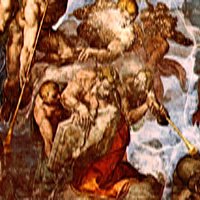
One of the two most influential frescos(1) in the career of Michelangelo—The Last Judgment—depict angelic hosts holding the Book of Good Deeds and the Book of Evil Deeds. Ironically Michelangelo paints the latter, the Book of Evil Deeds, as substantially larger. Sadly, as far as one can tell, this is true in the human condition. Even to Michelangelo in the 1500's it was apparent that the tally of evil human deeds significantly outnumbers those of our good deeds.

Consequently an atheist will appeal to the existence and proliferation of evil in our society as a claim that there is no God. If there were a God and was good He would not allow evil, i.e. that which is contrary to His nature. According to the atheist if there was indeed a God He would intervene in the evil happenings of our world. The cliché is, “Why do bad things happen to good people?” or “How can there be a good God in a world where evil exists?”

Critics and honest people alike have wrestled since and no doubt before the times of Socrates and Aristotle with this issue of a good God and evil co-existing simultaneously. If God is such a good God and a God of love why does he tolerate the genocide of Ruwanda, the Oklahoma City Bombing, 9/11, Abortion, Euthanasia, or Homosexuality. Why is God silent or seemingly passive? Clearly this argument assumes many things and also exhibits an inadequate understanding of theology.

The Problem of Evil (hereon POE) is one of the most important arguments against theism primarily because it is an apparent proof used by an atheist to make the absolute claim that there is no God because evil exits. In fact this argument is apparently the only one that claims to prove that there is no God. There are many arguments against theism, but none of them amounts to a proof or demonstration. There are objections to all the arguments for theism, but even if they are successful, these objections only refute the arguments as invalid or inconclusive—they do not thereby disprove God's existence.

There are also serious practical and personal objections against faith, such as the atrocity of the Inquisition or hypocrisy among believers, or the trouble and surprise to one's ego of having to repent of prized sins. However, none of these prove that God does not exist.

A second reason why POE is important is because it is worldwide. People of all types, Americans or Russians, wonder why bad things happen to good people. POE knows no racial, cultural, or geographical boundary.

In The Problem With Pain(2) C.S. Lewis, a former atheist, formulates the argument in an anthropomorphic or existential version. He suggests that the argument would go something like this:

1. If God is all-good, he wants his creatures to be happy.
2. If he is all-powerful, he can do whatever he wants.
3. But the creatures are not happy. Therefore God lacks either goodness or power or both. Missing either of the two would make Him finite.


"How much evil can a ant do?" Douglas Groothius, from Denver Seminary. "How much evil can a bear do?" Obviously the point is that evil can be experienced in degrees. Groothius went on to say that"Evils is good gone wrong...we are all damaged goods". Evil is sometimes defined as a cosmic force. Although it is real, it is not an entity or a being. Evil has been defined as suffering. In some sense this is true but can we honestly say that all suffering is evil? Some suffering may not be inflicted upon the innocent and some suffering may be inflicted to achieve a greater moral good. Evil is unruly love, unmitigated will. It is a vile relationship, it is nonconformity between our will and God's will. God did not make it—we did.

For clarity, it is possible that evil can be placed in three categories—Moral, Natural, and Physical. “Actually there are many problems relating to evil, for example, the problems about its origin, nature, purpose, and avoidability.”(3) Moral evil possibly relates to the inner condition, the natural to the harmful and physical to negative environmental events. In some sense it is possible that all three have some relationship, this point can be seen as we progress.

There is evidence that would seem to indicate that the psychology of the POE argument is emotive or at least some attempt to understand one’s own suffering or even that of others. For example, Sigmund Freud, popularly known as an atheist and the father of psychoanalysis, is often quoted and has written voluminous works defending his claim. However, Dr. Armandi M. Nicholi Jr., in The Question of God(4), states,

“Freud kept trying to identify our primary sources of pain, perhaps in an effort to understand his own suffering. He [Freud] writes in The Future of an Illusion: ‘There are the elements, which seem to mock at all human control: the earth…water…diseases…the painful riddle of death…’ A few years later, in Civilization and Discontents, he adds another source of pain—namely, other human beings. ‘The suffering which comes from this last source is perhaps more painful to us than any other.’ Freud concludes that ‘life is hard to bear’ and often results in ‘a permanent state of anxious expectation.’”
First, would we want to see laws forbidding pre-marital sex or divorce? The obvious answer by both a Christian and an atheist would be “No!” This is because we have and cherish moral freedom. To say that an evil choice should be eliminated from our abilities to choose would contradict the idea of moral freedom or free will. In fact, there would in fact be no choice but to only do good. We would be bound to commit only acts of goodness. The argument can then turn circular because some would ask why God doesn’t allow them to indulge in natural pleasures.

Second, if we were bound to certain choices there would be no moral freedom. If God forced us to make certain decisions would that be love? No. That would be force. Love is the utmost good for all free creatures—because love is the greatest commandment and we are told to love our neighbors as ourselves (Matthew 22:36-40). This being so it is virtually impossible for love to exist apart from freedom. All else is coercion, manipulation, or bondage.

Therefore, to destroy all propensities for evil then would indeed be an act of evil itself. Norman Geisler suggests that “If evil is to be overcome we should talk of its defeat and not it’s destruction.”(5) A syllogism then could be:

1. Man is the principle source of moral and natural evil.
2. God has given us the Holy Spirit as a source of power to indeed defeat evils.
3. Moral and Natural Evil can be defeated in and by man.


Then the atheist would argue that our God is a mean God and why isn’t there a God who gives us choices? The answer is obvious. If God turned every bullet or every knife to butter when aimed or plunged at innocent lives then God would overstepping free-will. God did not create humans as chess pieces for His pleasure, instead we move towards Him willingly.

In Mere Christianity(6) C.S. Lewis states,
“Because free will, though it makes evil possible, is also the only thing that makes possible any love or goodness or joy worth having. A world of automata—of creatures that worked like machines—would hardly be worth creating.”
Third, when God made humans as free moral agents He made possible the existence of evil. He created the actuality of freedom; we perform the acts of freedom. Geisler says, “God made evil possible and subsequently men make evil actual.”(7)

Man when left to natural unmitigated impulses will use all manner of contrivances to succeed or exact revenge upon others. In fact, most of human suffering can probably be attributed to this source. It is humans, not God, who have fashioned guns, bombs, whips, torture chambers, disease and genocide. Indeed it is primarily by human greed and languor that we have poverty.

Atheism tends to run circular or contradictory in some sense eventually. Nicholi explores this area in his book,

"Freud in his paper “A Religious Experience”, asserts “God allows horrors” to occur and that he will hold God responsible. In a later letter to Dr. James J. Putnam of Boston, Freud says, “I…have no dread at all of the Almighty. If we ever were to meet I should have more reproaches to make to Him than he could to me.” These are indeed common sentiments of bewildered believers experiencing loss; however, Freud is an atheist—with whom is he angry? The question could aptly be posed to most professed atheists, “With whom are you angry?”

“God whispers to us in our pleasures, speaks in our conscience, but shouts in our pains; it is His megaphone to rouse a deaf world.” ~C.S. Lewis


Sources Cited in Order of Appearance:

1. For actual online representations of these frescos go to: http://www.christusrex.org/www1/sistine/40-Resurrect.html
2. Lewis, Clives Staples. The Problem of Pain. Harper Collins Edition 2001
3. Geisler, N. L. (1999). Baker encyclopedia of Christian apologetics. Baker reference library (219). Grand Rapids, Mich.: Baker Books.
4. Nicholi Armandi M. The Question of God. Free Press © 2002 by Armand Nicholi
5. Lewis, Clives Staples. Mere Christianity. Harper Collins Edition 2001
6. Geisler, Norman L., and Ronald M. Brooks. When Skeptics Ask. Wheaton, Ill.: Victor Books, 1990.
7. Ibid.

Are You Really An Atheist?


It has been estimated that only about 5%, a small fraction, of the world’s population question or denies the existence of God. Historically, the belief in supernatural beings is a universal ingredient in all human cultures, whether they are highly technical like the United States or primitive like the Australian aborigines. For most, the issue isn’t whether or not God exists but what is that God like? Or, are there more than one?

Atheism is probably an ancient belief, but as a philosophical movement it is relatively new. Polytheism dominated much of ancient Greek thought and theism dominated the medieval Christian view; however, atheism has had emerged modern times. Early philosophers such as Socrates and Aristotle did not deny the existence of an eternal being, they simply questioned and were at time unsure of what that God is like or how He interacted with the human world. Late philosophers like David Hume or Immanuel Kant laid much groundwork for contemporary agnostics and atheists alike. In fact, most atheistic arguments stem from these two men’s writings.

An atheist is a person who denies the existence of a God. This position, however, is indefensible and is frankly arrogant. Virtually, the only way anyone can prove no God exists is to be a god themselves. A person would have to be omnipresent and omniscient to have enough information to know that no deity exists. Ironically, these are the very attributes that a God indeed would posses. Therefore, it is quite plausible that no finite being can prove that God does not exist because God may very well exist beyond one’s comprehension or experience.

Many alleged atheists are actually agnostics, ignostics, or antitheists. Some atheists do not concern themselves with proofs or absolute truths therefore the idea of God is unknowable or doubted; this view is basic agnosticism. Gnosticism is actually a more tenable position and is less arrogant for the finite. Ignostics feel that the question about whether or not God exists is meaningless and thus do not care to discuss it at length. Antitheists are just generally against God or divine things in general, thus they do not necessarily have to be an atheist. It is easy for antitheists to posit emotive arguments based upon bitter pasts. Atheists typically assert that they either “know” God does not exist (Strong/Hard Atheism) or that they simply believe that God does not exist (Weak/Soft Atheism). The former is the most arrogant whereas the latter is simply blind faith, which ironically is accused of believers.

Atheists attempt to assert that the believer has the burden of proof, rather than an atheist bearing the burden of proving God does not exist. When Christians state that God exists and offer evidences to support this claim, they have moved the debate into a new arena—an arena in which atheists must prove that the Christian evidences are erroneous. The theistic argument is historically the principle belief and general arguments have been asserted in time affirming this belief. Therefore, since atheism is relatively new it bears the burden of proving its assertion. Sadly, the person who claims that he does not have to defend his position normally does so because he has no evidence to support his view.

When an atheist does argue they usually have a myriad of arguments. These arguments are varied and more nuanced as you observe them closer; however, atheistic arguments are typically Non-design in the Universe, Argument from Evolution, Theological Non-Cognitivism, Incoherency Arguments such as The Problem of Evil and The Argument from Non-Belief, and more.

Adversus Trinitas

"...unless you believe that I am he you will die in your sins." (John 8:24 ESV)