Showing posts with label Eschatology. Show all posts

9.05.2012

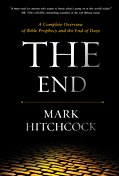
Book Review: The End by Mark Hitchcock


Mark Hitchock is a husband, father, pastor, attorney, and graduate of Dallas Theological Seminary. In his recent work The End Mark examines almost every question about the end of times from a futurist premillennial perspective. This work is a comprehensive and essential tool for any student of Bible prophecy. 

In over 500 pages, 39 chapters, an appendix section along with notes, index and Scripture index Hitchcock lays out his view along with interaction with other views. From my perspective as a historical premillennialist Hitchcock's work offers alternative views in many places with fairness and grace. The book is easy to navigate and contains illustrations and summaries adequately throughout the text. I also found his research on the topics of the binding of Satan, the Millennium and the New Heavens and Earth to be especially insightful and persuasive.

In chapter 34 while discussing the Millennium he suggests, "Jesus wins. All Christians can agree on a few things, and this is one of them. It's one of those nonnegotiables. In the end, Jesus will reign over the whole world as King." (Hitchock, pg. 399) The book also discusses the question, "Are We in the Millennium Now?" Hitchcock notes, "Many premillennialists agree with amillennialists and postmillenialits that Jesus is ruling over the church during this present age and that He reigns in the hearts of his people. He was, is, and always will be the Soverign of the Universe." (Hitchcock, pg. 404) 

From a premillennial perspective the millennium involves a physical reign of Christ on the earth. During this time certain prophecies could be fulfilled. The Old Testament prophet Isaiah foretells of a removal of a curse on the earth. His prophecy includes an elimination of sickness neither of which has occurred historically (Isaiah 11:6-9; 33:24). He speaks of harmony in the animal kingdom which has apparently not occurred (Isaiah 11:6-9; 65:25).

In chapter 35 while discussing "Why The Millennium?" he notes "The Millennium will bring creation full circle as God brings to pass with the second Adam, Jesus Christ, what the first Adam failed to do (1 Corinthians 15:21-22." (Hitchcock, pg. 420) In the Millennium God will change or renew a New Heaven and New Earth (Isaiah 65:17; 2 Peter 3:13; Revelations 21:1-3). One that reverses the curse on creation (Genesis 3:14-19) and establishes the original purpose of God for the earth. Even the body of the resurrected believer is changed or renewed (1 Corinthians 15; Philippians 3:20; Romans 8:23).

For more information on this book, the author and where to pick up your copy of this book today, please click on the link below:

8.27.2009

"It is not for you to know the times or the dates..." (Acts 1:7)


Acts 1:7 NIV
He said to them: "It is not for you to know the times or dates the Father has set by his own authority.

Kenneth O. Gangel has noted that the answer Christ is giving here has not been “heeded very well for almost two thousand years:”1 Despite the warning of Christ some have persisted in trying, at a feverish rate, to discern the Second Coming of Christ to set up a millennial kingdom. Besides this, and realizing there is a kingdom of Heaven, then it is hard to imagine a notion of “kingdom” pertaining to a particular location or within a fixed boundary.

In 1st Century times, no doubt, “kingdom” referred to something akin to a Roman imperial system. One where its boundaries fixed, for the time, and protected to establish peace, e.g. Pax Romana. Christ’s very threat to this notion was what ultimately caused Roman intervention and eventual crucifixion of the Messiah.

The Disciple have more reason to be concerned since the Old Testament Scriptures associates the coming of the Spirit with the coming of a kingdom (See Isaiah 32;15-20; Ezekiel 39:28-29; Joel 2:28:31). This belief system is what prompted them, along with their desire to be a part of the kingdom themselves.

Christ’s reply to the disciples was different than the reply to the mother of Zebedee’s sons. In vss. 7-9 we find His reply:

Acts 1:7-9 NIV, “He said to them: "It is not for you to know the times or dates the Father has set by his own authority. (8) But you will receive power when the Holy Spirit comes on you; and you will be my witnesses in Jerusalem, and in all Judea and Samaria, and to the ends of the earth." (9) After he said this, he was taken up before their very eyes, and a cloud hid him from their sight.

Jesus instructs them that they do not need to know the specifics times or dates because the Father has set them in His sovereignty. The Holy Spirit, or helper, will come upon them and they will be witnesses “to the ends of the earth”. The kingdom of God then is not a geographical location, as much as Eden is a place pinpointed in Iraqi topography. The Kingdom is the authoritative power and empowering by Immanuel—God with us.

2.26.2009

One Who Sits Upon The Throne


Oneness theologians and teachers often use the fact that there is only one throne, in the heavenly throne room, and that both the Father and the Son are found to be seated upon that one throne. This is a supporting point of Oneness theology since it describes the unified view of the throne occupant.

John Walvoord, former president of Dallas Theological Seminary states: “It is significant that God is not given an anthropomorphic figure in this revelation and does not appear as a man. A part from the fact that He is said to sit on the throne, no description is given except the colors which impressed John.” (The Revelation of Jesus Christ, pg. 105)

Anthropomorphic terms (God's arm, hand, eye, ear, mouth, etc) have symbolic value and are used to ascribe to God some human shape or form. God, who is Spirit (John 4:24), does not have a literal hand or nostril. These are used to help us understand God. As a Trinitarian Walvoord does not need us to imagine Jesus Christ seated upon the throne because that would mean that only one divine person sits upon the Throne. That would go against the idea that there is no "anthropomorphic figure" in this discussion of the One who sits upon the throne.

In Revelation 4:2 the One who sits upon the Throne is Jesus. Here John has reproduced the visions of Isaiah 6 and 1 Kings 22:19. In Isaiah 6 and 1 Kings 22 the Lord is described as "his train filled the temple" and sitting on "his throne" (KJV). The pronoun "his" refers to one person seated upon one throne. From Isaiah to John it is a He who sits upon the throne.

Jesus actually makes it clear in His revelation to John, "The one who conquers, I will grant him to sit with me on my throne, as I also conquered and sat down with my Father on his throne." (Revelation 3:21 ESV) Earlier in the Gospel of John Jesus stated, "He that hath seen me hath seen the Father"; "I and my father are one." (John 14:9; 10:30). Jesus makes it clear that He is the visible expression of the invisible and immaterial Father. This does not mean "Jesus is the Father" since any Biblical discussion retains distinctions without separateness. Consider what the author of Hebrews records:
Hebrews 1:1-3
God, who at sundry times and in divers manners spake in time past unto the fathers by the prophets, 2 Hath in these last days spoken unto us by his Son, whom he hath appointed heir of all things, by whom also he made the worlds; 3 Who being the brightness of his glory, and the express image of his person, and upholding all things by the word of his power, when he had by himself purged our sins, sat down on the right hand of the Majesty on high; KJV

Hebrews 1:1-3
Log ago God spoke to our ancestors in many and various ways by the prophets, 2 but in these last days he has spoken to us by a Son, whom he appointed heir of all things, through whom he also created the worlds. 3 He is the reflection of God's glory and the exact imprint of God's very being, and he sustains all things by his powerful word. When he had made purification for sins, he sat down at the right hand of the Majesty on high NRSV
The person of Christ was from the same singular transcendant deity of our time-space-matter continuum (Genesis 1:1). In the Incarnation humanity was united inseparably with this deity. Jesus was the only begotten of the Father, meaning He was unique (1 John 4:9). He was unique in that His birth came from the womb of a virgin and yet every person has entered our existence from the womb of a mother. As did Christ. He is also unique in that there has never been such a birth. He is God's image creature, the self-revelation of the Father to humanity. He is the lamb and the victor in God's creative story. He is the true singular divine existence working existentially in time and matter.
1 John 4:9 By this the love of God is revealed in us: that God sent his one and only Son into the world in order that we may live through him. LEB

1 John 4:9 In this the love of God was manifested toward us, that God has sent His only begotten Son into the world, that we might live through Him. NKJV

The two translations above have "one and only" and "only begotten" Son. To say that Jesus was sent should be understood as an expression referring to the mission and authority of the Son. His sending into the world, from the womb of Mary (Galatians 4:4), was no mere "coming into the world". Here John uses Jewish expression to legitimize and authorize to the Son's mission as one sent from God. The Spirit of the Lord was upon the Son who is sent to "proclaim liberty to the captives and recovering of sight to the blind" (Luke 4:18 ESV); is sent to "preach the kingdom of God" (Luke 4:43 ESV) and to be the Savior of the world. (1 John 4:14).

This sending should be understood within the temporal perspective that Jesus Christ experienced. It should at least be the starting point. The “sending” or “coming” is in terms of a commissioning and sending of the only begotten Son of God. A descent from a non-earthly location in the sense of an angel or emanation was probably not on the mind of John here. As the Son of God Jesus was both humanity and deity inseparably and perfectly united. Although God continues to exist beyond the Incarnation God was manifest in the flesh (1 Timothy 3:16). To speak of God in Christ is speak of the person, character and sum total of Deity which was in bodily form (Colossians 2:9).

John recorded that the heavenly throne room had one throne and yet from it come the Father and the Lamb, or Christ. Lighting, thunder, and voices even come from the throne (Revelation 4:5). Yet there is only "one" who sits upon the "one" throne (Revelation 4:2). Only one is described as doing the action of sitting. This is not a logical contradiction but indicates the singular God and His manner of revelation, distinction, and power. Jesus is not a copy but the exact visible representation of the invisible, indescribable God.

Adversus Trinitas

"...unless you believe that I am he you will die in your sins." (John 8:24 ESV)