Showing posts with label Angel of the LORD. Show all posts

10.02.2011

Angel of the LORD: Part Eight

The Offer of Manoah by Rembrandt


Judges 13: Angel of the LORD Announces the Birth of Samson
2 There was a certain man of Zorah, of the tribe of the Danites, whose name was Manoah. And his wife was barren and had no children. 3 And the angel of the Lord appeared to the woman and said to her, “Behold, you are barren and have not borne children, but you shall conceive and bear a son. ESV
This is an extensive and drawn out account of the angel of the LORD interacting with Manoah and his wife who is consequently left unnamed. As the painting by Rembrandt reveals there are many ideas about this passage and especially concerning angels. Judges 13 comprises about 25 verses in typical translations so I will not cite the entire portion here. I do recommend it be read through one or two times completely to get a grasp of the story. It is probably one of the most intriguing portions of the Old Testament. Victor P. Hamilton noted this about our text:
“Among all the places in Scripture where Yahweh’s angel appears to a visionary, Judg. 13:6 is the only one that suggests that the theophanic recipient perceived something significantly different than a normal human form...” (1)
In this chapter is recorded the miraculous birth of Samson. Manoah and his wife were soon to be the parents of a judge of Israel--Samson. The Angel of the LORD appears to them both. Manoah’s wife first sees him and describes him as a “man” of God (13:6). Such a reference is often used in prophetic contexts (See Josh. 14:6). This might be a result of her initially understanding him to be a human emissary or envoy from Yahweh. By the time she reaches Manoah to explain what had happened she concluded that there was something different about his appearance. She says, “A man of God came to me, and his appearance was like the appearance of the angel of God, very awesome. I did not ask him where he was from, and he did not tell me his name,” (Judges 13:6, ESV)

Although Manoah’s wife is never named she is probably the stronger and more interesting character in this narrative. Manoah rightly seems skeptical and prays for God to allow this “man of God” to return yet again (13:8). God grants his request and the “man of God” appears once more. This time only to confirm what Manoah’s wife had already said. Manoah offers to “prepare a young goat” for the “angel” which seems to turn into Manoah asking the “angel” for his name. Manoah creates a sacrifice for worship to the “Lord...the one who works wonders” (13:19, ESV) While the flames on the altar consume the “young goat” and “grain offering” the “angel of the Lord” went up into the flame and apparently disappears (13:20). After this Manoah and “his wife” fell on their faces to the ground. A few verses later Manoah realizes that the “visitor had been the LORD”s messenger” (13:21, NET) and his wife concludes “We shall surely die, for we have seen God.” (13:22)

Initial readings of this Old Testament passage do not seem to produce a Trinitarian understanding. As noted in previous posts Yahweh is always referred to and understood as personal and one divine person. The Old Testament must then be thought of as ambiguous for Trinitarians. By this I mean there is no recognition or indication that Yahweh is or even could be more than one person.

Trinitarians will use the interplay of words here to suggest that Jesus is actually speaking to Manoah in some pre-human form. Elohim can be used for angels, judges and God. It is used in 13:22. If Elohim means the Trinity when God speaks to Moses or Manoah all three persons should be speaking at one time. Yoel Natan suggests that in the phrase ‘angel of the LORD” the term “angel” refers to the second divine person called Son and “LORD” refers to the first divine person called Father.(2) In other words, the title “angel of the LORD” is actually a reference to two divine persons.

Such an anachronism is absurd. Natan reads later Trinitarian ideas back into the Scripture. The idea of two divine person quickly vanishes when the “angel of the LORD” actually speaks as one person. If any of this is true then Manoah should have communicated with either all three divine persons or at the least two of them. The angel of the LORD appeared to Manoah and his wife. In Natan’s understanding this should be the Father and the Son. That amounts to two divine persons that are both conscious and aware. Manoah even tells his wife that they had seen Elohim (13:22).

The use of Elohim has likely nothing to do with a Trinity. If so, then the entire trio of divine persons or at least two of them could be seen as lesser deity. The NET translators make this interesting note here:
“Some take the Hebrew term אֱלֹהִים (’elohim) as the divine name (“God”) here, but this seems unlikely since v. 21 informs us that Manoah realized this was the LORD’s messenger, not God himself. Of course, he may be exaggerating for the sake of emphasis. Another option, the one followed in the translation, understands Manoah to be referring to a lesser deity. The term אֱלֹהִים (’elohim) is sometimes used of an individual deity other than the LORD (see BDB 43 s.v. 2.a). One cannot assume that Manoah was a theologically sophisticated monotheist.”(2)
The use of elohim here then may not even be in reference to Yahweh but an angel. Manoah's wife goes on to assure him that they will not die. She gives several reasons why that accord with Israelite laws of evidence. D.I. Block notes:
Theologically his statement was correct, for no one can see God and live, but logically he is incorrect. His wife coolly and rationally allays his fears with three observations. First, Yahweh has accepted the whole burnt offering, that is, the tribute/gift they have presented to him. The fire is the sign. Second, Yahweh has put on a visual display of all these things for them. “All these” would refer to everything they had witnessed including the twofold appearance of the messenger and the fire that consumed the offering and took the messenger to heaven. Third, Yahweh has communicated orally284 with them. “This” (lit., “like this”) refers to “the oracle concerning the boy,” inclusive of the promise of a son, the instructions for Manoah’s wife, and the declared mission of the son (vv. 3–5, 13–14)...With impeccable logic and according to the Israelite laws of evidence, Manoah’s wife presents incontestable proof that they will not die. God has spoken cultically, visually, and orally, declaring to them the future, which obviously depends upon their continued living.(4)
If a Trinity of divine persons was revealed it was not perceptible to Manoah nor his wife. What did they see? How did they speak of what they saw? The Scriptures are actually clear and unambiguous. Prior we saw that Manoah even asked for the name of the messenger but it was not given (13:17). The ways of God may have been a riddle here on purpose. It is interesting to note that Manoah understood only after the messenger left (13:21).

Instead of a Trinity Manoah and his wife possibly saw and talked with an angelic messenger or a single manifestation of God. The more interesting fact though seems to be that the angel of the LORD speaks to them using singular personal pronouns such as “I” (13:11) and “me” (13:16). Manoah’s wife even describes what she saw as “a man of God” and describes this character as a “him” (13:6). Obviously the angel nor God are perceived as being multiple persons. Such a notion was not impressed upon them by their experience with Yahweh.


JNA


NOTES:


1) Hamilton, Victor P. (2004) Handbook on the Historical Books (150). Grand Rapids, MI: Baker Academic.

2) Natan, Yoel. (2003) The Jewish Trinity Sourcebook : Trinitarian Readings From The Old Testament. Copyright (c) 2003 by Yoel Natan. All Rights Reserved.

3) Biblical Studies Press. (2006; 2006). The NET Bible First Edition; Biblical Studies Press.

4) Block, D. I. (2001). Vol. 6: Judges, Ruth (electronic ed.). Logos Library System; The New American Commentary (415–416). Nashville: Broadman & Holman Publishers.


9.17.2011

Angel of the LORD by John Miller


Below is an excerpt from Is God A Trinity? by Princeton theologian John Miller who was born in Princeton, N.J., April 6, 1819. Miller was the son of the Rev. Samuel and Sarah (Sergeant) Miller. He was graduated at the College of New Jersey, A.B., 1836, A.M., 1839, and at the Princeton Theological seminary in 1842. He was a military veteran and pastor for a few Presbyterian congregations from 1842-1871. Most anyone who denied the Trinity in his times was treated harshly and liberally labelled Unitarians (e.g. William Richards). Because of his views Miller was dismissed from the Presbytery of Baltimore. He went on to start churches in Plainsboro, Princeton and New Brunswick. He died in Princeton, N.J., April 14, 1895. I may not agree with every word he writes or doctrine he believed but in the spirit of my series I've been doing on the Angel of the LORD I thought I would share.

____________
§ 12. The Angel of Jehovah.
We think that the angel of Jehovah was a common angel, sent on the errands of the Most High. We believe so for one very strong reason, that the Apostle Paul, speaking of the incarnation of Christ, speaks in this wise, " He does not sure enough take on angels, but he does take on the seed of Abraham" (Heb. ii: 16). That scatters difficulty at a breath. He seemed to be actually an angel. That was his appearance. He seemed to be actually a man. But he makes a vast discrimination. He did not sure enough take on an angel; or, to make it more true to the history, any of them (plural), for he appeared in many,—but he did take on the seed of Abraham. And we are to understand that he employed angels, and that they personated him often; but that he became incarnate in the Son; and that he had, therefore, that sure-enough union, which a peculiar Greek word (depou) denies in the other case.

If anyone asks, Is that your only passage? I say, No. Look at the last chapter of Revelation. The angel, there, rejects the worship of the Apostle (v. 9), and, yet, the next moment personates the Redeemer. " See thou do it not," he says in the ninth verse, and in the twelfth, " Behold I come quickly." This is the manner of angels. They did so at Sodom (Gen. xviii: 2, 13). They did so with Hagar(Gen. xvi: 7, 13), and Lot (Gen. xix: 1,21); and one did so under the oak at Ophrah (Jud. vi: II, 16,20). Our persuasion is, that the " man " who was singled out as Jehovah, was a common angel. And if anyone asks, How dare he personate God, I answer, How dare the prophets? (Œhler, Theol.O. T., § 60); or, as a most satisfying instance, how dare Moses? for most undoubtedly he says, " I will give you the rain of your land in his due season, the first rain and the latter rain" (Deut. xi: 14); and most undoubtedly he declares, " I will send grass in thy fields for thy cattle, that thou mayest eat and be full" (v 15).

The fact is, it makes the slenderest sort of difference whether it was an angel or not. If it was an angel, God appeared in him, and spoke by him, and wrought miracles by his mouth; and, moreover, gave him a human form, and wrought that miracle in the very act of sending him. If it was not an angel, still it was a human form; and it seems to make not the smallest difference. If it were the Son of God, it would not be his body; nobody pretends that. And if it were a body, God, personally in it, and representing himself by it, would be so like stretching out his arm (Deut. v: 15), as to preclude every possibility of Trinitarian demonstration.

So the matter stands, therefore. We believe that they were angels: but it is unimportant. We believe that they were angels, because the Apostle speaks so, and a distinction is drawn between the ministry of angels and the ministry of Christ (Acts vii: 53; Gal. iii: 19). We believe that they were angels, because Moses deprecated such a convoy, and pled so hard for the presence of God (Ex. xxxiii: 2, 12-15); which surely would be nothing higher than the presence of Christ. We believe that they were angels, out of deference to the straight-forwardness of speech. But grant that they were anything you please. They cannot be built into a hypostatic argumentation; for the rhetoric must remain indifferent. To send an angel, or to send an apparition, or to send a dream, or to send the Second Person in the Trinity, would be all covered under the very same miracle, and there could be no possible distinction that could breed a reasoning.

Miller, John IS GOD A TRINITY? Oak Grove. Kindle Edition.

8.19.2011

Angel of the LORD: Part Seven


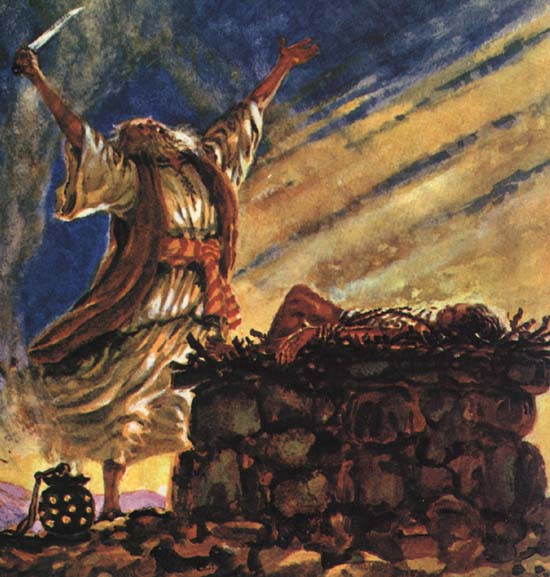
Genesis 22:8-18: The Sacrifice of Isaac
ESV | ‎Genesis 22:8 Abraham said, “God will provide for himself the lamb for a burnt offering, my son.” So they went both of them together.  ‎9 When they came to the place of which God had told him, Abraham built the altar there and laid the wood in order and bound Isaac his son and laid him on the altar, on top of the wood.  ‎10 Then Abraham reached out his hand and took the knife to slaughter his son.  ‎11 But the angel of the LORD called to him from heaven and said, “Abraham, Abraham!” And he said, “Here am I.”  ‎12 He said, “Do not lay your hand on the boy or do anything to him, for now I know that you fear God, seeing you have not withheld your son, your only son, from me.”  ‎13 And Abraham lifted up his eyes and looked, and behold, behind him was a ram, caught in a thicket by his horns. And Abraham went and took the ram and offered it up as a burnt offering instead of his son.  ‎14 So Abraham called the name of that place, “The LORD will provide”; as it is said to this day, “On the mount of the LORD it shall be provided.”  ‎15 And the angel of the LORD called to Abraham a second time from heaven  ‎16 and said, “By myself I have sworn, declares the LORD, because you have done this and have not withheld your son, your only son,  ‎17 I will surely bless you, and I will surely multiply your offspring as the stars of heaven and as the sand that is on the seashore. And your offspring shall possess the gate of his enemies,  ‎18 and in your offspring shall all the nations of the earth be blessed, because you have obeyed my voice.” 
In his Commentary on Genesis Martin Luther noted, "The angels likewise, appear in human form, though it is certain that they are only spirits; spirits we cannot recognize when they present themselves as such, but likenesses we do recognize...This is the simplest way of treating such passages, for the nature of God we cannot define; what he is not we can well define—he is not a voice, a dove, water, bread, wine. And yet in these visible forms he presents himself to us and deals with us."(1) In many of the passages which include the angel of the LORD it is conspicuous that God Himself is acting and working in our world. To suggest that God is more than one person as a result is to make judgments about the nature of God that are not warranted by Scripture.

In the passages we have considered so far it was obvious in most cases that Yahweh and Yahweh's Messenger are one and the same divine person. In Genesis 16:11 the angel of the LORD begins speaking to Hagar after leaving the tent of Abraham. In verse 13 she calls this angel LORD or Yahweh. Commenting on the appearance of the angel of the LORD to Hagar in Genesis 16:13 Reyburn and Fry note that the LORD and the angel of the LORD are the same. They suggest that "the Lord replaces the expression the angel of the Lord, giving the understanding that the two expressions mean the same in this passage, that is, an appearance or manifestation of God to a person. As von Rad says, “The one who speaks, now Yahweh, now the messenger …, is obviously one and the same person. The angel of the Lord is therefore a form in which Yahweh appears. He is God himself in human form.”(2) 

In Genesis 22:8 the ESV, NKJV, NASB and NET have"God will provide for himself...". The NAB, NRSV have "God himself will provide..." and the AV "God will provide himself...".  The emphasis here is that the same personal God of Abraham will, alone, provide the lamb. Without help God will supply the sacrifice. Everett Fox translates "...God will see-for-himself..."(3) God needs no consort or additional persons in order to save. He is the source of provision and only God can save. In Romans 8:31-32 Paul uses irony to explain that if God is for us who can be against us? In verse 32 God, who did not spare his own Son, gave him up for us all. We may can find some similarities here with the offering of Isaac. Yet we know that the Son is God Himself uniquely present (Hebrews 1:1-3). Without the shedding of blood there is no remission of sin (Hebrews 9:22) but if the Son is only body and flesh then there could be no atonement for our sins. 

Matthew records that Jesus is "Emmanuel...God with us." (Matthew 1:23) but before God came in flesh (John 1:14) it was foretold that Yahweh would be our redeemer and savior (Ps. 130:7-8; Deut. 32:43). Exodus 15:2 records, "The LORD is my strength and my song, and he has become my salvation; this is my God, and I will praise him, my father’s God, and I will exalt him." (ESV) Here the LORD or Yahweh is our salvation or yeshua and is David's God and Lord (See also Ps. 42:6, 12; 43:5; 62:2; 68:20; 89:27 where the title "savior" is given to Yahweh). 

In verse 11 Abraham is poised with knife in hand when the angel of the LORD calls out to him. Starting in verse 16 the angel of the LORD actually speaks and declares the words of Yahweh in first person (22:16-18). As noted just prior the angel of the LORD is actually the LORD or Yahweh Himself. Use of "angel of the LORD" is not to distinguish one divine person from another but a reverential way of referring to the same divine person--Yahweh. 

In Isaiah 44:6 we have another interesting interplay of words. We read, "Thus says the LORD, the King of Israel and his Redeemer, the LORD of hosts: “I am the first and I am the last; besides me there is no god." (ESV) Notice the slight difference of rendering here by the NET: "This is what the LORD, Israel’s king, says, their protector, the LORD who commands armies: “I am the first and I am the last, there is no God but me." Trinitarians often suggest that the phrase "the King of Israel and his Redeemer, the LORD of hosts" makes a distinction between two divine persons of the Trinity. In reality, God is presented with a double title and not double persons. Such a view allows the Scriptures to be interpreted by themselves without having to insert later philosophical or theological ideas about God who is actually a council of divine persons. J.D.W. Watts seems to support such an idea also. He noted, "The Herald presents God by a double title. He is King of Israel....He is revealed in this act as Israel’s redeemer, Yahweh of Hosts."(4) Verse seven through eight makes things even more clear concerning how many persons are being spoken of in this verse. Yahweh says:
"Who is like me? Let him make his claim! Let him announce it and explain it to me – since I established an ancient people – let them announce future events! ‎8 Don’t panic! Don’t be afraid! Did I not tell you beforehand and decree it? You are my witnesses! Is there any God but me? There is no other sheltering rock; I know of none." (44:7-8 ESV) 
If more than one divine person is being referenced then the memo must have gotten lost. Instead Yahweh speaks with singular personal pronouns, "Who is like me?....Is there any God but me?" Here Yahweh says that his hearers are "my witnesses" meaning He has testified to them concerning His Oneness. He also says "I know of none". The verb "know" here is in the perfect tense (See also Ps. 140:13, Job 42:2). It means that God does not possess information(5) about anyone else nor can He find out about anyone else. Yahweh is our rock and our salvation and there is no one beside Him. Yahweh is without distinction in His eternal nature and does not recognize or perceive any other God beside Him. Any future NT revelations are not intended to contradict this either. The singularity referenced here is "first and last" meaning it applies to all times. Therefore, no other divine person who is called God could exist. NT revelation will further show that Jesus is God and that He is the True God manifest in flesh  (e.g. John 1:1, Titus 2:13, Romans 9:5, 1 Peter 1:1, 1 John 5:20, 1 Tim. 3:16). Jesus is the express image of Yahweh's being (Heb. 1:3) and we shall behold His face on that Day.

NOTES:

1) Luther, Martin. Commentary on Genesis. Translated by John Nicholas Lenker, D.D. Vol. II The Luther Press: Minneapolis, Minn. USA: 1910

2) Reyburn, W. D., & Fry, E. M. (1997). A handbook on Genesis. UBS handbook series (355). New York: United Bible Societies.

3) Fox, E. (1995). Vol. 1: The five books of Moses : Genesis, Exodus, Leviticus, Numbers, Deuteronomy ; a new translation with introductions, commentary, and notes. The Schocken Bible (Ge 22:8). New York: Schocken Books.

4) Watts, J. D. W. (2002). Vol. 25: Word Biblical Commentary : Isaiah 34-66. Word Biblical Commentary (145). Dallas: Word, Incorporated.

5) See Swanson, J. (1997). Dictionary of Biblical Languages with Semantic Domains : Hebrew (Old Testament) (electronic ed.). Oak Harbor: Logos Research Systems, Inc.

8.13.2011

Angel of the LORD: Part Six


Genesis 19:24 and Double Use of Yahweh: 
Genesis 19:23-26: The sun had risen on the earth when Lot came to Zoar. 24 Then the LORD rained on Sodom and Gomorrah sulfur and fire from the LORD out of heaven. 25 And he overthrew those cities, and all the valley, and all the inhabitants of the cities, and what grew on the ground. 26 But Lot’s wife, behind him, looked back, and she became a pillar of salt. ESV
In his book Trinity: Evidence and Issues, under section title "Two Yahwehs" Dr. Robert Morey suggests that the "only" natural interpretation "possible" of Genesis 19:24 is that Yahweh in human form rained down fire from the Yahweh in heaven. Morey suggests, "No other interpretation fits the context and grammar of the Hebrew text."(1) Trinitarian apologist Dr. James White has also appealed to this very passage suggesting it too reveals Yahweh as consisting of multiple persons.(2)  Such Trinitarians have in mind here as well that each Yahweh is a separate divine person with their own mind and center of consciousness. Therefore, the divine person on earth is raining down fire from the other divine person in heaven.

One is forced to ask why one divine person would even need to rain down fire from heaven from another divine person? Is this what Moses was intending to impress upon us as the author of Genesis? Sadly, this may just be another case of Trinitarians trying to find the Trinity under every verse. Many Trinitarian commentaries are silent on this verse concerning the Trinity. However, if the "only" interpretation is the one of Morey or White then we should see some recognition of this from Abraham or Lot in the Genesis narrative. A conception of Yahweh being more than one person though is nowhere found in the Scriptures and especially in the Old Testament. 

In Genesis 18 Abraham visited with Yahweh and possibly two angels. He later intercedes with God on the behalf of the people of Sodom and Gomorrah. Genesis 18:22 suggests that the angels leave God and Abraham and continue "toward Sodom" (ESV) Now God's judgement upon human wickedness had come. The two angels convince Lot and his family to move from the path of God's judgment. Before we look closer at verse 24 let's look at some verses prior.
12 Then the men said to Lot, “Have you anyone else here? Sons-in-law, sons, daughters, or anyone you have in the city, bring them out of the place. 13 For we are about to destroy this place, because the outcry against its people has become great before the LORD, and the LORD has sent us to destroy it.” 14 So Lot went out and said to his sons-in-law, who were to marry his daughters, “Up! Get out of this place, for the LORD is about to destroy the city.”...17 And as they brought them out, one said, “Escape for your life. Do not look back or stop anywhere in the valley. Escape to the hills, lest you be swept away.” 18 And Lot said to them, “Oh, no, my lords. 19 Behold, your servant has found favor in your sight, and you have shown me great kindness in saving my life. But I cannot escape to the hills, lest the disaster overtake me and I die. 20 Behold, this city is near enough to flee to, and it is a little one. Let me escape there—is it not a little one?—and my life will be saved!” 21 He said to him, “Behold, I grant you this favor also, that I will not overthrow the city of which you have spoken. 22 Escape there quickly, for I can do nothing till you arrive there.” Therefore the name of the city was called Zoar. ESV
The word "men" is referencing angels (vs.12). They also tell Lot that "we are about to destroy this place"(vs. 13). Why? Because the the outcry had become great before Yahweh and it is Yahweh Himself who sends the angels (vs. 13). Lot immediately tells his family that Yahweh is about to destroy the city (vs. 14). He recognizes that God is involved in what these angels had to say. Then while recognizing something special about them Lot calls the angels "my lords" (ESV, NRSV, NASB, NKJV); "my lord" (NAB, KJV, Tanakh); "No, please, Lord" (NET). The Hebrew word for "Lord" here is adonai and has several uses. The word form in this verse is an emphatic plural. This plural can also be taken to be singular or plural but should more likely be translated in the singular in this case. Lot actually continues in verse 19 with "your servant has found favor in your sight," where both pronouns ("your") are in the singular form. Nothing about this is an indicator for the Trinity. The angel grants Lot's request and he is allowed to escape to Bela a city thereafter called Zoar. 

Once Lot and his family are removed we read verse 24. The narrative is reaching a climax wherein the impending judgement the angels had warned Lot and his family about is now overhead. Yahweh rains down "sulfur and fire" (ESV) is the conclusion. Here we possibly have two words that form a hendiadys(3) which is used to increase the effect of what is said. By doing it this way two words are used to refer to one thing for added emphasis. The meaning could be something like "burning sulfur".(4) Either way it has no bearing upon the nature of God here. Now let's compare 19:24 in several major translations to see how they treat the double use of Yahweh in this verse. Notice the differences carefully.

NAB | at the same time the LORD rained down sulphurous fire upon Sodom and Gomorrah (from the LORD out of heaven). 
‎‎NRSV | Then the LORD rained on Sodom and Gomorrah sulfur and fire from the LORD out of heaven; 
‎‎ESV | ‎Then the LORD rained on Sodom and Gomorrah sulfur and fire from the LORD out of heaven. 
‎‎NASB95 | ‎Then the LORD rained on Sodom and Gomorrah brimstone and fire from the LORD out of heaven, 
‎‎NKJV | ‎Then the LORD rained brimstone and fire on Sodom and Gomorrah, from the LORD out of the heavens. 
‎‎NET | ‎Then the LORD rained down sulfur and fire on Sodom and Gomorrah. It was sent down from the sky by the LORD. 
NIV11| Then the LORD rained down burning sulfur on Sodom and Gomorrah—from the LORD out of the heavens.

Did God allow Moses to record this verse in such a way to represent two separate or different divine persons? They must be different because if they are the "same" then one person is identical to the other person. As noted above some interpret Genesis 19:24 to refer to two divine persons each called LORD. If this is true then this also means one LORD (first divine person) on earth orchestrated with, in some way, the other LORD (second divine person) in heaven to rain down fire. 

All translations involve interpretation but the point seems clear to this reader. The NAB places the second occurrence of Yahweh in a parenthesis to suggest its use for further emphasis. The NRSV, ESV, NASB are nearly identical. The NKJV places a comma after the word "Gommorah" and the NET makes another sentence while supplying the words “It was sent down” for stylistic reasons. They also suggest that "The text explicitly states that the sulfur and fire that fell on Sodom and Gomorrah was sent down from the sky by the LORD. What exactly this was, and how it happened, can only be left to intelligent speculation..."(5) The NIV is also careful to distinguish the second use with "—from the LORD out of the heavens." By way of the second use of Yahweh it appears the Hebrew writer has given us an example of a restatement. The Reformation scholar John Calvin also suggested this view.(6) Everett Fox's translation here seems to capture this as well. Notice, "But YHWH rained down brimstone and fire upon Sedom and Amora, coming from YHWH, from the heavens,"(7)

Whether this burning sulfur was a natural phenomena is not important when one considers the source. This was the divine judgement of Yahweh, the Creator of heaven and earth. This is the very thing the angels had warned Lot about. The source of the destruction being emphasized is from the LORD/Yahweh above. The Hebrew writer may have restated and used Yahweh twice to emphasize this very thing. Jeremiah 23:24 suggests that no man can hide himself from Yahweh and that He fills heaven and earth. Even if Yahweh had appeared here in a human or theophanic form this would not limit Yahweh, the Almighty, from being able to rain down fire from the heavens. His ability to do so does not require Him to also consist of multiple persons. 

If this interpretation is valid it cannot be said that Moses had such a one in mind. Such conclusions are likely to come only when an individual is familiar with or using Trinitarian philosophy. The philosophical terminology needed for the Trinity would not be provided for several hundred years after the death of the Bible writers (e.g. John - A.D. 100). In verse 24 both LORD/Yahweh statements describe the LORD as one being, in one place and doing one thing, i.e. in heaven, raining down fire. Keil and Delitzsch suggest there is no distinction implied here:
In the words “Jehovah caused it to rain from Jehovah” there is no distinction implied between the hidden and the manifested God, between the Jehovah present upon earth in His angels who called down the judgment, and the Jehovah enthroned in heaven who sent it down;(8)
Some have gone so far with Old Testament plurals to suggest the Hebrews were polytheists that had evolved into monotheism. The typical Trinitarian will reign in just short of this view suggesting there is a distinction between persons not gods. I do applaud my Trinitarian friends for stopping short here but in reality they can only offer a soft defense of monotheism. Such an inference is not necessary or conclusive. We should always press further to adhere to the very monotheistic creed Jesus Himself affirmed to the Jewish ruler (Mark 12:29-30). 

We should never overemphasize any conceived plurality at the expense of His singularity. Suggesting that there are two divine persons who are "LORD" and also separate from each other with their own mind or consciousness falls short of true monotheism. This view is militated against by the Scriptures themselves. There is only one LORD (Deuteronomy 6:4; Eph. 4:3-6). Our interpretation of Scripture should never deviate from what it has already fundamentally revealed. We do not understand everything about God but the fact of His Oneness is not hidden from even those who but casually read His Word.


NOTES:

1) Morey, R. A. (1996). The Trinity : Evidence and Issues (116). Iowa Falls, IA.: World Pub. "The only natural interpretation possible is that יְהוָה in human form standing on the earth rained fire from the יְהוָה who was in heaven. No other interpretation fits the context and grammar of the Hebrew text."


3) See NIV or NAB. The NET editors suggest “burning sulfur” in the footnotes. See Biblical Studies Press. (2006; 2006). The NET Bible First Edition; Bible. English. NET Bible.; The NET Bible. Biblical Studies Press. 

3) Hendiadys: using two or three terms to express the same idea.

4) Biblical Studies Press. (2006; 2006). The NET Bible First Edition; Bible. English. NET Bible.; The NET Bible. Biblical Studies Press.

5) Biblical Studies Press. (2006; 2006). The NET Bible First Edition; Bible. English. NET Bible.; The NET Bible. Biblical Studies Press.

6) "To this point belongs what Moses says, that the Lord rained fire from the Lord. The repetition is emphatical, because the Lord did not then cause it to rain, in the ordinary course of nature; but, as if with a stretched out hand, he openly fulminated in a manner to which he was not accustomed, for the purpose of making it sufficiently plain, that this rain of fire and brimstone was produced by no natural causes." (Calvin, John. Commentary on Genesis (Vol. I) - See also "From the Lord out of heaven: this emphasizes that the source of the destruction is from the Lord above. NEB, REB say “from the skies.” Reyburn, W. D., Fry, E. M. (1997). A handbook on Genesis. UBS handbook series (432). New York: United Bible Societies.

7) Fox, E. (1995). Vol. 1: The five books of Moses : Genesis, Exodus, Leviticus, Numbers, Deuteronomy ; a new translation with introductions, commentary, and notes. The Schocken Bible (Ge 19:24). New York: Schocken Books.

8) Keil, C. F., Delitzsch, F. (2002). Commentary on the Old Testament. (Ge 19:23–28). Peabody, MA: Hendrickson.

8.06.2011

Angel of the LORD: Part Five


Exodus 3: Moses’ Burning Bush Experience
2 And the angel of theLord appeared to him in a flame of fire out of the midst of a bush. He looked, and behold, the bush was burning, yet it was not consumed. 3 And Moses said, “I will turn aside to see this great sight, why the bush is not burned.” 4 When the Lord saw that he turned aside to see, God called to him out of the bush, “Moses, Moses!” And he said, “Here I am. ESV
On Mount Sinai Moses had perhaps the most defining moment of his life. In Exodus 3 God appears to Moses as he is keeping the flock of Jethro, his father-in-law, at the mountain of God. It may be best to understand this location as referring to Mount Sinai which was considered a holy mountain. However, the identification or exact location of Mount Sinai is doubtful.(26) This experience was so profound on the life of Moses. So much so that that this mount is the same place he would later bring Israel back to after the exodus from Egypt (See Exodus 19:2-3).

In The Jewish Trinity Sourcebook author Yoel Natan literally pushes his interpretation of the Trinity further from true Biblical monotheism. He suggests that "mountain of God" should read, “He led the flock to the back of the wilderness, and came to the mountain of All The Gods.”(27) This may not be so bad since he is referencing a location but in the same verse identifies “Gods” or Elohim here as referring to the Trinity. Natan also suggests, "Often in sections where there is a mix of singular and plural words referring to Yahveh, the singular words do refer to The Trinity."

Elohim is translated as god, gods or God (28) and never person or persons. In context of the Jewish Deity it always refers to the One True God. This term is also used in Genesis 1:26 when God addresses the angels and says “Let us...”. God communicating or addressing angels is a common feature in the Old Testament (Gen. 1:26, 3:22, 11:7, Isa. 6:8, Job 38:7). Elohim is used to refer to both pagan gods and Yahweh God. It is translated in the KJV as “thou are mighty” in Genesis 23:6; “with great” in Genesis 30:8; “thy gods” Genesis 31:32; it is also used in Judges 16:23 to refer to the god Dagon of the Philistines. 

Elohim can also be used to refer to everything we can comprehend about the divine reality or God. This is why El is accompanied in the word to emphasize that Elohim alone "exhausts everything comprehended in the category of divine reality."(29) Its reference within the context of  Jewish monotheism means God not gods or god. G.T. Manley and F.F. Bruce, commenting on the names of God, suggest that Elohim "is appropriate to cosmic and world-wide relationships (Gn. 1:1), because there is only one supreme and true God, and he is a Person; it approaches the character of a proper noun, while not losing its abstract and conceptual quality."(30) They go on to suggest that Yahweh "in contrast with Elohim, is a proper noun, the name of a Person, though that Person is divine. As such, it has its own ideological setting; it presents God as a Person, and so brings him into relationship with other, human, personalities. It brings God near to man, and he speaks to the Patriarchs as one friend to another."(31)

Yahweh is shown to be God of gods (Deut. 10:17). Yahweh is Elohim (God) and declared that no one is besides Him. (Deut. 4:35). The singular personal pronoun "Him" that is often used in reference to and actually by Yahweh can refer to one person. Yahweh's communication with the Hebrews is always as something like a person to person relationship. I have yet to find one experience where more than one divine person is represented as being Yahweh. Trinitarians can make such claims based upon a Kierkegaardean sense of faith but not one completely committed to the Biblical message.

Natan is using anachronistic Trinitarian presuppositions and concepts to read more into these texts than is necessary. His obvious bias is apparent though. Major Christian translations such as the NAB, NRSV, ESV, NASB, NKJV, and NET render this “the mountain of God.” Even Jewish translations such as those done by Everrett Fox, Robert Alter, Richard E. Friedman and the Tanakh (JPS) all render Elohim here as “God.” The LXX does not even render Elohim and instead only has “mountain of Choreb.” Abegg, Flint, and Ulrich in their rendering of the Dead Sea Scrolls even have “mountain of God.”(32) 

No ordinary situation would have probably caused Moses to get distracted from tending to his flock. After seeing this bush Moses turned aside to see this great sight. Fire and smoke are frequently used symbolically with divine presence (See Ex. 13:21-22). In this passage we have no mere man or an angel. It is God Himself who calls out to Moses. God is communicating His presence and message to Moses. It will change his life forever. 

As we saw with Abraham in Genesis 18 the use of "angel of the LORD" here could be a way of previewing the events that are to be reported.(33). It may be like saying, "This is how it happened..." Different meanings have been suggested here though. In the Commentary Critical and Explanatory of the Old and New Testaments it is suggested, “Here the preternatural fire may be primarily meant by the expression “angel of the Lord””.(34) The Jewish Study Bible suggests this is an angel that "takes the form of fire, a substance evocative of the divine because it is insubstantial yet powerful, dangerous, illuminating, and purifying.” (35) In any case, God appears to Moses as the angel of the LORD(36) and something supernatural is happening. As Moses draws near God speaks from the burning bush. Robert Alter, professor of Hebrew and Comparative Literature, notes:
“In what follows, it is God Himself reported as speaking to Moses from the burning bush. Either God first assigns a divine emissary to initiate the pyrotechnic display that will get Moses’ attention, or the piety of early scribal tradition introduced an intermediary into the original text in order to avoid the uncomfortable image of the LORD’S revealing Himself in a bush.”(37) 
As we noted in previous posts by scholars such as Lampe, Dunn and the Oxford Companion to the Bible that the idea of God Himself reaching out to communicate His message may have been replaced with the need for intermediaries between the untouchable and unknowable. Between God and humans. It is God Himself who has come near to communicate His message and presence to Moses. God is not contingent upon persons or intermediaries.

Such a divine act is not predicated or determined by how many persons God may or may not have nor upon a need for an intermediary. These are all human conclusions of the events. God can be a perfect and complete self that is capable of interacting with and entering into His own creation. The burning bush that was not consumed cannot be explained by natural phenomenon. This suggests to us that God is not hopelessly unknowable or merely prior to creation but at the same time willing to engage it in real time and space. 

The movement of these verses is very fluid as it moves from the angel of the LORD being thought of as merely an angel or a burning bush to being Yahweh Himself. Notice the angel of the LORD was said to be “in” the bush and yet God calls out from the bush. Yahweh serves as His own messenger. The meaning is clear that messenger or angel of the LORD referenced here is used with reverence as a synonym of Yahweh Himself. R. Alan Cole suggests a similar interpretation when he suggests, 
“The angel of the Lord: literally ‘messenger of YHWH’. As verse 4 speaks of God Himself calling to Moses out of the bush, ‘angel’ here is probably only a reverential synonym for God’s own presence, as in the Patriarchal stories (Gen. 18:1; 19:1)...Advanced angelology does not occur until the apocalyptic books of the Old Testament (Ezekiel, Daniel, Zechariah). Throughout the whole of the earlier period, it would be better to translate the word ‘angel’ as ‘messenger’ and leave it to the context to decide whether this emissary is human, superhuman, or simply a reverential way of referring to God Himself, as apparently here.” (38)
In the ESV above we read “LORD” and “God”. The first term "LORD" is actually the Hebrew word for Yahweh and the latter "God" is Elohim. John I. Durham has suggested, “there was no inconsistency: the addition of Elohim (v 4) to the messenger, the fire, and Yahweh of v 2 simply provided four designations of the same and single reality.”(39) We cannot assume by the language of these verses that more than one divine person is present and speaking. Yahweh Himself. That would be to say too much about the passage. It was obviously not revealed unto Moses and the Hebrew people. We shall look closer at this when we discuss Judges 13. Notice Exodus 3:5-6:

5 Then he said, “Do not come near; take your sandals off your feet, for the place on which you are standing is holy ground.”6 And he said, “I am the God of your father, the God of Abraham, the God of Isaac, and the God of Jacob.” And Moses hid his face, for he was afraid to look at God. ESV

Exodus 3:2 contains the first mention of Yahweh (Yahweh's messenger) in that book. Once Yahweh had the attention of Moses he lays out an essential element in Monotheism. Here God cannot be confused with any god of the Orient. He cannot be simply an impersonal "what" in the context of Biblical revelation including the Old Testament. Yahweh  immediately reveals His identity to Moses as the God of Abraham, Isaac, and Jacob.  In verses 7-9 God continues to let Moses know that He is greatly concerned about the suffering of His people. An obvious expression of feeling or emotion. God here is not a "what" but a "who" that speaks as a "He", "me" and is called a "Him". 


NOTES:

26) Negev, A. (1996). The Archaeological encyclopedia of the Holy Land (3rd ed.). New York: Prentice Hall Press.

27) Natan, Yoel. (2003) The Jewish Trinity Sourcebook : Trinitarian Readings From The Old Testament. Copyright (c) 2003 by Yoel Natan. All Rights Reserved.

28) Henry, C. F. H. (1999). Vol. 2: God, revelation, and authority (185). Wheaton, Ill.: Crossway Books.

29) Holladay, W. L., Köhler, L., & Köhler, L. (1971). A concise Hebrew and Aramaic lexicon of the Old Testament. (16). Leiden: Brill.

30) Wood, D. R. W., & Marshall, I. H. (1996). New Bible dictionary (3rd ed.) (420). Leicester, England; Downers Grove, Ill.: InterVarsity Press.

31) ibid. pg. 421

32) Abegg, Martin Jr & Flint, Peter. & Ulrich, Eugene. (1999) The Dead Sea Scrolls Bible. (28) New York, NY: Harper Collins Publishers.

33) "a kind of preview or superscription to the events reported in 3:2b–6, which are then described in chronological sequence. This is a rhetorical device occasionally used in biblical narrative. In some languages it may be necessary to make this explicit by adding the words “and this is how it happened” at the end of the clause. The And at the beginning of the verse may be understood as “There” (3:2 TEV), or “In that place." (Osborn, N. D., & Hatton, H. (1999). A handbook on Exodus. UBS handbook series; Helps for translators (55). New York: United Bible Societies.)

34) Jamieson, R., Fausset, A. R., Fausset, A. R., Brown, D., & Brown, D. (1997). A commentary, critical and explanatory, on the Old and New Testaments (Ex 3:2–3). Oak Harbor, WA: Logos Research Systems, Inc.

35) Adele Berlin, Marc Zvi Brettler, Michael Fishbane. (2004) Jewish Study Bible: The Jewish Publication Society TANAKH Translation. (110) New York, NY: Oxford University Press

36) Keil, C. F., & Delitzsch, F. (2002). Commentary on the Old Testament. (Ex 3:2–5). Peabody, MA: Hendrickson.

37) Alter, Robert. (2004) The Five Books of Moses: A Translation With Commentary. New York, NY: W.W. Norton & Company

38) Cole, Alan R. (1973) Exodus: Tyndale Old Testament Commentaries. (64) Downers, Grove: Inter-Varsity Press

39) Durham, J. I. (2002). Vol. 3: Word Biblical Commentary : Exodus. Word Biblical Commentary (31). Dallas: Word, Incorporated.

8.05.2011

Angel of the LORD: Part Four


Genesis 18: Abraham and Three Men
1 And the Lord appeared to him by the oaks of Mamre, as he sat at the door of his tent in the heat of the day. 2 He lifted up his eyes and looked, and behold, three men were standing in front of him When he saw them, he ran from the tent door to meet them and bowed himself to the earth 3 and said, “O Lord, if I have found favor in your sight, do not pass by your servant. ESV
John J. Davis notes, "Some commentators argue that the three men were the three persons of the trinity, but their argument is unconvincing."(21) Many passages cited by Trinitarians as evidence of multiple divine persons are in reality inconclusive. Such an interpretation is not certain nor necessary. Let's allow the inspired Bible writer to tell his own story.

Two chapters prior the angel of the LORD had appeared to Hagar after she had been removed from the camp of Abraham (See Gen. 16). In this chapter Abraham and his wife Sara are promised to have a son who would be called Isaac. This is the beginning of God's fulfillment to Abraham as being a great nation (Gen. 17:5). In Judges 13 the angel of the LORD also appears to Manoah announcing the birth of Samson. This chapter also leads into the story of God’s judgment upon Sodom and Gomorrah (Genesis 19). That is why God reveals to Abraham his intentions to bring judgement (Gen. 18:17-21).

Verse 1 begins by telling us that the LORD or Yahweh was made visible to Abraham while he was sitting at the door of his tent perhaps preparing for an afternoon nap. Some have suggested thought that the phrase “And the LORD appeared to him by the oaks of Mamre” might be a title or heading for the elaborate story that follows (e.g. Genesis 17:1). In other words, it sets the stage for the following events. (22) If this is true then as Abraham is seated by the door of his tent he sees what appears to be three men.

As verse two makes clear Abraham thought they were men at first. He rushes to extend the typical hospitality and humility of the Oriental tradition by bowing and asking to wash their feet (18:2). He offers a respectful greeting and bows. His bowing to the visitors was nothing more than an expression of humility. Richard E. Friedman suggests these three "men" are all three angels. He notes, “Abraham can face three angels and address “my Lord.” And an angel can speak God’s words in first person or can speak about God in third person. All this is so because in some ways an angel is an identifiable thing itself, and in some ways it is merely a representation of divine presence in human affairs.” (23) I agree with Friedman here about first person and third person language. However, I disagree that all three men were really angels.

Jewish NT scholar Pinchas Lapide admits, “...it appears clear to most of the exegetes that God is manifested here in a triad of men, or as one of the three men, which corresponds to a dynamic monotheism attempting to bring the manifoldness of the experience of God under a single roof.” (24) Keil and Delitzch and other scholars suggest here that it is Yahweh and two angels that appears to Abraham, in human form.(25) For God to appear to us it would have to be in a form we could safely and intelligibly understand or discern. This could also explain why the Scriptures also record the presence of the angel of the LORD.

In 18:3 Abraham says, "if I have found favor in your sight". This is actually common when used to reference someone of a higher rank or to honor someone. Laban (Gen. 30:27), Jacob (32:5) Shechem (Gen. 34:11) and the Egyptians (Gen. 47:25) all used this same phrase. This alone is no evidence of a theophany or even an angel at this point. However, perhaps Abraham did not immediately recognize who his guests truly were. It seems though Abraham and Sarah were indeed visited by the LORD Himself. In 18:12-13 the LORD discerns Sara's inner laughter and asks if anything is "too hard" for the LORD?

In verse 13 we read, “The Lord said to Abraham, “Why did Sarah laugh and say, ‘Shall I indeed bear a child, now that I am old?’” (18:13, ESV) Here the Lord, alone, speaks to Abraham. This becomes even more clear as we reach verse 22 where we read, “22 So the men turned from there and went toward Sodom, but Abraham still stood before the Lord.” (18:22, ESV) The term “Lord” here is used throughout this chapter as an obvious and specific reference to God and not the other two angels. Only one of them is recognized as true LORD while the others are angels. These two angels eventually leave Abraham and are the very two who later appear to Lot in the next chapter (Gen. 19:1) to bring judgement to Sodom (Gen. 19:12-13). 

Genesis 18 includes no Trinitarian concepts. The LORD appears to Abraham with probably two angels that at first appeared to be men. These are not three divine persons of the Trinity. If so, the Trinity is actually three divine beings who are all called God, i.e. tritheism. It seems clear, at least to this writer, that Yahweh Himself appears as one person in human form.

NOTES:

21) Davis, John J (1975). Paradise to Prison (196) Salem, Wisconsin. Sheffield Publishing Company.

22) See Wenham, G. J. (2002). Vol. 2: Word Biblical Commentary : Genesis 16-50. Word Biblical Commentary (45). Dallas: Word, Incorporated. - Reyburn, W. D., & Fry, E. M. (1997). A handbook on Genesis. UBS handbook series (384). New York: United Bible Societies.

23) Friedman, Richard E. (2001) Commentary on Torah. (63) New York, NY: Harper Collins Publishers.

24) Lapide, Pinchas. (2002) Jewish Monotheism and Christian Trinitarian Doctrine. A Dialogue by Pinchas Lapide and Jurgen Moltmann. Eugene, Oregon: Wiipf and Stock Publishers

25) See Keil, C. F., & Delitzsch, F. (2002). Commentary on the Old Testament. (Ge 18:1–15). Peabody, MA: Hendrickson. - Davis, John J (1975). Paradise to Prison (196) Salem, Wisconsin. Sheffield Publishing Company. - Carson, D. A. (1994). New Bible commentary : 21st century edition (4th ed.) (Ge 18:1–15). Leicester, England; Downers Grove, Ill., USA: Inter-Varsity Press. - Whitlock, L. G., Sproul, R. C., Waltke, B. K., & Silva, M. (1995). Reformation study Bible, the : Bringing the light of the Reformation to Scripture : New King James Version (Ge 18:2). Nashville: T. Nelson. - Reyburn, W. D., & Fry, E. M. (1997). A handbook on Genesis. UBS handbook series (385). New York: United Bible Societies.

8.03.2011

Angel of the LORD: Part Three


Who is the“Angel of the LORD”?

Everett Fox gives a somewhat vague answer. He suggests it is an “unspecified manifestation of God, and open to wide interpretation.”(8) In the Oxford Companion to The Bible we read a rather critical suggestion, “The Angel of the Lord” is a problematic figure. The ambiguous Hebrew phrase is best translated without the definite article, that is “an angel of Yahweh”. Later Christian theology tended to see the pre-incarnate Christ in this figure (hence the definite article), but the phrase probably referred vaguely to any mediator sent by God...(Gen. 16.7-13; 22.11-12; 31:11-13; Exod. 3.2-4; Judg. 6.11-23), it is probably that some of these stories originally described God at work but were modified through time to accommodate God’s increasing transcendence as one who no longer casually confronted mankind.” (9)

The question of identity concerning this Biblical character is debated from the start. (10) There are even mixed views amongst Trinitarians on this subject. Some have gone so far as to compare this Biblical character to the Incarnation itself. The Nelson’s Illustrated Bible Dictionary needlessly appeals to mystery, “This special relationship is a mystery similar to that between Jesus and God in the New Testament.”(11) In a newer edition they remove the term "mystery": "This special relationship has led many to conclude that the Angel of the Lord was Jesus in a pre-incarnate form." (12) There is no need to further obfuscate Trinitarian theology by appealing to mystery. Some will also suggest that it is only an angel or Michael, the archangel. Justin Martyr speaks of this character often. In his Dialogue with Trypho he frequently calls Jesus “the Angel.”  The Hellenized Jewish philosopher Philo identified the Angel of the Lord with the logos.

D.M. Howard suggests that there are about three options. He notes, (1) It is simply an angel with a special commission. (2) It may be a momentary descent of God himself into visibility. (3) It may be the Logos himself (i.e., Christ) “a kind of temporary preincarnation of the second person of the trinity.” Because of the close relationship—even alternation—of the angel of the Lord and the Lord himself, it would seem that the first option is not adequate. The angel represents God himself in very real ways.”(13) We would agree with Howard on the fact that the first one is not adequate and would also suggest that the latter is stating too much. Advanced angelology is probably not very developed at this point in Jewish history either. The second option is most coherent and is compatible with the Oneness view: God Himself became visible if only momentarily.

The term “angel” can also be thought of as simply “messenger” and should be defined more closely by its usage in context. The Hebrew writers are simply relating to us the divine presence that they saw and felt through these experiences with God Himself. D.R. Wood offers this view, “In the NT there is no possibility of the “Angel of Jehovah” being confused with God. He appears as *GABRIEL in Lk. 1:19,”(14) Although Wood is referencing the New Testament it seems quite logical that some of the appearances of the “angel of the Lord” in the Old Testament are indeed Gabriel (one of two named angels), or another angel. The angel Gabriel or another angel simply cannot account for all of the Biblical records of this character.

This character can also be thought of as referring to someone other than God. When this is so the angel is often doing the work of God and speaking for God. In the fourth vision of Zechariah 1 the angel of the Lord asks the Lord for information and then receives comforting words indicating that he is perhaps not co-equal with God in power or knowledge. D.J. Clark and H.A. Hatton  recommend that "(a) that the angel among the myrtles and the angel who talked with the prophet are regarded as separate figures; and (b) that “the angel of the Lord” in verse 12 is identified with the angel among the myrtles."(15)

An early Reformation scholar Michael Servetus suggested that Christ is compared to the angels in the book of Hebrews so that we “could understand that Christ himself...was above the angels as the true God.” He goes on to say, “The Jews saw the angel in God and God in the angel; we see Christ in God and God in Christ. God was once worshipped via an angel, but now He is truly worshipped in Christ alone...for us Christ’s voice is God’s voice (Acts 12). Christ speaks the words of the Father (John 3).”(16) 

The New Testament is not reluctant to identify Jesus Christ with Old Testament figures, i.e. King, Messiah, Priest, or Word. Nevertheless, the Old Testament never identifies Christ with the “angel of the Lord”. Nothing in the Scriptures requires our understanding God’s self-expressions or manifestations prior to Jesus’ birth to have been a second or even third person of the Trinity. This type of information is nowhere suggested as being assumed or even seeded in a Bible writer’s thought.

In his book God is Spirit Geoffrey W. Lampe noted, “The concept of the angel of the Lord also refers in the first instance to human experience. In this case, too, it is an experience of a communication from God, of a message received from beyond the human personality itself...The angel of the Lord signified the manifestation of the divine presence itself in action at certain specific times and places; but the idea of a messenger from God came to replace that of God himself reaching out to communicate his message.”(17) T. E. McComiskey’s conclusion seems to be a sensible one, “It is best to see the angel as a self-manifestation of Yahweh in a form that would communicate his immanence and direct concern to those to whom he ministered.”(18)

Both Lampe and McComiskey note that the angel of the LORD is a manifestation of Yahweh. Both scholars would have little agreement other than that but they at least recognize the activity is Yahweh acting in the world. If what was communicated to Hagar (Gen. 16), Abraham (Gen. 18), or Moses (Ex. 3) was any suggestion of God existing as multiple persons then they never got the communique. Instead, the Hebrew writers speak of God as absolutely one in the strictest sense. James D.G. Dunn in his book Christology in the Making seems to confirm the fact that they surely did not understand the angel of the LORD as being separate or independent of Yahweh. It was a way of speaking about Yahweh Himself. He notes:

“to understand the angel of Yahweh as a being somehow independent of Yahweh is basically to misunderstand what the ancient writers intended...it is clear enough even from a cursory study of the passages...‘the angel of Yahweh’ is simply a way of speaking about Yahweh himself...it is impossible to distinguish between the angel of Yahweh and Yahweh himself; they are obviously one and the same person.”(19) 

In Judges 19:9-24 Yahweh speaks and changes from speaking as an “I” to speaking of Himself as “He” or from first person to third person often. This does not require the speaker be more than one person which is necessary for Trinitarian theology. We cannot be thinking of the One True God if we must begin to count beyond one. Yahweh was experienced by Abraham, Isaac and Jacob each in his own way, each according to his own destiny. Abraham, Isaac and Jacob all experienced God in different yet personal ways. The God of the Old Testament is not impersonal but is active as a partner with creation, nations and even individuals. These experiences and partnerships did not suggest to Abraham or Jacob that God consisted of more than one person. All three Hebrews experienced God in unique ways without thinking of God as nothing but the one "Living God" (See Deut. 5:26).

In addition, if Moses is understood to be the speaker in Deuteronomy 11:14-15 he shifts from referring to God in the third person to speaking directly on God’s behalf, in the first person . Jewish scholars such as Robert Friedman suggest, "The subject of "I'll give" must be God, and so Moses has apparent shifted in the middle of his discussion and is now quoting God when until now he has been speaking as his own name and referring to God in the third person." (20) (See also TANAKH (JPS), Jewish Study Bible, Alter, Friedman, Fox translations). All the while Moses is the only person speaking. In Jewish thinking this literary device can be employed without suggesting more than one person is speaking. 

References to the “angel of the LORD” usually occur when something dramatic and meaningful is about to happen, generally with serious consequences. Either for good or ill concerning God’s people. This character both commissions and commends God’s servants. The angel of the Lord can be a reverential way of speaking about God revealing His divine presence or simply a manifestation of God Himself. It can also be a created angel/messenger in applicable passages. 

In future posts we will examine some of the passages that reference the Angel of the LORD


NOTES:

8) Fox, E. (1995). Vol. 1: The five books of Moses : Genesis, Exodus, Leviticus, Numbers, Deuteronomy ; a new translation with introductions, commentary, and notes. The Schocken Bible (Ex 3:2). New York: Schocken Books.

9) Metzger, Bruce M. & Coogan, Michael. (1993) Oxford Companion To The Bible. (28) New York, NY: Oxford University Press

10) Whitlock, L. G., Sproul, R. C., Waltke, B. K., & Silva, M. (1995). Reformation study Bible, the : Bringing the light of the Reformation to Scripture : New King James Version (Ge 18:2). Nashville: T. Nelson.


11) Lockyer, Herbert, Bruce, F.F., Harrison, R.K., et al. "Angel of The Lord" Nelson's Illustrated Bible Dictionary, Copyright © 1986, Thomas Nelson Publishers

12) Youngblood, R. F., Bruce, F. F., Harrison, R. K., & Thomas Nelson Publishers. (1995). "Angel of The Lord" Nelson's new illustrated Bible dictionary. Nashville: T. Nelson.

13) Howard, D. M., Jr. (2001, c1998). Vol. 5: Joshua (electronic ed.). Logos Library System; The New American Commentary. Nashville: Broadman & Holman Publishers.
14) Wood, D. R. W. (1996, c1982, c1962). New Bible Dictionary (37). InterVarsity Press.

15) Clark, D. J., & Hatton, H. (2002). A handbook on Zechariah. UBS handbook series (81). New York: United Bible Societies.

16) Servetus, Michael. The Restoration of Christianity (An English Translation of Chistianismi Restitutio, 1553) by Michael Servetus. Translated by Hoffman and Hillar. The Edwin Mellen Press

17) Lampe, Geoffrey W. God As Spirit. Oxford University Press 1977

18) McComiskey, T.E. Evangelical Dictionary of Theology, “Angel,” See also M. Erickson, Christian Theology (Grand Rapids: Baker, 1986) who has a similar conclusion.

19) Dunn, James D. G. (1996) Christology In The Making. (150) Grand Rapids, Michigan: William B. Eerdmans Publishing Company

20) Friedman, Richard E. (2001) Commentary on Torah. (63) New York, NY: Harper Collins Publishers.

8.02.2011

Angel of the LORD: Part Two


Two Yahweh’s = Two God’s:

Before we look closer at this Biblical character we should learn from the mistakes of others. The debate over this phrase has led some to really suggest that there is more than one Yahweh. This flies in the face of Biblical monotheism. The fact that there is only one True God, or only One Yahweh, seems to escape our Trinitarian friends. Trinitarian apologist Robert Morey capitulates to polytheism in one of his most recent books. Notice this quote on Genesis 16:
“The Unitarian may be tempted to say that verse 11 proves that the man talking to her was not Yahweh and, thus, we are not confronted with two Yahwehs. But in verse 13, Hagar leaves no doubt as to the identity of the Messenger who is talking with her. In verse 13, Hagar calls upon the name of Yahweh. But is it the Yahweh referred to in verse 11, or the Yahweh who is standing there talking with her? Which Yahweh is it?”(6)
Here Morey suggests the Unitarian is tempted to say “we are not confronted with two Yahwehs.” This is obviously the view that Morey holds and one he feel Unitarians challenge. What is this belief? The one that there is more than one Yahweh. We will discuss monotheism later in this dicussion but If this is not enough trinitiarans also say that each of these Yahweh’s are separate or distinct persons. Each complete with mind and center of consciousness. Each possessing unique attributes and not the same as the other

Clearly, Trinitarians want to say that there are truly three Yahweh’s. This is not Biblical monotheism and despite any reasonable exegesis we do not find more than one divine person who can rightly be called Yahweh. No exegete rightfully conflates person from being in order to introduce additional personalities. God suffers no multiple personality disorder. Walther Eichrodt, from Basel University, noted the following about the one God of Deut. 6:4). Eichrodt notices that Yahweh's oneness is not only in reference to His being but also in His personality.
"Linguistically, it is certainly possible to support the rendering "Yahweh our God is one single Yahweh"; that is to say, he is not a God who can be split up into various divinities or powers, like the Baals of Tyre, of Hazor and or Schechem, etc., but one who unites himself as a single person everything which Israel thought of as appertaining to God."(7)
Ezekiel 33:24 records, “Son of man, the inhabitants of these waste places in the land of Israel keep saying, ‘Abraham was only one man, yet he got possession of the land; but we are many; the land is surely given us to possess.’ (ESV) In this text, the word "one" is echad and is used to refer to Abraham as one man or one person. Occasionally echad is used to modify a collective noun (e.g. “one bunch”; “one pair”; “one herd”) but its actual meaning never changes. It still means “one” and only “one.” Any plurality is found in the collective noun, not in the word echad. Compare the following translations of Deuteronomy 6:4. Remember, “LORD” is representative of the Hebrew word for Yahweh. It is obvious that there can only be one.

NRSV | Hear, O Israel: The LORD is our God, the LORD alone.
ESV | “Hear, O Israel: The LORD our God, the LORD is one.
NASB95 | “Hear, O Israel! The LORD is our God, the LORD is one!
NKJV | “Hear, O Israel: The LORD our God, the LORD is one!
NIV84 | Hear, O Israel: The LORD our God, the LORD is one.
NET | Listen, Israel: The LORD is our God, the LORD is one!
NAB | “Hear, O Israel! The LORD is our God, the LORD alone!
1901 ASV | Hear, O Israel: Jehovah our God is one Jehovah:

The Bible from Covenant to Covenant never teaches that there is more than one Yahweh or even that God is more than one person. The functions of the angel of the Lord are similar and possibly pre-figure the ministry of Jesus. They do not however prove that Jesus is the second divine person of three who are all called God.

NOTES:

6) Morey, R. A. (1996). The Trinity : Evidence and Issues (142). Iowa Falls, IA.: World Pub.

7) Eichrodt, Walther. Theology of the Old Testament. Translated by J.A. Baker. Philadelphia : Westminster Press, 1961.

8.01.2011

Angel of the LORD: Part One

Popular but Disputed Site of Mount Sinai

The phrase “angel of the LORD”” (מַלְאַךְ יהוה) is a peculiar aggregate of words that appear often in the Old Testament and a phrase sparingly found in the Gospels and Acts. The word "LORD" is in all caps since it is a reference to God or Yahweh. The first Christians did not interpret Jesus as an angel but as far much greater. The writer of Hebrews says that Jesus is better than the angels (Heb. 1:4) and that His concern is not for angels but for the descendants of Abraham (Heb. 2:16). This Biblical character is variously interpreted as only an angel, the second person of the Trinity, or God Himself. In future posts we will look consider some of these options closer. For the sake of our discussion we will be evaluating the Trinitarian and Oneness perspectives.

Why the angel of the LORD?

The immediate answer here is because this messenger does some amazing things. More to the point though. B.B. Warfield tells us that “we cannot speak broadly of the revelation of the doctrine of the Trinity in the Old Testament...It is a plain matter of fact that none who have depended on the revelation embodied in the Old Testament alone have ever attained to the doctrine of the Trinity.”(1) James D.G. Dunn is a Trinitarian scholar but is even more reserved. He notes, “The understanding of God as Trinity is only to be found in the NT itself with hindsight, foreshadowed in passages like Matt 28:19, 1 Cor 12:4-6, and 2 Cor 13:14.”(2) Here Dunn is even more reserved than Warfield but ends up in the same place suggesting it is only found by additional revelation, namely NT passages.(3)

For such Trinitarians it is the NT revelation of the Trinity which will inform their understanding of it in the OT. I point this out because it is not in the Old Testament, itself, where a Trinity can be found. Warfield and Dunn are quick to leave the Old Testament landscape to find a Trinity elsewhere but it is actually later presuppositions, and especially creedal ones, that Trinitarians use to read a tri-personal God back into the Old Testament literature.

The quotes from Warfield and Dunn are generous but it is obvious that the Old Testament is not high ground for Trinitarians. Non-Trinitarians do not waste time in pointing this out. As a result this Biblical character is typically used as an attempt to strengthen a tri-personal view there. How do Trinitarians imagine the angel of the Lord? The Baker Encyclopedia of the Bible suggests this character is a veritable extension of “the subordinate ministry of the second person of the Trinity”.(4)

Trinitarian scholar Daniel G. Finestone concludes: “We are therefore justified in asking what relationship exists between the “Angel of Jehovah” of the Old Testament and the Jehovah Jesus Christ. Many devout scholars have replied that they are the One Divine Person, the second Person of the Trinity.”(5) In his Bibliotheca Sacra article Finestone, like others, attempts to prove the assertion that the “Angel of Jehovah” is Jesus Christ. As we shall see, this is an argument from silence. There is no verse or set of verses that indicate the angel of the LORD is a second person in the Trinity.

We should remember that Trinitarians believe that God is one being who consists of three divine persons. They view this angel of the Lord as being one of those divine persons. Oneness believe that God consists eternally undivided and there can be only one divine person who can be called God. In Trinitarianism, each person has their own mind and will and is also separate or distinct from each other. Jesus, the second person, is the angel of the Lord but they will also suggest he is more than an angel that operates separate or distinct from God but yet is God. They suggest that in certain passages the angel of the Lord and God the Father are radically distinguished to the point where God has manifest Himself as more than one person. In Oneness theology Jesus is this one divine person who is God.

The “angel of the LORD” seems superior to other angels and is able to forgive sins (Exod. 23:21). In other instances he speaks with authority as though he were God Himself speaking in the first person (Gen. 16:10, 22:12). In some instances, the “angel of the Lord” is worshipped and referred to interchangeably as God Himself (Judges 6:11-14). In certain texts these premises are true but the Trinitarian conclusion that more than one divine person is being referenced as God is a false conclusion.


NOTES:

1) Warfield, B.B. "Trinity" International Standard Bible Encyclopedia. Edited by James Orr. Electronic Database Copyright (c)1996 by Biblesoft

2) Dunn, James D.G. (2009-05-01). New Testament Theology (Library of Biblical Theology) (Kindle Locations 1484-1485). Abingdon Press. Kindle Edition.

3) It is the opinion of this writer and others that the NT does not contain the popular doctrine called the Trinity but it is not the purpose of this discussion to examine certain NT passages.

4) Elwell, W. A., & Beitzel, B. J. (1988). Baker encyclopedia of the Bible. Map on lining papers. (90). Grand Rapids, Mich.: Baker Book House.

5) Finestone, Daniel G. Bibliotheca Sacra, Vol. 95, pg. 374 Dallas Theological Seminary.

Adversus Trinitas

"...unless you believe that I am he you will die in your sins." (John 8:24 ESV)