8.20.2012

Book Review: Honor and Shame by Roland Muller


The text Honor and Shame by Roland Muller was an eye-opener for this writer. Muller has over 30 years of missionary experience and this experience is evident in the text. Here he gives an basic introduction to cultures that are honor, shame or fear based and how this can pose difficulties for a traditional Gospel presentation. Muller then looks closer at Islam and how its culture base is dominated by shame and honor. 

The reality of sin results in the sending of missionaries to enter other cultures. If there were no sin then even the Christian attending church in padded pews would not feel the need to present the good news about Jesus Christ. Why would he if there is no sin?

The influence of sin brings about one of three emotional responses: guilt, shame and fear. Adam and Eve once confronted with the knowledge of their sin knew the pull of guilt upon their conscience. This is typified today in much of western culture which is a guilt-based culture. Our focus in the West is upon guilt and innocence.

Adam and Eve were capable of knowing right and wrong but they also exhibited shame. Genesis 3:8 records that when “they heard the sound of the LORD” Adam and Eve “hid themselves” from the LORD. The Roman accusers of Christ knew that crucifixion was a shameful death. Yet, Christ whose joy it was to disarm sin and death endured the cross despising the shame (Hebrews 12:2).

Muller notes that the “guilt aspect of salvation is due in part to our preoccupation with guilt as a western culture…the shame-based cultures of the world span an area from Morocco to Korea, and cover much of what is known today in mission circles as the 10/40 window.” (Muller, pg. 18) Even Judas after betraying Christ felt guilt and shame and took back the money he had taken for betraying the Lord of Glory (See Matthew 27:1-5) Guilt and shame are not the only emotions experienced however because there is a third.

Adam and Eve came to understand and feel the presence of fear. They knew their guilt, felt shame and feared being exposed by God. So, they hid themselves. Adam and Eve no longer stood erect and walked with God in the Garden, perhaps as other times, but hid themselves from His face. Even Peter feared to be identified with Christ after his capture. Matthew 26 records his denying the Lord three times. In Matthew 26:75 after denying Jesus three times Peter “went out and wept bitterly”. Clearly Peter knew the guilt, the shame and the fear of sin.

One of the negatives of Muller’s text is the lack of footnoting. The book has an excellent bibliography and suggested reading section but footnoting would have helped this writer more. That said he does make some interesting conclusions.

Muller notes that “fear-based cultures are found in Africa, Central and South America, and some islands in the Far East.” (Muller, pg. 19) He also notes that the Church has done better in some areas than in others. “In the shame-based cultures of the 10/40 window, we have done much poorer. Where there has been a blend of shame and fear-based cultures, the church has done reasonably well, but in the Muslim cultures of the Middle East which are primarily shame-based, the church has struggled to communicate the gospel in an effective manner.” (Muller, pg. 20)

Muller points out that there are “three basic planes on which worldview, function.” (Muller, pg. 69). They are extremes or tensions. He lists them as 1) guilt and innocence 2) shame and honor 3) fear and power. He suggests that typically an individual or culture who exists under one of those extremes operates somewhere in between, e.g. guilt and innocence. Muller notes that it is also possible to find all three in most cultures but usually one or two are more dominate.

Muller also writes about the clash of cultures. The North American Indian chose to die rather than face the shame of living on a reservation. Muller attributes this to a clash of guilt/innocence with shame/honor cultures.

In chapter nine Muller more closely discusses Islam and shame. The Arab culture is made up of system of “rival relationships” (Muller, pg. 80). As in tribal situations the Arabs value and emphasize dominance over others. The tensions between these rivals is never quite suppressed but always surviving in order to maintain dominance.

Muller also indicates that there are many types of shame in Arab culture. In the West individualism is accepted and admired whereas in the East conformity to the group is predominant. He notes, “The very meaning of Islam is to conform to the point of submission. The very object of public prayers and universal fasting is to force conformity on all.” (Muller, pg. 81). Muller notes that the other side of shame is honor. Every Arab desires to be honorable. To the Muslim conforming to the group identity is a method to retain one’s honor.

Sin exists wherever man exists. Guilt, shame and fear then permeate every part of our globe. Is there a one size fits all presentation of the Gospel? Is there a one size fits all when it comes to communicating the Gospel effectively and comprehensibly? Muller suggests the answer is in the negative. A Gospel presentation should address all three areas: guilt, shame and fear. Muller suggests that with these in mind we should address five different areas regarding God’s plan of salvation:

1. Repentance.

Repentance is the act of turning from our way and accepting God’s way. It is to turn from pursuing human honor and accept the honorable sacrifice of God.

2. Sacrifice.

The sacrifice of Calvary answers guilt, shame and fear. It takes away our guilt, releases us from the shame of sin and teaches us that we can overcome fear and walk in victory. All because of His singular sacrifice.

3. Redemption.

Redemption here need not only reference sin or guilt but one who makes the payment when we cannot. It is a reference to the one who can redeem those who are unable to redeem themselves.

4. Propitiation.

Muller notes that “If propitiation is the removal of wrath by the offering of a gift, then propitiation can be explained in terms of God’s wrath being removed by Jesus’ work on the cross.” (Muller, pg. 103). The shame or fear can be removed because God’s wrath is quelled by the death of the Son of God.

5. Reconciliation.

Muller suggests that this step is restoring the relationship between man and God. 2 Corinthians 5:19 tell us “in Christ God was reconciling the world to himself, not counting their trespasses against them, and entrusting to us the message of reconciliation.” Reconciliation is the act of God bringing lost sons and daughters into a personal relationship with Himself.


NOTES:
1) Muller, Roland. (2000) Honor and Shame: Unlocking the Door. Xlibris Corporation.

2) All Scripture quotations are from the English Standard Version (ESV) unless indicated otherwise.

8.14.2012

Trinitarian Analogies: Cerberus and The Trinity Box?

Cerberus and Hades
I was scheduled to debate James White in October of this year concerning the Trinity but that debate will have to be rescheduled at a later time. In that debate I intended to ask White about his analogy of the Trinity. Recently, White and William (Bill) Craig, have been discussing the frightful nature of analogizing the Trinitarian doctrine. In an earlier post in April of 2011 I was discussing the eternal begotten Son doctrine where Trinitarians do not imagine "day" to be a period in temporal space but a timeless, incomprehensible process in atemporal space. I noted that Trinitarians "invoke a philosophical conclusion and then avoid explaining how that is so at all cost. In fact, every example or analogy of the Trinity will fail as has been repeatedly demonstrated (e.g. three headed dog Cerberus used by William Craig and J.P. Moreland in Philosophical Foundations for a Christian Worldview)." I have also discussed the Trinitarian argument using 1x1x1=1 here.

In a recent podcast responding to White's criticism of the Cerberus analogy (Greek mythological creature pictured above) Craig once again asserted the Cerberus analogy but rejects and denounces it as inadquate a few moments later. Craig indicates he is simply trying to explain his views in a comprehensible fashion. It is wise to admit that no analogy is perfect and is only good as far as it goes but a three-headed dog seems to be a non-starter. It seems that White and Craig both affirm and acknowledge this despite the analogy comparisons between them. Conversely, Unitarian philosopher Dale Tuggy contends God is analogous and has criticized White and Craig here.


In a video on March of 2012, criticizing Craig for his analogy, ironically White also produced his own. Surprisingly, Craig does not offer criticism of White's analogy which is called the Trinity Box. He does indicate that all analogies fall short but indicates that using them does help to make progress towards understanding the affirmations of the Trinity.

The Trinity Box? The name sounds like an upcoming video game by Sony but it is actually White's attempt at analogizing the "revelation" of the Trinity. White has rightly criticized Trinitarian philosophers and apologists for referring to Cerberus. But what of his Trinity Box which he posits in their place? As Craig points out there is nothing wrong with positing an analogy or using thought experiments to get a point across. If one realizes the limits of the analogy this is fine and well but I get the impression White feels the Trinity Box is a little better off than Cerberus. I must admit Cerberus is about as bad an analogy that I have ever heard but the Trinity Box is not any better or successful by any measure. 

White qualifies his analogy by saying that he believes God is the only being who exists as the Trinity. Therefore, there is nothing which is completely analogous to the Trinity. But as Craig does he also sees the limited benefit of analogies. The Trinity Box is a homemade illustration consisting of a little black box with an opening on one end and three on the other. Plug the cord into the electrical outlet and bingo--the revelation of the Trinity. 

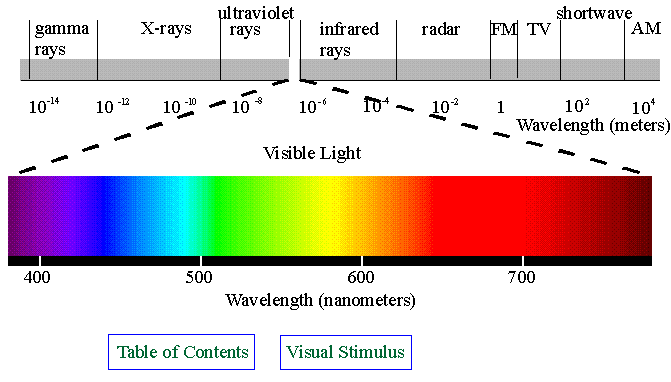
Actually, one end shows one opening of white light and the other has been made as to only show the three primary colors (red, green and blue). See the graphic above. That seems a little arbitrary but he explains that the white light in the light spectrum is analogous to the divine nature of God. Yet, the one white light in the Trinity Box can also be seen as red, green and blue. Thus God (white light which must represent His being) is revealed as three colors (red, green, and blue) or three persons (Father, Son and Holy Spirit). White contends in this analogy the revelation of the Trinity does not reveal something new but shows us something we simply have never seen before. White considers this analogy to be more fitting to the revelation of the Trinity as the three divine persons are believed to be eternally pre-existing and equally sharing in the divine nature.


In the graphics above we quickly see there is much more to be seen than red, green or blue. God's creation of light is not limited to three primary colors and a prism can be manipulated to produce more colors. One could ask then is there more revelation? Will we see more light in our glorified state? Perhaps, in the new heavens and new earth? For example, ultra-violet and infra-red are also colors in the light spectrum and with secondary instruments can easily be seen as well.

Which persons of the Trinity could these new colors represent? One must ask then is the revelation of God's divine nature (white light) really complete? After all, the three persons were not revealed to Abraham, Isaac, Jacob or even Moses who spoke with God and met Him face to face. Do we have a guarantee, in Scripture, that the Trinitarian revelation is complete?

Even the early and original Nicene Creed is not explicitly Trinitarian since its principle aim is Christological. This is not hopeful. Even in an embryonic creed a more explicit Trinitarianism is to be hoped for given the 1) divine inspiriation of Scripture gone before hand and 2) the conscious knowledge of the Trinity by the Bible writers (as Trinitarians must presuppose). Yet, after this original creed many more followed until a codified and articulate doctrine of the Trinity was hammered out by the Cappodocian bishops of AD 451.

Certainly this Trinity should be in later Church History literature where writers are supposedly building off New Testament concepts. Yet, many of these writers in the second century and after do not show an adequate appreciation to the Old Testament or Jewish heritage in which the Bible writers came from. The technical sense in which Trinitarians describe the Incarnation or the properties of the Father, Son and Holy Spirit are not found in Scripture but must come from later creeds and later formulations. Trinitarians argue from certain Bible passages and thus the Trinitarian must conclude that the Trinity is present in the consciousness of certain early Biblical writers and communities such as Phillippi or Corinth. These are necessary hermeneutical presuppositions for Trinitarianism in order for it to be an explicit teaching of Scripture. With such a knowledge repository and divine inspiration a more explicit Trinity should be found.

We should not have to appeal to frightening analogies of a dog with three heads that would scare the Pentecostal or Puritan school child. Nor to instantly contradictory arguments from nature such as the Trinity Box. As noted in prior posts and confirmed by many Biblical scholars, the Bible writers do not clearly and explicitly teach a doctrine of the Trinity. Instead, it must be pieced together, much like a quilt, from certain passages seen as applicable using the Trinitarian presupposition.

8.08.2012

Interpreting and Using Matthew 28:19 - III


Threefold Reference: 

James D.G. Dunn: "...in Matt. 28:19, the title Son is used with the Father and the Holy Spirit in a triadic formulation which foreshadows, in at least some degree, the later trinitiarian understanding of God; though here too it should be noted that the idea of pre-existence is absent (we are still far from talk of the eternal being of God in its threefold inner relationships), and the authority Jesus claims and expresses in his commission is that of the risen one."(1)

Matthew 28:19, Go therefore and make disciples of all nations, baptizing them in the name of the Father and of the Son and of the Holy Spirit, (ESV)

Above Trinitarian scholar James D.G. Dunn believes this text "foreshadows" a Trinity but here even he does not see Matthew 28:19 as referring to the divine nature of God existing as three persons. Using later creedal language one might see a Trinity in these verses. However, those present in the times of Jesus knew of no such thing nor did they impress upon us that God had even revealed such a thing to them. It is obvious from the setting that Jesus spoke to His disciples who were Jews strictly upholding monotheism and had no prior knowledge of a Trinity.

To embrace such concepts would require clear and explicit teaching. Instead, in the first chapter of Matthew we learn that Jesus is Immanuel--God with us. In the 28th and last chapter we learn that Jesus will be with us for all time. In the third chapter Matthew quotes from the prophet Isaiah saying "prepare the way of the Lord" (3:3). In the Hebrew Old Testament Isaiah had said, "prepare the way of the LORD" or the way of Yahweh. (Isa. 40:3 ESV) Jesus has also taught them, around the same time, that to see Him was to see the Father and that the Holy Spirit would come in another form (See John 14). There are no distinctions between the Father and Jesus except those produced by His humanity. The context reveals the authority of Christ in the glory of His resurrection. It tells us of His commandments and His continual presence. Not the glory or presence or commands of three divine persons who each comprise a Triune being.

The Theological Dictionary of the New Testament notes, "We thus find triadic formulas embracing God, Christ, and Spirit in 1 Cor. 12:4ff.; 2 Cor. 13:13; Mt. 28:19. These formulas express the indissoluble threefold relationship but do not actually speak of triunity. The clear-cut statement of 1 Jn. 5 is brought into the text only in the sixth century."(2) Here we see that triadic formulas do not necessarily speak of a unity between three divine persons. The author of the TDNT also suggests 1 John 5:7 is a clear cut statement of the Trinity but further admits that text is an interpolation inserted in the "sixth century".(2) As Dunn noted earlier the Trinitarian understanding is "later" and of course any doctrine can be made to order "later".

In Matthew 28:19 we have three titles that are used for representations of God's revelation, which all point to the one name of Jesus. The three subjects are called by the singular name of Jesus Christ. Well before the times of Christ's earthly, humble state kings and Pharaohs were given throne names. The prophet Isaiah foretold (Isaiah 9;6) early on that the child born and Son given was given throne names (wonderful, counselor (or wonderful counselor), mighty God, everlasting Father). Thus, according to Isaiah the Son would have many names expressing who He was--the mighty God, the everlasting father. The fulfillment of the command in Matthew 28:19 is to baptize into the one name by which we associate the Father and the Son and the Holy Spirit. All three subjects Father, Son and Holy Spirit are separated by "and" and are preceded by a definite article "the". This is no great wonder however since Matthew has in mind the Son of God and not just any Son of God.

Granville Sharp's sixth rule/exception

Matthew 28:19 does have a threefold reference to the Father, the Son and the Holy Spirit. Although Sharp never cites or includes Matthew 28:19 in his study some Trinitarians have appealed to Granville Sharp’s sixth rule here, which says, in part, that when two or more nouns are listed and separated by “and” and each noun has the definite article “the” in front of it, then each noun refers to a different person, place, thing, or quality than the first noun. There are exceptions however and such is the case when distinct or different actions are intended to be given to the same person. It is the context that must point this out though and not simply three nouns preceded by definite articles. 

When applied to Matt. 28:19 this rule simply identities the Father, Son, and Holy Spirit as distinct in some way. If the distinction is pressed to hard, as Trinitarians want to suggest, then they must show how these are not three separate beings when orthodox Trinitarians typically affirm one being consisting of three persons. Oneness believers have never ceased to acknowledge the distinctions made here. Oneness Pentecostals see that they are distinct manifestations or roles in our salvation, but all are fulfilled in, and revealed through Jesus. His is the one name mentioned. To say a grammatical rule forces three different nouns to be regarded as separate divine persons that are co-equal, co-eternal, and co-substantial is merely theological interpretation. No rule of grammar does such a thing.

In a Jewish way of thinking it is easy to use such a form stylistically. For example, the following verses uses such a threefold formula: 1 Tim. 5:21 speaks of God, Christ and elect angels (See also Luke 9:26). In 1 Thess. 3:13 Paul has God and Father, our Lord Jesus and all his saints. In Rev. 3:12 Johns uses this Hebraism for emphasis when he has the name of my God, the name of the city of my God and the new Jerusalem. Father, Son (John 1:1, 8:58; 20:28; Phil. 2:5-11) and Holy Spirit (Acts 5:3-9) are God/Yahweh of Israel and are identified as such. The God of Israel is not vague or hidden but has a personal name as one unified personal spirit being. Yet, these distinctions do not necessitate that the inexhaustible and unlimited personality of the God of Israel be divided or separated. Such threefold repetitions are for emphasis and glorify the majesty of our God. They are not to distinguish multiple divine persons.

In 1 Thess. 5:23 Paul records, "Now may the God of peace himself sanctify you completely, and may your whole spirit and soul and body be kept blameless at the coming of our Lord Jesus Christ." (ESV) In the Greek text the nouns "spirit", "soul" and "body" have the article before them are separated by "and" and refer to one person. The English translations leave out the articles. Yet, in spite of this verse some theologians still do not believe the soul and the spirit are distinct but the same.

Does anything in the context of Matthew 28:19 indicate an exception to Sharp's rule? Is there anything that indicates one person is in view rather than three persons? As we have already seen above we can safely answer, "Yes!" It's clear that the word "name" is a singular noun. Even Trinitarian scholar R. Kendall Soulen has argued that Matthew 28:19 does refer to one name but further adds "The name of the Holy Trinity is one name in three inflexions."(3)

This name refers to the One Who has been Resurrected and appeared before many. It is the name of the One whose empty tomb was covered up with money by the Jews as a night raid by the disciples. It is the name of the missing body in the empty tomb that the governor was never to know about. It is the name of the One who was worshiped while others doubted. It is the name of the One who has all power and for whom we are to make disciples. It is the name of the One who will be with us always. It is the name of the One who Matthew calls Immanuel "God with us" (Matt. 1:23).

The Great Commission:

Consider these other parallel Great Commission texts. In Mark 16 below we see something very similar to Matthew 28. Mark begins with the same participle.

Mark 16:15-16,
15 And he said to them, “Go into all the world and proclaim the gospel to the whole creation. 16 Whoever believes and is baptized will be saved, but whoever does not believe will be condemned.” (ESV)

Luke 24:44-49,
44 Then he said to them, “These are my words that I spoke to you while I was still with you, that everything written about me in the Law of Moses and the Prophets and the Psalms must be fulfilled.” 45 Then he opened their minds to understand the Scriptures, 46 and said to them, “Thus it is written, that the Christ should suffer and on the third day rise from the dead, 47 and that repentance and forgiveness of sins should be proclaimed in his name to all nations, beginning from Jerusalem. 48 You are witnesses of these things. 49 And behold, I am sending the promise of my Father upon you. But stay in the city until you are clothed with power from on high.” (ESV)

In Acts 3:6, 16 Peter orally invokes the name of Jesus and commands the cripple to "rise up and walk". He further clarifies in verse 16 that it was Jesus' name, through faith in His name, that brought healing to the cripple. In Acts 4:10, 12 the name of Jesus is connected to healing and salvation. 

Greek New Testament scholar D.A. Wallace notes, ""In many ways, the books of Acts is a detailed account of how these apostles accomplished the command of Matt. 28:19-20".(4) Trinitarians mistakenly baptize converts by actually quoting the titles Father, Son, and Holy Spirit. As noted earlier, the disciples are not being told something to say but rather something to do (Go, make disciples, teach). If quoting the words of Jesus was the intention of this Gospel writer or Christ Himself then we should expect to find it referenced in another parallel account or in passages relating to baptism. No such thing exists for good reason. In fact, as Wallace suggests the book of Acts records how the disciples carried out the commands of Matthew 28:19 and that was done by invoking the name of Jesus. 

NOTES:

1) Dunn, James D.G. (1989) Christology in the Making SCM Press (49)

2) Kittel, G., Friedrich, G., & Bromiley, G. W. (1995). Theological Dictionary of the New Testament (329). Grand Rapids, MI: W.B. Eerdmans.

3) Soulen, Kendall R. "Who Shall I Say Sent Me? The Name of God in Trinitarian Perspective" Wesley Theological Seminary, Washington, D. C.http://etext.lib.virginia.edu/journals/jsrforum/writings/SouWhos.html

4) Wallace, D.A. (1996) Greek Grammar: Beyond the Basics. Grand Rapids, MI: Zondervan (645)

7.27.2012

James Anderson and Thomas Thrasher Debate Audio

Oneness and Trinity Debate

James Anderson and Thomas Thrasher

July 19th and 20th

Audio available at EvidentialFaith.com
www.evidentialfaith.com

4.27.2012

UPDATE: Church of Christ Debater Kevin Pendergrass Ignores Point of Order in First Night of Debate

From J.C. Carroll's blog (Weatherly's moderator). Click link below to read more.
John Calvin: Calvinism My Way: Debate Update: Debate Firsts: I have had a lot of debate firsts: My first debate. My first oral debate. My first written debate. My first godhead debate. My first Eternal security debate. My first communion debate. My first baptism debate. My first impeccability debate. My first marriage and divorce debate. My first debate with a Church of Christ. My first debate with a Baptist. My first debate to be a moderator. I am sure that the list could go on, but last in the Weatherly-Pendergrass debate was another first.

 MY FIRST DEBATE WHERE A POINT OF ORDER WAS IGNORED!

Adversus Trinitas

"...unless you believe that I am he you will die in your sins." (John 8:24 ESV)