9.29.2011

Medical Aspects of the Crucifixion by R. P. Kloepper II, M.D.


The Romans copied the art of crucifixion from Carthage. The cross was not as we usually see depicted in drawings and paintings. It was composed of two separate pieces. The stipes, the vertical portion, was permanently affixed in the ground and was used many times. It was about six feet in height which allowed the wild animals to devour the corpses of the crucified men. The horizontal portion, named patibulum, was the beam the condemned man carried. There were two common types of crosses. There was the kind which we usually envision (+) and another where the patibulum could fit into a mortis atop the stipes to form a cross in the shape of the Greek capital letter Tau (T).

This form of Capital punishment was meant to deter crime. A sign was carried before the condemned man and placed on his cross. Jesus' inscription, written in Greek, Latin, and Hebrew, read, "Jesus of Nazareth, King of the Jews." After Jesus' appearances before Pilate and Herod, He and two other prisoners were readied for the journey to Golgotha. In deference to Jewish custom, Jesus was allowed to be clothed. The patibulum was of rough cypress wood, approximately six feet in length, and weighed twenty five to thirty pounds. The method of carrying it was fairly constant.

Jesus' hands were bound, the patibulum placed on His right shoulder, and the bound hands draped over the anterior portion of the beam with the shoulder serving as the fulcrum. The centurion was worried about Jesus' obviously weakened condition. Christ stumbled several times. As He fell forward, the end of the patibulum struck the ground first, then His knees and elbows. Blood flowed. The rough cypress wood tore at His face. The piece of wood balanced momentarily and then fell across His back reopening the wounds of His scourging. The centurion was displeased. This was to be an orderly Roman execution. The condemned men should be dead by the sabbath. However, He should die on the cross, not on the way to His crucifixion. A North African, Simon of Cyrene, was commanded to carry the cross of Jesus. The pathetic parade moved forward. It was six hundred and fifty yards from Antonio, Pilate's residence, to Golgotha.

The society of charitable women were present when they arrived at the hill. These women assisted poor families in Jerusalem during death,gave gifts at weddings, etc. They offered those about to be executed a drink of wine mixed with myrrh or incense. Some question the analgesic properties of the mixture; however, this was its intended use, to dull the pain. Christ would not drink. He desired to feel the fullness of His suffering, He flinched when His robe was removed for the blood from His beating had caused it to be "scabbed" to his back. The feeling was that of ripping a dressing from a tender wound.

Dr. Pierre Barbet studied crucifixion and did a lot of experimental work with amputated arms and bodies of deceased. As a result of his research, He clearly demonstrated that nails in the palms of the hands will not support the weight of a man when he is suspended. There is adequate anatomical explanation for this since there are no strong horizontal structures in the hands. This of course, would be unsatisfactory for crucifixion. Yet, He was consistently able to drive large nails between the carpal bones of the wrist with radiographic proof of no resulting fractures. There is a natural passageway there between the bones. (See Psalms 34:20, John 19:31-36.) This location is considered to be a part of the hand and for it to be used brought no contradiction of scripture. This placements of nails will adequately suspend a man's weight. So, it was probably this spot that was used by the Roman executioner.

It was about 9:00 a.m. when Simon placed the patibulum on the ground. Jesus was thrown down on top of it striking His head and driving the thorns still deeper. The Roman executioner wore a leather apron which carried five inch spikes. He was adept at his work and soon Jesus was nailed to the patibulum. The wooden  beam with the full weight of Christ's body suspended from the nails was lifted by the soldiers and dropped into place in the mortis atop the standing vertical portion of the cross. His knees were flexed and His right foot placed over His left. A spike was driven into the soft tissues between the metatarsal bones of His feet.

He was now suspended on the cross. His arms formed a "V" as His body sagged, and His entire body weight was supported by the nails. He soon became aware of excruciating pain in His arms. The median nerve, which supplies motor function to the flexor muscles of the hand, was stretched tautly over the nails in His wrists. It was partially severed. Each time he moved it was like a bow being dragged across the string of a violin pouring forth a strong chord of agonizing pain.

Think about it, raw nerve against rough steel! Tetanic spasms developed in the muscles of His hands and marched up His arms to the pectoralis muscles of His chest. These muscles of the anterior chest wall are accessory muscles of respiration. They assist forceful inspiration by elevating the rib cage. When these muscles contracted in spasm, it was impossible to exhale. Only small volumes of air could be inhaled. There was inadequate oxygenation, and the carbon dioxide level in the blood increased fairly rapidly. To relieve the muscle spasm and the panicky feeling of shortness of breath, Jesus pushed Himself up the cross and transferred His weight to the nail in His feet. The spasm disappeared, and He was able to breathe more easily.

However, After a short while, leg muscle spasms and the unbearable pain of supporting His full weight on the nail in His feet forced Him to slide back down the cross and once again suspend himself from the nails in His hands. The rough cypress wood clawed at the open wounds on His back as He moved up and down the cross. In the darkness, the insects buzzed around His matted beard and settled on His blood smeared face. They laid their eggs in puss filled wounds. He was helpless to ward them off. Yes, there was nothing pretty about Calvary. The agonizing cycle was repeated again and again as the soldiers beneath Him gambled for His robe. Finally, about 3:00 p.m. He commended His spirit. The earth trembled, and the veil in the temple was rent in twain.

Some crucified men lived as long as two days. Since it was meant to deter crime, the spectacle was no longer useful when the crowds dispersed after several hours. The usual method of death after crucifixion was asphyxiation. When the condemned man no longer had the strength to raise himself on the cross, he soon died from inadequate respiration produced by the chest muscle spasms. The Romans broke the femurs, the large thigh bones, to hasten death. With the broken legs, a man could no longer raise himself on the cross. He soon asphyxiated.

Jesus lived only six hours on the cross. Why? John gave us a clue when he recorded that after the Roman soldier pierced Jesus' side to insure death, blood and water came forth. The cross was six feet in height, A raised spear would enter the chest cavity; only blood from the heart should exit the wound. What was the water? The pericardium is a membrane that surrounds the heart. It is known that fluid can collect in the space between the heart and the pericardium after a non-penetrating blow to the chest (postcardiac-injury syndrome). If this effusion is large enough, cardiac tamponade can occur. This means the heart is constricted and is no longer an effective pumper of blood.

Congestive heart failure and pulmonary edema develop. One's breathing becomes labored as the lungs fill with fluid. Jesus' breathing difficulty described previously was compounded by this condition. This helps to explain His short time on the cross. The pain associated with traumatic pericarditis is torturous. After His death, we have another insight into a segment of His suffering. His heart was broken for me.

That is how Jesus purchased our salvation.

A huge chasm existed at Calvary between the benevolence of God and the gratitude of mankind. God had no guarantee there would be any human response to this supreme act, The Roman centurion may grasp a small segment of the magnitude of the situation and exclaim, "Truly this was the Son of God." Joseph of Arimathea may feel a twinge of guilt and beg for the body of Christ, but what would be the reaction of the human race? God could only hope that in the future someone would catch a glimpse of the unprecedented love exhibited at Calvary and return that love with the devotion of his life. I hope this article helps to bridge the gulf between God's benevolence and each reader's gratitude. I trust it produces a large increase in gratefulness for what was accomplished on a hill called Golgotha.

"When I survey the Wondrous Cross
On which the Prince of Glory died,
My richest gain I count but lost And pour contempt on all my pride,

"Were the whole realm of nature mine,
That were a present far too small; Love so amazing, so divine,
Demands my soul, my life, my  all."


R. P. Kloepper II, M.D. 

The above material appeared in an April, 1975 issue of The Conqueror.

Links of Interest


  1. New book co-authored by David Bernard and Robin Johnston: On Being Pentecostal. It is thought to be a good introduction to what Pentecostals believe.
  2. Roger Olson new book: Against Calvinsim. Click here to read more.
  3. The Israel Museum welcomes you to the Dead Sea Scrolls Digital Project, allowing users to examine and explore these most ancient manuscripts from Second Temple times at a level of detail never before possible. Developed in partnership with Google, the new website gives users access to searchable, fast-loading, high-resolution images of the scrolls, as well as short explanatory videos and background information on the texts and their history.
  4. A team of archaeologists is examining thousands of stone structures found between Syria and Saudi Arabia. Known as "wheels" the purpose and meaning of them is a mystery. Click here to read more.
  5. The FBI has publicly declared that its counterterrorism training seminars linking “mainstream” Muslims to terrorists was a “one time only” affair that began and ended in April 2011. But two months later, the Bureau employee who delivered those controversial briefings gave a similar lecture to a gathering of dozens of law enforcement officials at an FBI-sponsored public-private partnership in New York City. And during that June presentation, the FBI’s William Gawthrop told his audience that the fight against al-Qaida is a “waste,” compared to the threat presented by the ideology of Islam itself. Video here.

9.25.2011

Islam Is Not A Religion Of Peace


Angry Calvinist?

Interesting article from the Society of Evangelical Arminians:
There seems to be lots of talk about angry Calvinists going on, with Calvinist leaders recognizing that there seems to be a problem with anger/rudeness/harshness/incivility etc. particularly among Calvinists. Here are 2 posts on this:

Ed Setzer interviews Calvinist Joe Thorn about the issue: "Joe Thorn and Angry (Fake) Calvinists"

Justin Taylor, "The Problem of 'Angry Calvinists' "

If we grant that there is a special problem among Calvinists in this area (surely the problem is not limited to Calvinists, but some Calvinist leaders seem to be observing that there is a special problem among their own), the following comments are in order:  
 Click here to read full article.

9.24.2011

Book of Enoch Part Two

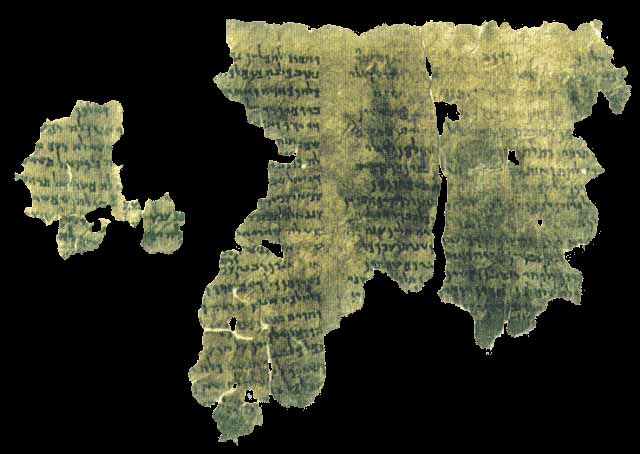
Fragment found among Dead Sea Scrolls

Why Enoch?

Why would Jude reference such events or even reference such a figure? The answer could be long and varied since Enoch’s writings contain apocalyptic thought. I think it is worth pointing out at this point that what Jude actually quotes is indeed Scriptural. Jude quoting something that the Book of Enoch also records might be an incidental consequence of re-quoting an original quotation.

Since the Enoch writings were popular and considered inspired by some early on it seems Jude would be aware of them. If Jude directly cites from the Book of Enoch then he could be using the event to turn it against them. Something similar is seen In Numbers 21:27-30 when “ballad singers” (ESV) or “those who speak in proverbs” (NET) began citing “a brief poem to remember the event, like an Egyptian victory song. It may have originated as an Amorite war taunt song; it was sung to commemorate this victory.”(10) See also Ezekiel 18:25, 29 and 33:17.

Jude does not appear to address the events of Enoch as Scripture. He does not give wholesale approval of Enoch writings. This should help us orient our own view as well. Jude obviously believes that Enoch was a historic figure and that the events he quotes are considered true also. It does not necessarily follow from even those premises that he also considered the writings of Enoch as divinely inspired. As noted earlier what Jude quotes is Scriptural. Not only is Jude citing an event found in Enoch but is also providing indirect quotation from whatever Old Testament passage Enoch might have also cited. G.L. Green in the Baker Exegetical New Testament Commentary sheds light on this:
“In each case, the incident recorded is tied intimately with some set canonical text. The angelic fall (v6) became a very common interpretation of Gen 6:1-4, and the dispute over the body of Moses (v9) was an interpretive tradition that developed due to the rather obscure reference to Moses’s death in Deut 34:5-6, which concludes ‘but no one knows his burial place to this day’ (NRSV). Jude’s reference is to the Assumption (Testament) of Moses, but it also evokes the words of Zech 3:1-2. The quotation of 1 En. 1:9 in vv14-15 draws on Deut 33:2, which was considered prophetic of the day of the Lord: ‘The Lord came from Sinai…with him were myriads of holy ones; at his right, a host of his own” (NRSV). Jude makes judicious and limited use of references to apocryphal literature and evokes only sources that tie into the canonical text and interpretive traditions surrounding it. Jude’s use of apocryphal texts is closer to canonical bedrock than is sometimes acknowledged.”(11)
Stanley Horton has noted, “there appears to be a similarity to the Book of Enoch 1:9, and even this is not difficult to attribute to a common oral tradition available both to the writer of the Book of Enoch and to Jude.”(12) Marvin Vincent and A.T. Robertson affirms this possibility as well. Vincent notes, “It is quoted from the apocryphal book of Enoch, directly, or from a tradition based upon it.”(13) Robert D. Culver has suggested the Enoch writings were “evidently current literature in the first century BC and not only contributed to unhealthy interest in unseen spirits but also contributed to fantastic elaboration of their activities among our Lord's immediate ancestors...” He also suggests that it is an “unhealthy preoccupation with an occult doctrine of angels is not reflected in the New Testament, but rather corrected — as is fantastic interpretation of prophecy by Jewish non-biblical apocalypse.”(14)

Adam Clarke considered these writings to be forgeries.(15) R. H. Charles noted that these writings come from many writers and almost as many periods. Charles also concludes, “It touches upon every subject that could have arisen in the ancient schools of the prophets, but naturally it deals with these subjects in an advanced stage of development. Nearly every religious idea appears in a variety of forms, and, if these are studied in relation to their contexts and dates, we cannot fail to observe that in the age to which the Enoch literature belongs there is movement everywhere, and nowhere dogmatic fixity and finality.(16)

Importance and Value:

We should always bear in mind that the Book of Enoch may not even be directly referred to in the New Testament. Jude may have only cited a similar event recorded in the Book of Enoch. Jesus nor any other New Testament writer ever quoted the Apocryphal nor Pseudepigraphal works as Scripture even though it was likely that they were aware of them. Jesus specifically quoted books from each parts of the Old Testament and considered them as Scripture (see Luke 24:27). In John 10:35 he also states, “the scripture cannot be broken” (NET).

Walter Martin made a salient point in this regard. Referring to Jesus he noted, “Those who would own Him as their Master cannot in good conscience hold a view of Scripture inferior to His.”(17) The Apostle Paul well schooled in Jewish piety explicitly states that “First of all, the Jews were entrusted with the oracles of God.” (Romans 3:2 NET) Gleason Archer suggests that a standardization of certain texts (Majority Text) of the Old Testament took place around 100 B.C.(18) Some have suggested this took place as the council of Jamnia in AD 90. In either case, the Jewish scholars then did not accept the Apocrypha or Pseudepigraphal books as part of their Jewish canon. Although Jews may use or reference the Enoch writings not very many would place it on the level as the Torah.(19)

The importance or value of Enoch writings are limited and useful for apocalyptic thought. They should not be regarded as divinely inspired though. At least in the sense that they are equally as authoritative as those found in our Biblical canon.

NOTES:

10) Biblical Studies Press. (2006; 2006). The NET Bible First Edition. “Proverbs of antiquity could include pithy sayings or longer songs, riddles, or poems composed to catch the significance or the irony of an event. This is a brief poem to remember the event, like an Egyptian victory song. It may have originated as an Amorite war taunt song; it was sung to commemorate this victory. It was cited later by Jeremiah (48:45–46). The composer invites his victorious people to rebuild the conquered city as a new capital for Sihon. He then turns to address the other cities which his God(s) has/have given to him. See P. D. Hanson, “The Song of Heshbon and David’s Nir,” HTR 61 (1968): 301.”

11) Green, G.L. (2008) Jude & 2 Peter - Baker Exegetical Commentary. (32) Grand Rapids, Mi. Baker Academic.

12) Horton, Stanley H. (1993) Bible Doctrines: A Pentecostal Perspective © 1993 by Gospel Publishing House. All rights reserved.

13) Vincent, M. R. (2002). Word studies in the New Testament (Jud 14). Bellingham, WA: Logos Research Systems, Inc.’

14) Culver, Robert D. (2005) Systematic Theology © 2005 by Robert Duncan Culver. All rights reserved.

15) Clarke, Adam. Clarke's Commentary, Electronic Database. Copyright © 1996, 2003, 2005, 2006 by Biblesoft, Inc. All rights reserved.

16) R.H. Charles. (2004) Pseudepigrapha of the Old Testament. (Enoch 6:1–2). Bellingham, WA: Logos Research Systems, Inc.

17) Martin, Walter (1962) Essential Christianity. Copyright © 1962, 1975, 1980 by the estate of Walter R. Martin.

18) Archer, G. L. (1998). A survey of Old Testament introduction (3rd. ed.].) (47). Chicago: Moody Press. “this hardly agrees with the evidence of texts like the Hebrew University Isaiah Scroll, which corresponds almost letter for letter with the MT and yet dates from about 50 B.C. A more likely supposition is that the standardization of the consonantal text of the Old Testament took place around 100 B.C.”

19) Stone, Michael. Jewish Virtual Library. “A substantial number of works transmit proverbial teaching about religious and practical issues.” http://www.jewishvirtuallibrary.org/jsource/Judaism/apocrypha.html

Book of Enoch Part One

Fragment found among Dead Sea Scrolls

Introduction:

In the book of Genesis it is said that a man named Enoch lived 365 years. He walked with God and was no more for God took him (See Gen. 5:21-24). Since that time there has consequently been significant Jewish literature attributed to this figure. The writings are considered by some to be important and yet others even have and do consider them divinely inspired. The Book of Enoch is actually a compilation of five books that are apocalyptic in nature.

Four of the five have been found among the Dead Sea Scrolls. These writings are very important to the Second Temple period. The original language of most of this work was likely Aramaic. The original is lost but portions of a Greek translations were found in Egypt as well as quotations from early Church Fathers. Gleason Archer noted however that “no one could seriously contend that the straightlaced Qumran sectarians considered all these apocryphal and pseudepigraphical works canonical simply because they possessed copies of them.”(1)

History:

The Book of Enoch is considered a pseudoepigraphal work by many Christian scholars. Michael Stone from the Hebrew University in Jerusalem notes that “The oldest known Jewish work not included in the Bible is the Book of Enoch.”(2) As Stone implies it was not included in either the Hebrew or most Christian biblical canons. It may have been a sacred text for some but they might not be considered Christians. These writings have value but only in a limited sense in the view of this writer. It seems the book fell out of favor from the third century onward and was even banned by some theologians such as Hilary, Jerome, and Augustine. An Ethiopic version was found in recent times and it was written partly in Aramaic and partly in Hebrew. Aramaic was probably the conversational language of our Lord also.

The higher theology of Judaism in the two centuries before Christ could not be written without the writings of Enoch. Sadly there is little to no unity of time, authorship, or teaching. Norman Geisler and W.E. Nix suggest, “they do represent the religious lore of the Hebrews in the intertestamental period...Although they claim to have been written by biblical authors, they actually express religious fancy and magic from the period between about 200 B.C. and A.D. 200.”(3) G.H. Charles who has done recent work on the subject concluded that portions of these writings seem to have belonged originally to the Book of Noah.(4)

Charles also noted that the authors were probably Chasids or their successors the Pharisees. The work has an advanced angel and demonology. During the first century and the close of the second century this book was probably regarded in certain circles as inspired. Jude cites this book as well as the Epistle of Barnabas, Athenagoras. In the third century Clement, Irenaeus, Tertullian, Zosimus and Syncellus quote Enoch as well. Tertullian seems to suggest its inspiration and even suggests that the Jews may have rejected it because it taught the coming of the Lord. For Tertullian this was supposedly corroborated by Jude usage. Origen even noted its similarities and referenced it on occasion.

The Bible and The Book of Enoch:

The Book of Enoch is a voluminous work that describes many events. Some New Testament passages seem to refer to events that are described in the writings of Enoch. For example, 2 Peter 2:4 records that God did not spare the angels who sinned but cast them down and have reserved them for judgment. Jude 6 is a popular passage that references angels who did not keep their proper domain. Jude 14 references Enoch and the coming of the Lord with ten thousand of his saints. Below are the cited references:
2 Peter 2:4, For if God did not spare angels when they sinned, but cast them into hell and committed them to chains of gloomy darkness to be kept until the judgment; ESV
Jude 6, And the angels who did not stay within their own position of authority, but left their proper dwelling, he has kept in eternal chains under gloomy darkness until the judgment of the great day—ESV
Jude 14, It was also about these that Enoch, the seventh from Adam, prophesied, saying, “Behold, the Lord comes with ten thousands of his holy ones, ESV
More similarities could be produced but such things are not truly unique since the New Testament writers also cited from heathen poets like Aratus (Acts 17:28), Menander (1 Cor. 15:33); and Epimenies (Titus 1:2). Truth is truth no matter the who or the where. Truth was even uttered by a heathen prophet in Numbers 24:17 and even an ass says something right just two chapters prior (See Numbers 22:28). In the Jude references it seems he records a similar event as Enoch. As we shall see the event is more important than the actual writings of Enoch.

If Jude does literally reference a citation from the Book of Enoch then it would probably be to serve some point or denote an emphasis. Most believers would not consider it unusual for a pastor or minister to quote from a non-inspired book at some point during a sermon or lesson. This can be done to make a point even without the speaker addressing the inspiration of that particular book.

G.H. Schodde took a positive view of these writings. He notes, “The Fathers all, with possibly the one dissenting voice of Tertullian, deny the canonicity of this book, and properly regard it as apocryphal...” In reference to Jerome he also records, “some going even so far as to deny the canonicity of Jude because he had dared to quote an apocryphal work.”(5) Tertullian and Schodde may have been too generous in their claims. Many Protestant and Evangelical scholars have pointed this out. Jude could have been merely using a valid oral tradition and not necessarily the Book of Enoch. Here are some of the events Enoch records:
Enoch 1:9, And behold! He cometh with ten thousands of ‹His› holy ones To execute judgement upon all, And to destroy ‹all› the ungodly:
Enoch 6:1-2, And it came to pass when the children of men had multiplied that in those days were born unto them beautiful and comely daughters. 2 And the angels, the children of the heaven, saw and lusted after them, and said to one another: ‘Come, let us choose us wives from among the children of men and beget us children.’
Enoch 7:1-6, And all the others together with them took unto themselves wives, and each chose for himself one, and they began to go in unto them and to defile themselves with them, and they taught them charms and enchantments, and the cutting of roots, and made them acquainted with plants. 2 And they became pregnant, and they bare great giants, whose height was three thousand ells: 3 Who consumed all the acquisitions of men. 4 And when men could no longer sustain them, the giants turned against them and devoured mankind. 5 And they began to sin against birds, and beasts, and reptiles, and fish, and to devour one another’s flesh, and drink the blood. 6 Then the earth laid accusation against the lawless ones.
The Jewish Encyclopedia suggest that, “a cycle of Jewish legends about Enoch was derived, which, together with apocalyptic speculations naturally ascribed to such a man, credited with superhuman knowledge, found their literary expression in the Books of Enoch.”(6) The Catholic Encyclopedia suggests that Jude “explicitly” quotes from Enoch.(7) These writings include references to similar Biblical concepts and doctrines as well that are debated to this day (e.g. son of man, messiah, Kingdom, angels and demons). In the Semeia Journal Carl Holladay notes that “the Son of Man in the Similitudes of Enoch, are not pre-Christian.”(8) J.W. Drane in reference to Enoch and Esdras notes:
“There is no certainty that either of these books was actually written by the time of Jesus, and they are only known through relatively late texts that might in any case have been subject to later emendation and corruption. It is certainly not possible to use them with any confidence to show, for example, that the term ‘Son of man’ could have been a widely recognized title of any sort in the time of Jesus.”(9)

NOTES:

1) Archer, G. L. (1998). A survey of Old Testament introduction (3rd. ed.].) (82). Chicago: Moody Press.

2) Stone, Michael. Jewish Virtual Library http://www.jewishvirtuallibrary.org/jsource/Judaism/apocrypha.html

3) Geisler, N. L., & Nix, W. E. (1996). A general introduction to the Bible (Rev. and expanded.) (262). Chicago: Moody Press.

4) Charles, R.H. Editor. (2004) Vol. 2: Pseudepigrapha of the Old Testament. (163). Bellingham, WA: Logos Research Systems, Inc.

5) Schodde, George H. The Book of Enoch: Translated from the Ethiopic With Introduction and Notes. Andover: Warren F. Draper 1882 http://www.cimmay.us/pdf/schodde.pdf

6) Jewish Encyclopedia: Read more: http://jewishencyclopedia.com/view.jsp?artid=384&letter=E&search=Enoch#ixzz1YtCy1hxq

7) "The Book of Henoch (Ethiopic)." The Catholic Encyclopedia. Vol. 1. New York: Robert Appleton Company, 1907. 23 Sept. 2011<http://www.newadvent.org/cathen/01602a.htm>.

8) Holladay, Carl H. Robert Jewett, E. Society of Biblical Literature. (1984). Vol. 30: Semeia. (78). Decatur, GA: Society of Biblical Literature.

9) Drane, J. W. (2000). Introducing the New Testament (Completely rev. and updated.) (74). Oxford: Lion Publishing plc.

Adversus Trinitas

"...unless you believe that I am he you will die in your sins." (John 8:24 ESV)