 |
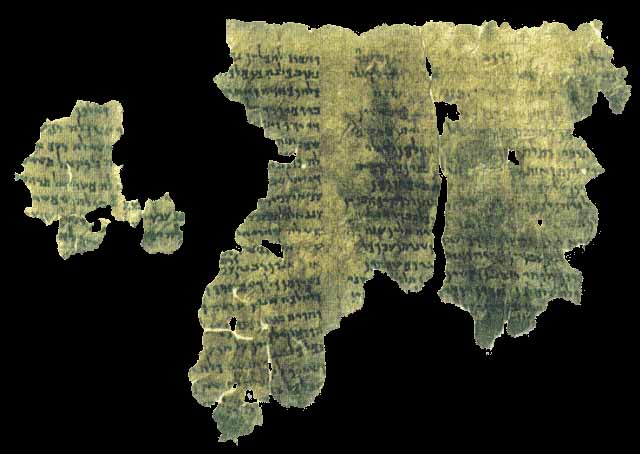
| Fragment found among Dead Sea Scrolls |
Why Enoch?
Why would Jude reference such events or even reference such a figure? The answer could be long and varied since Enoch’s writings contain apocalyptic thought. I think it is worth pointing out at this point that what Jude actually quotes is indeed Scriptural. Jude quoting something that the Book of Enoch also records might be an incidental consequence of re-quoting an original quotation.
Since the Enoch writings were popular and considered inspired by some early on it seems Jude would be aware of them. If Jude directly cites from the Book of Enoch then he could be using the event to turn it against them. Something similar is seen In Numbers 21:27-30 when “ballad singers” (ESV) or “those who speak in proverbs” (NET) began citing “a brief poem to remember the event, like an Egyptian victory song. It may have originated as an Amorite war taunt song; it was sung to commemorate this victory.”(10) See also Ezekiel 18:25, 29 and 33:17.
Jude does not appear to address the events of Enoch as Scripture. He does not give wholesale approval of Enoch writings. This should help us orient our own view as well. Jude obviously believes that Enoch was a historic figure and that the events he quotes are considered true also. It does not necessarily follow from even those premises that he also considered the writings of Enoch as divinely inspired. As noted earlier what Jude quotes is Scriptural. Not only is Jude citing an event found in Enoch but is also providing indirect quotation from whatever Old Testament passage Enoch might have also cited. G.L. Green in the Baker Exegetical New Testament Commentary sheds light on this:
Adam Clarke considered these writings to be forgeries.(15) R. H. Charles noted that these writings come from many writers and almost as many periods. Charles also concludes, “It touches upon every subject that could have arisen in the ancient schools of the prophets, but naturally it deals with these subjects in an advanced stage of development. Nearly every religious idea appears in a variety of forms, and, if these are studied in relation to their contexts and dates, we cannot fail to observe that in the age to which the Enoch literature belongs there is movement everywhere, and nowhere dogmatic fixity and finality.(16)
Importance and Value:
We should always bear in mind that the Book of Enoch may not even be directly referred to in the New Testament. Jude may have only cited a similar event recorded in the Book of Enoch. Jesus nor any other New Testament writer ever quoted the Apocryphal nor Pseudepigraphal works as Scripture even though it was likely that they were aware of them. Jesus specifically quoted books from each parts of the Old Testament and considered them as Scripture (see Luke 24:27). In John 10:35 he also states, “the scripture cannot be broken” (NET).
Walter Martin made a salient point in this regard. Referring to Jesus he noted, “Those who would own Him as their Master cannot in good conscience hold a view of Scripture inferior to His.”(17) The Apostle Paul well schooled in Jewish piety explicitly states that “First of all, the Jews were entrusted with the oracles of God.” (Romans 3:2 NET) Gleason Archer suggests that a standardization of certain texts (Majority Text) of the Old Testament took place around 100 B.C.(18) Some have suggested this took place as the council of Jamnia in AD 90. In either case, the Jewish scholars then did not accept the Apocrypha or Pseudepigraphal books as part of their Jewish canon. Although Jews may use or reference the Enoch writings not very many would place it on the level as the Torah.(19)
The importance or value of Enoch writings are limited and useful for apocalyptic thought. They should not be regarded as divinely inspired though. At least in the sense that they are equally as authoritative as those found in our Biblical canon.
Since the Enoch writings were popular and considered inspired by some early on it seems Jude would be aware of them. If Jude directly cites from the Book of Enoch then he could be using the event to turn it against them. Something similar is seen In Numbers 21:27-30 when “ballad singers” (ESV) or “those who speak in proverbs” (NET) began citing “a brief poem to remember the event, like an Egyptian victory song. It may have originated as an Amorite war taunt song; it was sung to commemorate this victory.”(10) See also Ezekiel 18:25, 29 and 33:17.
Jude does not appear to address the events of Enoch as Scripture. He does not give wholesale approval of Enoch writings. This should help us orient our own view as well. Jude obviously believes that Enoch was a historic figure and that the events he quotes are considered true also. It does not necessarily follow from even those premises that he also considered the writings of Enoch as divinely inspired. As noted earlier what Jude quotes is Scriptural. Not only is Jude citing an event found in Enoch but is also providing indirect quotation from whatever Old Testament passage Enoch might have also cited. G.L. Green in the Baker Exegetical New Testament Commentary sheds light on this:
“In each case, the incident recorded is tied intimately with some set canonical text. The angelic fall (v6) became a very common interpretation of Gen 6:1-4, and the dispute over the body of Moses (v9) was an interpretive tradition that developed due to the rather obscure reference to Moses’s death in Deut 34:5-6, which concludes ‘but no one knows his burial place to this day’ (NRSV). Jude’s reference is to the Assumption (Testament) of Moses, but it also evokes the words of Zech 3:1-2. The quotation of 1 En. 1:9 in vv14-15 draws on Deut 33:2, which was considered prophetic of the day of the Lord: ‘The Lord came from Sinai…with him were myriads of holy ones; at his right, a host of his own” (NRSV). Jude makes judicious and limited use of references to apocryphal literature and evokes only sources that tie into the canonical text and interpretive traditions surrounding it. Jude’s use of apocryphal texts is closer to canonical bedrock than is sometimes acknowledged.”(11)Stanley Horton has noted, “there appears to be a similarity to the Book of Enoch 1:9, and even this is not difficult to attribute to a common oral tradition available both to the writer of the Book of Enoch and to Jude.”(12) Marvin Vincent and A.T. Robertson affirms this possibility as well. Vincent notes, “It is quoted from the apocryphal book of Enoch, directly, or from a tradition based upon it.”(13) Robert D. Culver has suggested the Enoch writings were “evidently current literature in the first century BC and not only contributed to unhealthy interest in unseen spirits but also contributed to fantastic elaboration of their activities among our Lord's immediate ancestors...” He also suggests that it is an “unhealthy preoccupation with an occult doctrine of angels is not reflected in the New Testament, but rather corrected — as is fantastic interpretation of prophecy by Jewish non-biblical apocalypse.”(14)
Adam Clarke considered these writings to be forgeries.(15) R. H. Charles noted that these writings come from many writers and almost as many periods. Charles also concludes, “It touches upon every subject that could have arisen in the ancient schools of the prophets, but naturally it deals with these subjects in an advanced stage of development. Nearly every religious idea appears in a variety of forms, and, if these are studied in relation to their contexts and dates, we cannot fail to observe that in the age to which the Enoch literature belongs there is movement everywhere, and nowhere dogmatic fixity and finality.(16)
Importance and Value:
We should always bear in mind that the Book of Enoch may not even be directly referred to in the New Testament. Jude may have only cited a similar event recorded in the Book of Enoch. Jesus nor any other New Testament writer ever quoted the Apocryphal nor Pseudepigraphal works as Scripture even though it was likely that they were aware of them. Jesus specifically quoted books from each parts of the Old Testament and considered them as Scripture (see Luke 24:27). In John 10:35 he also states, “the scripture cannot be broken” (NET).
Walter Martin made a salient point in this regard. Referring to Jesus he noted, “Those who would own Him as their Master cannot in good conscience hold a view of Scripture inferior to His.”(17) The Apostle Paul well schooled in Jewish piety explicitly states that “First of all, the Jews were entrusted with the oracles of God.” (Romans 3:2 NET) Gleason Archer suggests that a standardization of certain texts (Majority Text) of the Old Testament took place around 100 B.C.(18) Some have suggested this took place as the council of Jamnia in AD 90. In either case, the Jewish scholars then did not accept the Apocrypha or Pseudepigraphal books as part of their Jewish canon. Although Jews may use or reference the Enoch writings not very many would place it on the level as the Torah.(19)
The importance or value of Enoch writings are limited and useful for apocalyptic thought. They should not be regarded as divinely inspired though. At least in the sense that they are equally as authoritative as those found in our Biblical canon.
NOTES:
10) Biblical Studies Press. (2006; 2006). The NET Bible First Edition. “Proverbs of antiquity could include pithy sayings or longer songs, riddles, or poems composed to catch the significance or the irony of an event. This is a brief poem to remember the event, like an Egyptian victory song. It may have originated as an Amorite war taunt song; it was sung to commemorate this victory. It was cited later by Jeremiah (48:45–46). The composer invites his victorious people to rebuild the conquered city as a new capital for Sihon. He then turns to address the other cities which his God(s) has/have given to him. See P. D. Hanson, “The Song of Heshbon and David’s Nir,” HTR 61 (1968): 301.”
11) Green, G.L. (2008) Jude & 2 Peter - Baker Exegetical Commentary. (32) Grand Rapids, Mi. Baker Academic.
12) Horton, Stanley H. (1993) Bible Doctrines: A Pentecostal Perspective © 1993 by Gospel Publishing House. All rights reserved.
13) Vincent, M. R. (2002). Word studies in the New Testament (Jud 14). Bellingham, WA: Logos Research Systems, Inc.’
14) Culver, Robert D. (2005) Systematic Theology © 2005 by Robert Duncan Culver. All rights reserved.
15) Clarke, Adam. Clarke's Commentary, Electronic Database. Copyright © 1996, 2003, 2005, 2006 by Biblesoft, Inc. All rights reserved.
16) R.H. Charles. (2004) Pseudepigrapha of the Old Testament. (Enoch 6:1–2). Bellingham, WA: Logos Research Systems, Inc.
17) Martin, Walter (1962) Essential Christianity. Copyright © 1962, 1975, 1980 by the estate of Walter R. Martin.
18) Archer, G. L. (1998). A survey of Old Testament introduction (3rd. ed.].) (47). Chicago: Moody Press. “this hardly agrees with the evidence of texts like the Hebrew University Isaiah Scroll, which corresponds almost letter for letter with the MT and yet dates from about 50 B.C. A more likely supposition is that the standardization of the consonantal text of the Old Testament took place around 100 B.C.”
19) Stone, Michael. Jewish Virtual Library. “A substantial number of works transmit proverbial teaching about religious and practical issues.” http://www.jewishvirtuallibrary.org/jsource/Judaism/apocrypha.html
11) Green, G.L. (2008) Jude & 2 Peter - Baker Exegetical Commentary. (32) Grand Rapids, Mi. Baker Academic.
12) Horton, Stanley H. (1993) Bible Doctrines: A Pentecostal Perspective © 1993 by Gospel Publishing House. All rights reserved.
13) Vincent, M. R. (2002). Word studies in the New Testament (Jud 14). Bellingham, WA: Logos Research Systems, Inc.’
14) Culver, Robert D. (2005) Systematic Theology © 2005 by Robert Duncan Culver. All rights reserved.
15) Clarke, Adam. Clarke's Commentary, Electronic Database. Copyright © 1996, 2003, 2005, 2006 by Biblesoft, Inc. All rights reserved.
16) R.H. Charles. (2004) Pseudepigrapha of the Old Testament. (Enoch 6:1–2). Bellingham, WA: Logos Research Systems, Inc.
17) Martin, Walter (1962) Essential Christianity. Copyright © 1962, 1975, 1980 by the estate of Walter R. Martin.
18) Archer, G. L. (1998). A survey of Old Testament introduction (3rd. ed.].) (47). Chicago: Moody Press. “this hardly agrees with the evidence of texts like the Hebrew University Isaiah Scroll, which corresponds almost letter for letter with the MT and yet dates from about 50 B.C. A more likely supposition is that the standardization of the consonantal text of the Old Testament took place around 100 B.C.”
19) Stone, Michael. Jewish Virtual Library. “A substantial number of works transmit proverbial teaching about religious and practical issues.” http://www.jewishvirtuallibrary.org/jsource/Judaism/apocrypha.html


