6.22.2011

Isaiah 55:6 : Seek the Lord


Isaiah 55:1-3, Why do you spend your money for that which is not bread, and your labor for that which does not satisfy? Listen carefully to me, and eat what is good, and delight yourselves in rich food. 3 Incline your ear, and come to me; listen, so that you may live. I will make with you an everlasting covenant, my steadfast, sure love for David. NRSV

Isaiah 55:6, Seek the LORD while he may be found, call upon him while he is near; NRSV

Amos 5:4, For thus says the LORD to the house of Israel: Seek me and live; NRSV

Isaiah asks why "spend your money for that...which does not satisfy?" This is an important question and the solution Yahweh gives is equally important. Similarly Jesus told the woman at the well that if anyone was to drink of the water He will give they shall never thirst. Isaiah records that both Jew and Gentile must "Seek the LORD..." This is God's answer for how to find that which truly satisfies. It is the condition of obtaining any spiritual benefit.(1) Ezekiel informs us that even Israel was allowed to enquire or "ask" of the LORD (Ezekiel 36:37). Indeed, we must "Ask...it will be given...search...you will find; knock...the door will be opened...everyone who searches finds..." Luke 11:9, 10 NRSV

The searching and seeking however must be done as Luke later described. He records "Strive to enter through the narrow door..." Luke 13:24 NRSV Our seeking and searching must be sincere and honest. This searching is more than mere intellectual inquiry but cannot be done without our use of the thinking equipment the LORD has provided us. Mere intellectual inquiry in such a search will probably produce no saving relationship between God and man. Honest and sincere seekers however will go where the evidence leads.

Isaiah doesn't leave us without reason. In fact, he gives us good reasons for seeking the LORD. 1) our thoughts and ways are not those of God and we are therefore unable to dictate the terms (55:8). 2) With implied reference to the Hydrology Cycle of the created world Isaiah compares rain and snow (moisture) with that of the Word of God. As the rain and snow come down from heaven they do not return until they have watered the earth and generated life. The word of God does not return empty or without effect but accomplishes that which the LORD has purposed. 3)Those who seek will "go out with joy" and be "led forth with peace." Seeking and searching brings joy and peace. Instead of a "thorn" bush a "cypress" and instead of "brier" up shall come the "mytrle". J.E. Smith notes that this means:
Happiness and contentment (“cypress” and “myrtle”) replace bitterness and sorrow (“thorn bush” and “nettle”) in the lives of obedient believers. (3)
The NRSV, ESV, NASB, NIV, and the NET begin Isaiah 55:6 with "Seek the LORD..." Brenton's rendering of the LXX starts like this, "Seek ye the Lord..." The LXX is also different from the other translations when it continues with, "and when ye find him" instead of ""while he may be found" (NRSV, ESV, NASB, NIV). The NET renders it "while he makes himself available..."

In 55:6 the word for "seek" is a Hebrew verb (דָּרַשׁ) which is derived from the word 'record"/midras (מִדְרָשׁ). It means to seek with care. Brown-Driver-Briggs Lexicon suggests its meaning is a command to "seek deity in prayer and worship...the true God".(4)

In the book, A Rabbi's Search for the Messiah, Rabbi Isidor Zwirn outlines his search to find the messiah. Rabbi Zwirn, who never found the trinity dogma in his search, did "through personal investigation of the Scriptures alone, came to recognize Yeshua (Jesus) of Nazareth as the Jewish Messiah." Zwirn notes that he "followed the Prophet isiah's admonition..." He then goes on to provide his rendering of 55:6 as "Research (doresh) the LORD, for he can be found, research him, for he is near."(5) Note the words of Charles Simeon on this subject:
Nor is it in a cold indifferent manner that we must seek; we must strive as persons in earnesti, and if once we get access to God, we must detain him, as it were, by force, and take his kingdom, as it were, by violence. And it is for want of this holy zeal in our endeavours, that so many of us seek him throughout our lives, and never obtain a saving “acquaintance with him.” We must also seek him in and through Christ: for it is by Christ only that we can ever come unto the Father. (2)
Seek the LORD while He may be found.


JNA


Notes:

1. "The condition and limit in the obtaining of the spiritual benefits (Is 55:1–3): (1) Seek the Lord. (2) Seek Him while He is to be found (Is 65:1; Ps 32:6; Mt 25:1–13; Jn 7:34; 8–21; 2Co 6:2; Heb 2:3)." Jamieson, R., Fausset, A. R., Fausset, A. R., Brown, D., & Brown, D. (1997). A commentary, critical and explanatory, on the Old and New Testaments (Is 55:6). Oak Harbor, WA: Logos Research Systems, Inc.

2. Simeon, C. (1832-63). Horae Homileticae Vol. 8: Isaiah, XXVII-LXVI (464–465). London.

3. Smith, J. E. (1992). The Major Prophets (Is 55:6–13). Joplin, Mo.: College Press.

4. Brown, F., Driver, S. R., & Briggs, C. A. (2000). Enhanced Brown-Driver-Briggs Hebrew and English Lexicon (electronic ed.) (205). Oak Harbor, WA: Logos Research Systems.

5. Zwirn, Rabbi Isidor and Owen, Bob. A Rabbi's Search for Messiah. (c) 2003 Published by Good News for Israel. pg. 75

6.21.2011

Islamic Radicals Debate: Debate Results (15 of 15)


Great debate on Islam. The debate is provided in a 15 part video series by Intelligence Squared. Two panels debate the proposition: "Islam is dominated by radicals." After hearing the debate 73% of the audience voted in favor of the proposition: "Islam is dominated by radicals." Only 23% voted against the proposition. 4% were undecided.

6.19.2011

Quotes from The Higher Criticism by Morgan P. Hayden D.D.


Morgan P. Hayden was born in 1845 and died in 1928. Graduated from Hiram College in 1872 and studied Hebrew from 1882-1886. He was also dean of the International Christian Bible College. His book The Higher Criticism was published in the 1920's. Click here for a sermon from Hayden on the deity of Christ and the object of our worship. This work, says Hayden, is a "concise treatise on an important subject, for the busy masses who want the facts in condensed form." He has some important and relevant advice for Bible students today.


"Every era has its own problems which must be faced and solved." pg. 3

"It is thus evident that Biblical criticism is an entirely legitimate realm of investigation, provided only that principles and proper methods be employed in the inquiry." pg. 6

"With the multiplication of editions, the attention of scholars was drawn to a comparison of editions, then of manuscripts,and out of this study of editions and manuscripts, Biblical criticism was born." pg. 8

"For three centuries...the work of Biblical criticism was almost wholly restricted to a correction of the text." pg. 8

"The modern rationalists are the scholastic descendants of the philosophers of Paul's day." pg. 11

"Having decided in their "inner consciousness" that the laws of nature could not be violated, that miracles are impossible, they laid down the rule that all supernatural or miraculous elements be rejected from the Bible and explained away as mythical or legendary." pg. 20

"The testimony which proves the miracles of the Bible can not be set aside without invalidating all evidence; and a rule which overthrows all evidence can not be accepted. If accepted, it would destroy the credibility of all history, and render impossible any reliable information concerning past events." pg. 21

"The rationalist...having accepted the theory of evolution as a sufficient explanation of all phenomena...rejecting a supernatural origin for the religion of the Old and the New Testaments..." pg. 21

"These rationalistic critics, not by the established laws of evidence, but by their own preconceived opinions...determine what must be fact, and what must be fiction in the record...They reject the supernatural elements in the books of the Bible because their theory requires it..." pg. 22, 23

Hayden quotes from Max Muller, "Without a constant return to its fountain head, every religions suffers from its contact with the world, as the purest air suffers from the mere fact of its being breathed." pg. 25

"'the faith' signifies the system of doctrines and precepts which constitutes the gospel of Christ...Now 'the faith' or the gospel, is the system of teaching concerning Jesus Christ, the Son of God and the Savior of men." pg. 27

Among others Hayden lists 7 "facts concerning Christ":

"His birth of a virgin; his baptism by John; His public ministry, teaching and miracles; his betrayal, condemnation, crucifixion and burial; His resurrection, appearances to His disciples and ascension; His exaltation, coronation, and right at the right hand of God; His work through His inspired apostles, as His ambassadors, in establishing His kingdom upon earth." pg. 28

He also lists "the commands of Christ":

"The commandment to the church to preach the gospel to the whole world, make disciples of all the nations, baptizing these disciples and teaching them to observe all the commands of Christ; and The requirements to the world to hear the gospel, believe on the Lord Jesus Christ, confess Christ, be baptized in the name of Christ, live a faithful Christian life in obedience to the teaching of Christ's apostles." pg. 28, 29

"The inspiration which directed and controlled the prophets, apostles, and all the writers of the books of the Bible is not merely the exalted and lofty conception which springs from human genius and insight, but it is something that comes upon men from without, and from God, a special divine illumination and superintendence. It is not the offspring of human wisdom, but of divine wisdom, and reveals to men that which never could have originated in the mind of man." pg. 32, 33

"To all believers in the living and true God it is evident that a revelation from God to man is possible." pg. 33

"The Bible purports to be a revelation from God our Creator, to be given by men who were inspired by the Spirit of God, to contain a message revealing a divine plan of redemption..." pg. 41

"Between rationalism and "the faith" or pure Bible Christianity there can be no peace." pg. 42

A Scientific Case for God (Rabbi Moshe Averick)


<$BlogItemFeedLinks$>

6.17.2011

Futurism and Preterism Debate : David Norris and Larry Smith

Jerusalem, A.D. 70

Defenders of the Faith and Jorge Medina has made the "Futurism vs. Preterism Debate" (DVD) available. This debate involved Larry Smith (Partial Preterist) and David Norris (Futurist). Click here to purchase DVD from Defenders of the Faith!

Larry Smith
Around 2002 Larry Smith sent an unsolicited book to many ministers in the UPCI and ALJC. In the book Smith sought to challenge normative views of eschatology held by Oneness Apostolics. Norris notes that Smith saw Revelations 6-19 as referring to past events “leading up to and including the destruction of Jerusalem in 70 AD.” He also suggests this view sees Revelations 20, where John speaks of the binding of Satan, as referring to the present church age. Matthew 24 is also about the destruction of Jerusalem and “nothing more.” The “coming of the Lord” is not about the Lord’s return for believers but for the destruction of Jerusalem in 70 AD.

David Norris
Some of the topics explored in the debate are What the early church believed?; The “Premillennial Return of Jesus Christ” in Church History; The Olivet Discourse; The Dating of the Book of Revelation and The Church in Prophecy Today.

Click here to purchase DVD from Defenders of the Faith!

6.15.2011

Encountering Jesus, Encountering Judaism : Karl Rahner and Pinchas Lapide on the Trinity

While reading the book Encountering Jesus--Encountering Judaism I came across a dialog between Lapide (Jewish) and Rahner (Catholic) on the doctrine of the Trinity. Two very respected scholars and theologians. The following are quotes from the chapter "Three Gods or a Triune God?"

Pinchas Lapide
Lapide, "it rightly says in the Bible, "the God of Abraham, the God of Isaac, and the God of Jacob," for it concerns three various experiences of God..." pg. 31

Rahner, "as if we could know and explain anything about the inner life of God. God does not communicate his inner life to us through mere speech in sentences, but rather through his authentic turning to us in grace and incarnation." pg. 32

Lapide, "What must confuse many Jews is the abandoning of the letter "u" by the dogmaticians. In the early church fathers it was still called triunitas, whereby the unity is placed in the foreground. Trinity, on the other hand, purely speaking, sounds like tri-theism or even like a heavenly triumvirate." pg. 32, 33

Rahner, "the word person, when applied to the Trinity, gives rise today to almost insurmountable misunderstandings that are not at all contained in the actual dogmatic formulation...one cannot speak dogmatically of three various persons in the Trinity in the modern sense of "person," that is, of a single, unique center of free action...unfortunately very many people today understand the doctrine of the three divine persons in the sense of a modern concept of person and then they are tri-theists, even if they don't want to be." pg. 34

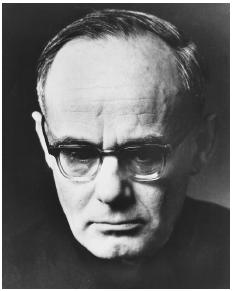
Karl Rahner
Rahner, "I have proposed to speak of three modes of subsistence in the doctrine of the Trinity..." pg. 35

Lapide, "would it not be simpler to remain for the present with the three various dimensions of the experience of God that characterize the faith of our patriarchs?" pg. 35

Rahner, "there are three most fundamental experiences of the one God: Father, Son (Word), Holy Spirit...this one and the same God is in himself threefold...therefore the economic Trinity and the immanent Trinity are the same for me." pg. 35

Lapide, "The prophets warn us repeatedly about the manufacturing of images of God: "To whom then will you liken God, or what likeness compare with him?" (Is. 40:18) It often appears almost as if Wittgenstein was right when he said, that about which we do not know, we should keep silent." pg. 36

Rahner, "No, I am not in agreement with Wittgenstein. Christian theology is simply speech about the incomprehensible God, about which one must speak..." pg. 36

Adversus Trinitas

"...unless you believe that I am he you will die in your sins." (John 8:24 ESV)