Showing posts with label Pinchas Lapide. Show all posts

6.15.2011

Encountering Jesus, Encountering Judaism : Karl Rahner and Pinchas Lapide on the Trinity

While reading the book Encountering Jesus--Encountering Judaism I came across a dialog between Lapide (Jewish) and Rahner (Catholic) on the doctrine of the Trinity. Two very respected scholars and theologians. The following are quotes from the chapter "Three Gods or a Triune God?"
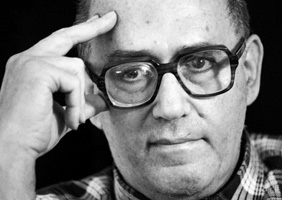
Pinchas Lapide
Lapide, "it rightly says in the Bible, "the God of Abraham, the God of Isaac, and the God of Jacob," for it concerns three various experiences of God..." pg. 31

Rahner, "as if we could know and explain anything about the inner life of God. God does not communicate his inner life to us through mere speech in sentences, but rather through his authentic turning to us in grace and incarnation." pg. 32

Lapide, "What must confuse many Jews is the abandoning of the letter "u" by the dogmaticians. In the early church fathers it was still called triunitas, whereby the unity is placed in the foreground. Trinity, on the other hand, purely speaking, sounds like tri-theism or even like a heavenly triumvirate." pg. 32, 33

Rahner, "the word person, when applied to the Trinity, gives rise today to almost insurmountable misunderstandings that are not at all contained in the actual dogmatic formulation...one cannot speak dogmatically of three various persons in the Trinity in the modern sense of "person," that is, of a single, unique center of free action...unfortunately very many people today understand the doctrine of the three divine persons in the sense of a modern concept of person and then they are tri-theists, even if they don't want to be." pg. 34
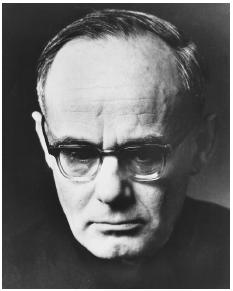
Karl Rahner
Rahner, "I have proposed to speak of three modes of subsistence in the doctrine of the Trinity..." pg. 35

Lapide, "would it not be simpler to remain for the present with the three various dimensions of the experience of God that characterize the faith of our patriarchs?" pg. 35

Rahner, "there are three most fundamental experiences of the one God: Father, Son (Word), Holy Spirit...this one and the same God is in himself threefold...therefore the economic Trinity and the immanent Trinity are the same for me." pg. 35

Lapide, "The prophets warn us repeatedly about the manufacturing of images of God: "To whom then will you liken God, or what likeness compare with him?" (Is. 40:18) It often appears almost as if Wittgenstein was right when he said, that about which we do not know, we should keep silent." pg. 36

Rahner, "No, I am not in agreement with Wittgenstein. Christian theology is simply speech about the incomprehensible God, about which one must speak..." pg. 36

5.06.2011

Quotes from Jewish Monotheism and Christian Trinitarian Doctrine (Lapide and Moltmann)


Lapide: "Israel grew up in the middle of a pagan world...with numberless gods...'In the beginning God created heaven and earth.' Here began the complete elimination of the power of all animal gods and idols; in fact, it emptied the heavenly bodies of all magic so that they, like all things in the universe, would be reduced to the instruments of the One God...the cosmos is explained as the order of nature providing humanity with a causal beginning..." (pg. 25)

Lapide : "Belief in One God is the foundation of Judaism...behind...all perceivable reality...which creation remains subordinated to God and to God alone. The Jew...can recognize the One God in all of God's raiments...The pagan...does not recognize God in God's numberless forms of appearance...the Lord set the family of humanity, to whom the Lord gave common parents, one and the same destiny of humanity, and a common hope along the way for a redemption at the end of time." (pg. 26)

Lapide : "Israel's monotheism...stems not so much from rational reflection as from the inextinguishable Thou experience which reveals the Lord of the universe...this I-thou experience of immediate relationship is so powerful, singular, and unique that it never allows the presentation of a plurality of principles or of a multiple personality of God to arise..." (pg. 27)

Lapide: "...the Hebraic concept of being denotes an effective-being, a dynamically living being, a co-being and a self-disclosing-being, which all together is experienced as a process of becoming without pause...God's dynamic essence that is becoming, and expressed itself by in-the-world actions...active, open, and always new are the three dimension which the three Hebrew words of the divine self-expression disclose: "I will be as the I will be" (Exodus 3:14)...concerns God's trustworthiness in helpful "co-being," God's being with us..." (pg. 29)

Lapide: "...the Trinity by the Church...not some kind of difference in number...rather a difference in essence...inner content...for "one" is not so much a quantitative concept as a qualitative one. Two or more cannot be absolute. Two or more cannot be timeless and eternal. If there are two or more, there can be no concept of omnipotence...the God of Israel is the only One." (pg. 30)

Lapide: "the Lord stands incomparably over against them, for the Lord alone is the Living One...from the Hebrew word echad we learn not only monotheism, not only that there is non outside of the Lord, but also that the Lord is One and therefore that the Lord cannot be viewed as something put together which would be divisible into various properties or attributes..." (pg. 31)

Lapide: "The average Jew today considers the  Trinity at best a kind of triumvirate, and at worst a tritheism which is reminiscent of a relapse into paganism...much too like polytheism to still earn the name of monotheism...." (pg. 32, 33)

Lapide: "'The God of Abraham, the God of Isaac, and the God of Jacob,' for it concerns three difference experiences of God which indeed fundamentally differ from each other..." (pg. 36)

Lapide: "Trishagion from Isa. 6:3...part of our daily morning prayer...spoken while standing...this so often repeated three-foldness of the holiness of God had led to a whole wave of quasi-trinitarian speculation...(pg. 36)

Lapide: "The grace of the Lord Jesus Christ, and the love of God, and the fellowship of the Holy Spirit." Here he appears rather to be speaking of a poetic triad, as faith, hope, and love in 1 Corinthians 13, rather than a dogmatic Trinity, of which indeed the Jew Paul could have had no knowledge, since that came into the world only centuries after his death..." (pg. 39)

Lapide: "In the first century God is still monotheistic in good Jewish fashion. In the second century God becomes two-in-one; from the third century on God gradually becomes threefold. Only in the fourth century...does the elevation of the Holy Spirit to a special hypostasis with its own value take place..." (pg. 39)

Lapide: "It was during the bloody intra-Christian religious wars of the fourth and fifth centuries, when thousands upon thousands of Christians slaughtered other Christians for the sake of the Trinity..." (pg. 40)

Lapide: "is it not time to take seriously the call of the General Synod of the Netherlands Reformed Church, which recommends a rethinking of the dogma of the Trinity?" (pg. 41)

Lapide: "Thus a God who was not communicable could not really be a Jewish God...we can only experience a God who gives himself to us to be known anthropocentrically. Hence all the Jewish attributes of God are oriented toward the human person..." (pg. 65)


Pinchas Lapide - Jewish Theologian and Historian


Adversus Trinitas

"...unless you believe that I am he you will die in your sins." (John 8:24 ESV)