5.19.2008

Musings on the Eternal Son

Fred Sanders a Trinitarian professor at Biola University made a statement for the doctrine of the Eternal Son. He stated:
The fundamental problem of all forms of modalism is this: if God, in order to reveal Himself, becomes something other than what He is, then he has not revealed Himself but has revealed something else. In this case, if God emerges from a state of being a non-modal and non-interpersonal being to become a modal, interpersonal being in the story of Jesus, then He has not revealed His true non-modal, non-interpersonal self. He has revealed instead a Father-God who has interpersonal fellowship with Himself in the modal person of the incarnate God, Jesus Christ. But according to Oneness theology, that interpersonal fellowship of Father and Son is precisely the thing He is not. So the unipersonal God attempts to reveal Himself but instead reveals an interpersonal divine being. The early Christians recognized this dilemma and solved it by confessing that if God reveals Himself to us by showing Himself to have a Son, then He must always have had a Son to show us in the fullness of time. Modalists, including Oneness Pentecostals, should face the unpleasant implication that their view makes God reveal Himself as that which He is not. Such a revelation, by its nature, cannot be true.

Fred Sanders

http://trinities.org/blog/archives/23

Sanders seems to be interpreting Scripture through the lens of ecclessiology. He is at least influenced by it heavily. God is not eternally "Father" anymore than he is eternally "Son". In the Old Testament His named is revealed to us thousands of times as "YHWH". Here it must be obvious that God has various titles in His relations with His creatures.

God's title as "Father" serves to describe Him in more than one sense of Fatherhood, i.e. Creator. The Old Testament concept of Fatherhood never relates to a Trinity of persons. It relates to His created people, Israel, and is indeed the very one who brought Adam into being at the dawn of Creation.

This assumption leads to a more problematic understanding of the Trinity, at least in the Old Testament texts. For example, if the Son is eternal and was just as coequal and coeternal as the Father, in person, then His absence as such a person in the Old Testament texts is further confounding of the properties of the persons in the Trinity. In the 4th Century the Cappodocian fathers basically rendered the properties of the persons of the Trinity as beyond human reason and incomprehensible.

Fifth, I feel Sanders is making the assumption that modalism is Oneness theology. This might be a misconception and/or a failure to articulate proper theology on someone's part, but Oneness theology is not ancient modalism. It should be known that all of our excerpts or texts that relate to Oneness teachers, notably Sabellius, Noetus, or Praxeas are found in quotations by Trinitarian apologists. It should also be noted, in historical context, that many of these Trinitarian apologists weren't even bishops or held any office. In fact, Tertuallian lets us know that he discounts the "majority" who disagreed with his "trinitas" as simple, yet not unlearned. That was kind, but it was also a concession. It concedes, in some sense that Trinitarian theology is a developmental dogma that was not even widely held, but in fact seen as a violation of true Monotheism early on (See Tertuallian "Against Praxeas:) Trinitarianism has proceeded from ecclesiastical efforts. I would also say that Protestantism has not protested enough.

Much of what we read of such Oneness teachers like Sabellius or Praxeas come from the pen of Trinitarian apologists like Tertullian or Hippolytus, etc. From their accounts these modalists (a word imposed upon them most likely) all believed in one God and one person of God. It is in the discussion of nature or humanity of Christ, in some sense, that it is distinguished from Oneness theology.That is why UPC teachers should and continue to say that our theology is coming from the Scripture texts and not ancient modalism.

For example, Modalism makes Christ to be a shell or some temporal mode, i.e. pure Modalism. Some Oneness Pentecostals do speak of Jesus manifesting in temporal terms such as "skin on" or "robed in flesh" etc. I believe Oneness theology disagrees with them though. An example of Oneness theology would be by the pen of Dr. Daniel Segraves or Dr. David Bernard. Neither of them write in such modalist terms. In fact, they both defy it at times.

Ultimately, it is not easy to say that these early Oneness teachers were totally right but neither can we say that they are totally wrong either. There is common beliefs found with Sabellius and Praxes or Noetus. Due to the fact, however, that their writings are found only in Trinitarian apologetics (Tertullian, Hippolytus, etc) we do not know some very important things:

a. if what we know is not distortion or
b. if we even know everything or the full extent of their writings.

The Restoration of Christianity was translated into English in 2007. Some may know that he wrote a lengthy piece against the Trinity and was burned by fire fueled by green wood and his own books. Servetus suffered a terrible death because He would not recant his beliefs. In 1628 William Harvey would use the writings of Servetus to explain blood flow.

I believe that the Son of God was truly God and man united inseparably. The humanity and deity were united inseparably into one divine person. The Son however was subject and in perfect obedience to the Father. This does not deny His existence as a true human. God existing as man. I do not believe God assumed a human person but rather Jesus is the only expressed image of the Divine Being. The distinction of existence is metaphysical and existential. God is always the eternal God Almighty but He did come into human history. He entered into His creation. God was in Christ (2 Cor. 5:19) bringing us back to proper relationship. Jesus was the Way and the Ultimate Sacrifice. He is the visible imprint of the invisible God's being (See Hebrews 1:3 NRSV).

5.16.2008

Quotes of Note:

"I think most Reformed folk have learned habits of worship that effectively constrain the sovereignty of God by adopting highly defined and narrow expectations of the Spirit's operations. I long for a kind of "Pentecostalized" Reformed spirituality that expects the sovereign Lord to show up in ways that might surprise us."

James K. A. Smith
"Teaching A Calvinist To Dance" Christianity Today, May 2008


There are those who desire to acquire knowledge for its own value—and this is a base vanity. But there are others who desire to have it to edify others—and this is charity. And there are others who desire it so that they may be edified—and this is wisdom.

—Bernard of Clairvaux, The Song of Solomon

5.08.2008

Dates to Remember

The chronology of the New Testament period is difficult to determine with precision, although some dates are known. In areas of uncertainty, however, scholars differ from one another only by a year or two.
Excerpted from:

Understanding the Bible Expanded Edition Copyright © 1972, 1976, 1984, 1999 by John Stott
Published by Zondervan Publishing House under special arrangement with Scripture Union, 130 City Road, London, England

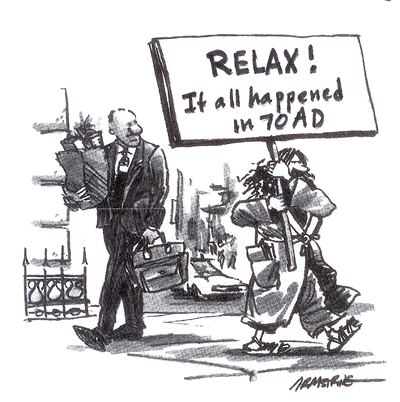
Musings on Preterism (2)


One of the major elements of Full preterism or so called "Apostolic Preterism" that interrupts its relationship with the Apostolic church is the omission of the imminent return of Christ. I feel Pentecost was founded upon the "soon coming of the Lord" and that is what brought them haste in "searching the scriptures", e.g. Charles Parham and students in Kansas.

This is old news, but preterism is problematic in regards to the dating of Revelation also. Preterist hold that since both the apostles and Jesus talk about the Lord’s coming as near, either the event happened in their lifetime or both Jesus and His apostles were liars. This is held despite the fact that Joel describes the same event as “nigh at hand” seven hundred years earlier.

The vast majority of all biblical scholars agree that the Book of Revelation was not written until the close of the first century, long after the fall of Jerusalem. If this were indeed the case, then it would obviously be impossible for the Book of Revelation to be prophesying the demise of a city that was already destroyed.

Revelation was written by John, and scholars typically suggest that it was written during the reign of Domitian (81-96). Irenaeus specifically supports this claim. Additional evidence can be supplied by any number of church fathers.

According to the Anchor Bible Dictionary,

“Victorinus of Pettau states that John was banished (damnatus) by Domitian to a mine or quarry (metallum) on the island of Patmos, where he saw the revelation.”
Additionally, ”Eusebius cites Irenaeus and follows him on the date of Revelation. Jerome states that John was banished (relegatus) by Domitian to the island of Patmos, where he wrote Revelation (De. Vir. Ill. 9).” The majority of scholars argue that the weight of evidence is that both Origen and Clement are making reference to Johannine authorship during the reign of Domitian, that is, at the close of the first century.

Preterism always finds itself in the minority, uses spurious documentation, and falsely interprets the Scripture. The interpretation is not even supported by the very dating of the book of Scripture (Revelation) that they wish to distort.

God created time. He transcends but at the same time works with us by the power of His Spirit. In the Incarnation God entered human history and events. As the creator of time He knows it from beginning to end, if there be. The past is only a human perspective of past time. The future is only our contemplation and hope for what will actually come in time. The only real time is the present.

The context of the Revelation of John is a revelation. A revelation from the Almighty God. It was a prophetic experience certainly where John saw things as they were happening and going into the past. He was however in a prophetic realm and therefore the events were yet to be done. They had not actually happened in actual time.

In fact that is why events have yet to happen in Revelation and other prophecy of Scripture as well.
The interpretation of Preterism is off, its understanding of time is off, and importantly the understanding of the very nature of John's Revelation is off as well.

The futurist does not need the dating of the Revelation to be early or late. By acknowledging the later date and its preeminence in scholarship the futurist simply points out the warning sign that reads STOP, or even DEAD END. Needless to say there was probably a few more warning signs before this one though. They just got ignored.

Musings on Preterism (1)


Before we get into a discussion of the Olivet Discourse or certain Biblical passages I would like to point out something that preterism often forgets. One Greek word can have many meanings. Strong's Dictionary and Concordance is a simple primer and it lists all possible meanings of one word, or the semantic range of that word. In defining Greek words in certain Biblical passages preterists typically pick a meaning among the various semantic range of a particular word and apply its meaning to a particular verse. This is done without really knowing that the context of the verse actually determines the applicable meaning. Strong's is a primer, and personally I recommend something a little better. Other lexicons will show what the word means in different contexts or different passages. For example consider the BADG on G3625. This is only one of the possible meanings:

1. the inhabited earth, the world—α. as such (Ps 23:1 and often): πάσας τ. βασιλείας τ. οἰκουμένης Lk 4:5. Cf. 21:26; Ro 10:18 (Ps 18:5); Hb 1:6. ὅλη ἡ οἰκ. the whole inhabited earth (Diod. S. 12, 2, 1 καθʼ ὅλην τὴν οἰκουμένην; Ep. Arist. 37.—Diod. S. 3, 64, 6 and Jos., Bell. 7, 43πᾶσα ἡ οἰκ.) Mt 24:14; Ac 11:28; Rv 3:10; 16:14. οἱ κατὰ τὴν οἰκ. ἄνθρωποι PK p. 15, l. 20. αἱ κατὰ τὴν οἰκ. ἐκκλησίαι the churches throughout the world MPol 5:1; cf. 8:1; 19:2.

Arndt, W., Gingrich, F. W., Danker, F. W., & Bauer, W. (1996, c1979). A Greek-English lexicon of the New Testament and other early Christian literature : A translation and adaption of the fourth revised and augmented edition of Walter Bauer's Griechisch-deutsches Worterbuch zu den Schrift en des Neuen Testaments und der ubrigen urchristlichen Literatur (561). Chicago: University of Chicago Press.
Just because Strong's lists all manner of possible definitions for one word does not make that one word apply every possible meaning in that Scripture verse. A bass can mean a fish, just as in other context it could refer to a musical instrument.

The Second Coming of our Lord is being discussed in such passages as Matthew 24 (also referred to as the Olivet Discourse), and the destruction of the Temple is under discussion as well (Matthew 24:2-3). Because the phrase these things is plural, more than the temple's destruction is in view. The conjunction “and” here also denotes two different clauses or thoughts are in view.

Verse 22 speaks of those days being cut short: surely this does not mean the preliminaries to the Fall of Jerusalem were cut short for the elect's sake, for that would entail the conclusion that the fall itself was a mercy on the elect.

Matthew 24:13"But he that shall endure unto the end, the same shall be saved."
What type of saving was being spoken of here for the ones who "endure unto the end"? Preterist suggest it was deliverance from destruction and imminent danger.

I believe that Christ’s promise of salvation here is bound to mean the soul’s salvation in the last days. I think it arbitrary to mean the safety of human life. He had already said some shall be killed (Matthew 24:9), therein he refers to “you“ as being the believers. Therefore, is the deliverance conditional or situational? Texts such as Matthew 10:22, Luke 8:15, Hebrews 3:6 & 14 share conspicuous affinity here with endurance persecution and salvation.

Matthew 24:14 "And this gospel of the kingdom shall be preached in all the world for a witness unto all nations; and then shall the end come."
This verse implies that the preaching of gospel is to be preached, and then shall the end come. If the end, which denotes a consummation, is come then why preach the gospel? Also, if this is not "The End" but a protracted form of coming then why does Jesus not indicate a sequence of comings or alert the disciples that I will come figuratively, then, later come again literally?

Preterist suggest that Colossians 1:5-6 states the gospel already went to all the world by the time Paul wrote Colossians. Paul refers here though to the then known world. Not, literally, to every person on the globe, for we know it highly probable that the North Americas were inhabited yet not exposed to the Gospel.

If the gospel had been preached to the world, assuming the preterist interpretation of Colossians, then why do we still preach? The comings seem to be too arbitrary, especially if it was so important to know and realize. We should have some explicit citations of multiple comings by the Disciples or historical writings. None of Epistles or other NT writings refer to Jesus being already come. It is hardly conceivable that if He had indeed came a second time that they would not write a word about such an event.

Matthew 24:15 "When ye therefore shall see the abomination of desolation, spoken of by Daniel the prophet, stand in the holy place, (whoso readeth, let him understand."
Here is one of the assumptions you must take for granted to interpret this passage in the preterist fashion. It is not historically proven that the Abomination of Desolation has occurred. No such man has done what is prophetically required of him. Therefore, this is a passage that should be in the immediate discussion of preterists to emphatically solidify, then once this is proven other time-texts can be relevant.

Matthew 24:30 "And then shall appear the sign of the Son of man in heaven: and then shall all the tribes of the earth mourn, and they shall see the Son of man coming in the clouds of heaven with power and great glory."
Here, the "sign of the Son of man" in the preterist fashion has occurred, yet no literary evidence remains of such a magnificent event. "They shall see" here comes from a Greek word always translated in meaning "look" or "see" etc and indicates an actually "looking on", "to be seen by" or "visible to", it is the same Greek word used of Jesus in Acts 1:3, "he was seen by them for forty days" It is hard, also, to restrict "all the tribes of the earth" to those of Israel alone.

Ge or earth is translated 188 times as “earth”. In instances where ge is translated land (only 33 times) the context indicates the locality. Such is not the case in Matthew 24. For example:

“Matthew 2:6 "And thou Bethlehem, in the land of Judah, art not the least among the princes of Judah: for out of thee shall come a Governor, that shall rule my people Israel.“
Notice Matthew uses ge here to be land and is localized by citing actual geographical locales.

Matthew 24:31 "And he shall send his angels with a great sound of a trumpet, and they shall gather together his elect from the four winds, from one end of heaven to the other."
Again, there is no record of such events. One must wonder, sincerely. "Four winds" is an Hebraism that refers to the four corners of the earth as well. No such gathering of the diaspora has occurred, as of yet.

5.05.2008

Quote from Bruce L. Shelley

In his attempts to elucidate Church History in Plain Language, Bruce Shelley says,


“The word “person,” however, did not mean to the early Christians what it means today. To us, a person means someone like Tom, Dick, or Harry. But the Latin word persona originally meant a mask worn by an actor on the stage. In Trinitarian thought the “mask” is not worn by God to hide but to reveal his true character. It is clear that when we think of the Trinity, we should not try to think of three persons in our sense of the term, but three personal disclosures of God that correspond to what he is really like.”


Shelley, Bruce L. Church History in Plain Language. Updated 2nd ed. Dallas, Tex.: Word Pub., 1995.

Adversus Trinitas

"...unless you believe that I am he you will die in your sins." (John 8:24 ESV)